
Almost every guide to this question is written by somebody who sells raised beds, and they all reach the same conclusion. So here is the honest version from a site that does earn affiliate commission on raised beds: for most people with reasonable garden soil, growing in the ground is cheaper, uses less water, and produces just as much food. Raised beds win on specific constraints, and if you do not have one of those constraints you are paying for a solution to a problem you do not have.
The short answer
Choose raised beds when your soil is contaminated, waterlogged, solid clay or non-existent, when you cannot kneel comfortably, or when the growing season is short and you need the soil to warm early. Choose in-ground when your soil is workable, your budget is limited, or water is expensive. Most gardens with decent soil should start in the ground and add beds where they solve something.
This guide works through the six factors that actually decide it, in the order that matters. If you have already decided on beds, our raised bed buyer's guide covers what to look for.
What you'll learn:
- The six factors that decide it, ranked by how much they matter
- When a raised bed is genuinely the right answer
- When in-ground beats it, including on yield
- The hybrid most experienced gardeners actually end up with
What Actually Decides It?
Six factors, and the first three settle most cases on their own.
| Factor | Raised bed | In-ground |
| Poor, contaminated or absent soil | Wins decisively | Not viable without years of work |
| Setup cost | Frame plus imported fill | Close to nothing if soil is workable |
| Water use | Higher, drains and warms faster | Lower, buffered by soil mass |
| Spring soil warming | Earlier, useful in short seasons | Later, an advantage in hot climates |
| Physical access | Much easier at 24 in or higher | Requires kneeling and bending |
| Yield per square foot | Comparable once soil is good | Comparable once soil is good |
Drawn from cooperative extension comparisons including University of Georgia Extension on raised beds versus in-ground gardens.
Note the last row. Raised beds are frequently sold on yield, and the evidence does not really support a yield advantage per square foot once both soils are in good condition. What raised beds reliably deliver is a faster route to good soil, not a higher ceiling.
When Should You Choose a Raised Bed?
Five situations where the extra cost buys something real.
Your soil is contaminated
Old urban plots, former industrial land, ground near painted structures built before 1978. Test first, and if lead or other contaminants show up, a raised bed with a barrier is the standard mitigation.
Your ground is waterlogged or solid clay
If water pools for days after rain, raising the growing surface is the fastest fix. You are not draining the clay, you are growing above it while it slowly improves.
There is no soil at all
Patios, roofs, balconies, gravel yards, rented ground you cannot dig. A raised bed is the only option, and here it is a container, so build deeper.
Bending or kneeling is difficult
This is the most underrated reason and often the most valuable. A bed at 24 to 32 inches turns gardening from something you endure into something you keep doing.
Your season is short
Raised soil warms earlier in spring, which can buy a week or two at the start of the season. In hot climates this reverses and becomes a drawback.
When Does In-Ground Win?
Whenever none of those five apply, which is more often than the internet suggests.
The cost gap is the obvious one. A raised bed costs the frame plus the fill, and fill is the larger number: a 4 by 8 foot bed at 12 inches deep needs roughly 32 cubic feet of soil. In-ground planting on workable soil costs the price of compost and seed.
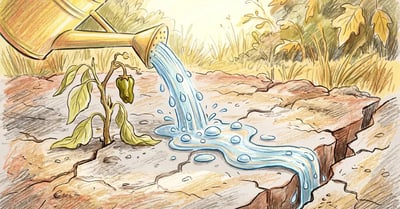
Water is the less obvious one and it compounds every season. A raised bed has more exposed surface area, drains faster and warms faster, so it dries out sooner and needs watering more often. In a hot, dry summer that difference is significant, and it is the reason raised beds are a harder sell in hot climates than in cool wet ones.
Then there is the thing raised beds cannot give you: soil volume. An in-ground bed has effectively unlimited rooting depth and a large thermal and moisture buffer. Deep-rooted perennials, drought tolerance and resilience through a heatwave all come from that buffer.
Why This Works
Permaculture starts from observation rather than from a preferred structure. The question is not which method is better, it is what is limiting yield in this particular spot. If the limit is compaction, the answer might be a broadfork rather than a bed. If the limit is drainage, it might be a swale uphill. A raised bed is one tool for one class of problem, and reaching for it before you have identified the problem is how people end up importing soil onto perfectly good ground.
Common Mistake to Avoid
Do not build raised beds to fix compacted soil without loosening what is underneath first. A bed on compacted ground still drains only as fast as that ground allows, and roots that reach the interface stop there. Fork or broadfork the base before you fill, and you get the benefits of both systems instead of building a container by accident.
What Does the Hybrid Look Like?
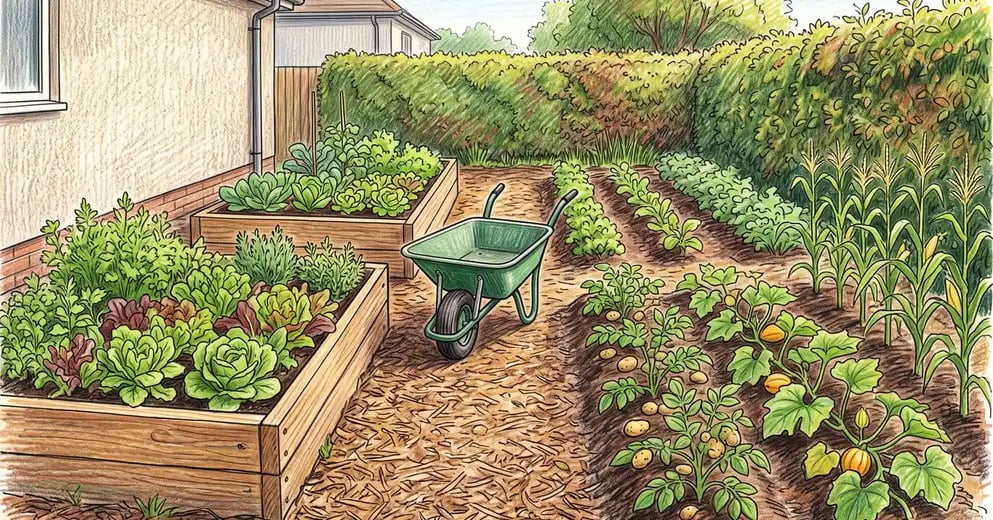
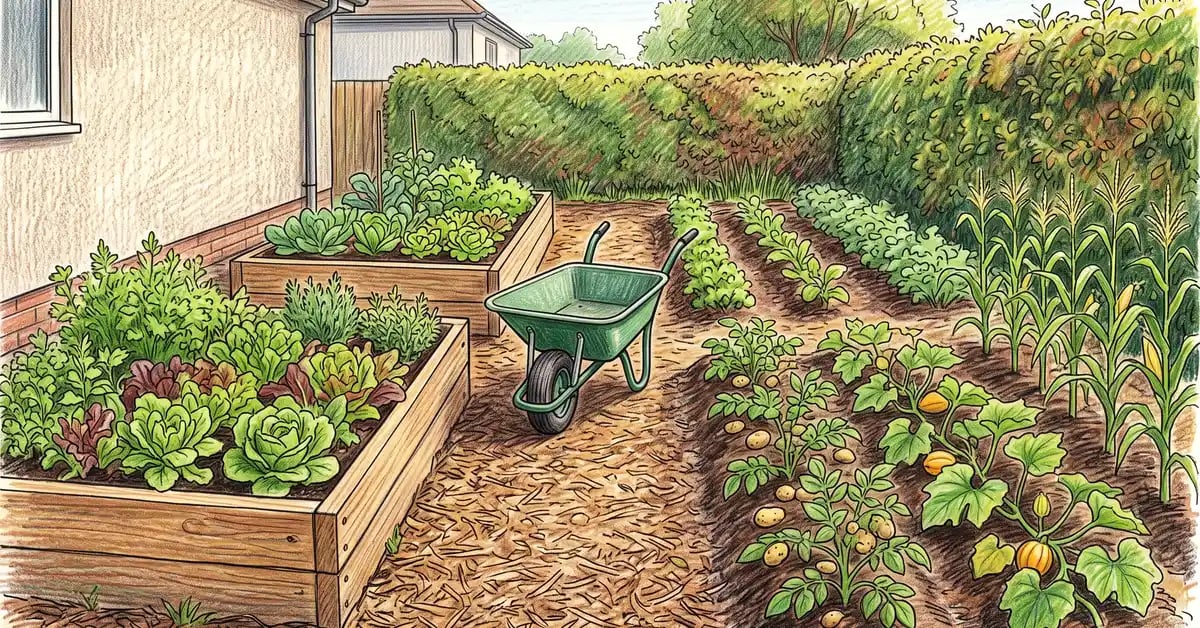
Most experienced gardeners end up running both, and not by accident. The pattern that emerges is consistent: raised beds close to the house for the crops you pick constantly and want at a comfortable height, in-ground rows further out for the crops that take space and do not need daily attention.
Salad, herbs, and anything you harvest in ones and twos goes in the beds. Potatoes, squash, sweetcorn, brassicas and anything you harvest once at the end of the season goes in the ground, where the space is cheap and the water buffer is better.
The other half of the hybrid is that in-ground ground improves. Sheet mulching, cover crops and annual compost turn mediocre soil into good soil over three to five years, which means the case for more raised beds gets weaker every year you garden well. Our guide to sheet mulching to build beds without digging covers the cheapest route.
Need the gear for this?
Metal, cedar or DIY: what each costs over ten years and where each one fails.
Compare raised bed kitsHow Do You Decide for Your Own Garden?
Answer three questions honestly and the choice usually makes itself.
First, can you push a spade into your soil when it is moist? If yes, your soil is workable and the case for beds is about access and convenience rather than necessity. If it stops dead at four inches, you have compaction to deal with either way.
Second, does water sit on the surface for more than a day after heavy rain? If yes, raise the growing surface. If no, drainage is not your reason.
Third, is there any reason to suspect contamination? Age of the property, previous industrial use, proximity to old painted structures or a busy road. If yes, test before you plant anything you intend to eat, and treat a positive result as decisive.
If all three answers point to in-ground, start there and spend the saved money on compost. If you still want beds for the look or the height, that is a perfectly good reason too, and worth being honest with yourself about, because it changes what you should spend on. Depth is the specification that matters most, and our guide to how deep a raised bed should be covers the numbers by crop.
Frequently Asked Questions
Are raised beds better than in-ground gardens?
Not inherently. Raised beds are better when the existing soil is contaminated, waterlogged, solid clay or absent, when bending and kneeling are difficult, or when a short season means early soil warming matters. In-ground gardens are better when the soil is workable, because they cost far less to establish, need less water, and give plants unlimited rooting depth. Once both soils are in good condition, yield per square foot is comparable, so the choice is about constraints rather than performance.
Do raised beds produce more vegetables than in-ground beds?
Not reliably, once both soils are in good condition. What raised beds offer is a faster route to good soil, because you import a decent mix rather than waiting for a poor soil to improve. They also allow denser planting, since you never walk on the bed and therefore do not need access rows. That density can raise yield per square foot of garden, but it is a function of not compacting the soil rather than of the frame itself, and you can achieve the same thing with permanent in-ground beds and paths.
Do raised beds need more water than in-ground gardens?
Yes. A raised bed has more surface area exposed to sun and wind, drains faster and warms earlier, so it dries out sooner than the surrounding ground. The effect is strongest in hot, dry climates and in beds with a sealed base, where there is no moisture exchange with the soil below. Mulching the surface is the single most effective countermeasure, and an open-bottomed bed on unsealed ground is noticeably more forgiving than one on a patio.
Are raised beds worth the cost?
They are if they solve a specific problem: bad soil, poor drainage, no soil, difficult access, or a short season. They are poor value if your soil is already workable and you simply like the look, because you are paying for a frame plus a large volume of imported fill to grow crops that would have done just as well in the ground. If budget is the constraint, spend it on compost and a broadfork before you spend it on timber.
Can you grow the same crops in raised beds and in the ground?
Almost all of them, with two caveats. Deep-rooted perennials such as asparagus and rhubarb need 18 inches or more in a bed, and are usually happier in the ground where depth is unlimited. Sprawling crops such as squash, sweetcorn and maincrop potatoes take up expensive bed space for a single harvest, so they are better value in the ground. Everything you pick repeatedly, especially salad and herbs, is a good use of bed space.
Should I put a raised bed on top of grass or remove the turf first?
You do not need to remove it. Lay plain cardboard over the grass inside the frame and fill on top: the grass dies from lack of light, the cardboard rots within a season, and the roots decompose in place, which feeds the soil and leaves the bed connected to the ground below. Removing turf costs an afternoon and takes away organic matter you would rather keep. The exception is aggressive perennial weeds such as bindweed, which need dealing with properly first.
Get the Weekly Dig
One practical permaculture guide a week, written for gardeners who do this on weekends: raised beds, from fill to first harvest. Free, no spam, unsubscribe any time.
Join the Weekly Dig