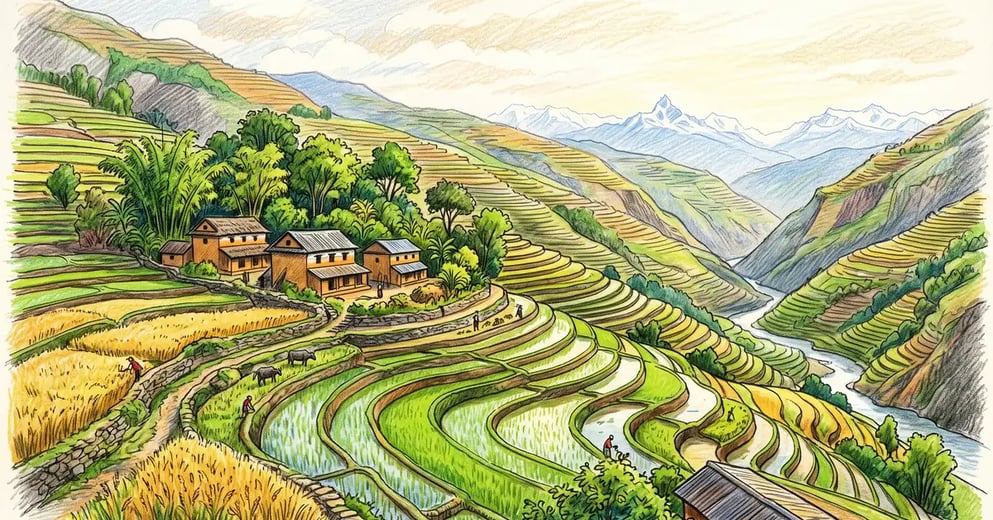

Fly into Kathmandu on a clear morning and the hillsides below look machined. Thousands of narrow green steps wrap every slope, following the contour so exactly that the pattern reads as engineering rather than farming. It is engineering. It was built by hand, over centuries, with no drawings. Scotland's wind-shaped growing systems
Nepal's middle hills hold one of the largest contour earthworks on the planet, and nobody who built them had heard the word permaculture. The design solves the same problems permaculture sets out to solve, and it is being abandoned at a rate that should give any designer pause.
What Is Terrace Farming, and How Does It Work?
Terrace farming cuts a steep slope into a staircase of level or near-level benches. Each bench holds soil and water that would otherwise run downhill. The vertical face between benches, the riser, takes the height. The horizontal bench takes the crop.
The mechanism is simple hydrology. Water moving down a long steep slope picks up speed and carries soil with it. Break that slope into short flat segments and it slows, sits and soaks in. A 2021 global review found that reducing hillslope gradient and length while widening the bench raises infiltration and cuts runoff. The catch, which the same review is clear about, is that badly built or unmaintained terraces increase landslide risk instead.
Here is what this guide covers:
- The real dimensions of a Nepali hill terrace, in feet and degrees
- Why irrigated and rainfed terraces are built and cropped differently
- Whether terracing actually stops erosion, and what the measurements say
- How fertility physically moves from forest to livestock to field
- Which parts of this transfer to a sloping backyard and which do not
Key Takeaway
A terrace is not a soil-holding structure on its own. It is a water-slowing structure that only holds soil while it is maintained. The Nepali system works because the earthworks, the vegetation on the risers and the annual manure cycle all run together. Take any one away and the whole thing degrades.
Khet and Bari: Two Terraces, Two Different Jobs
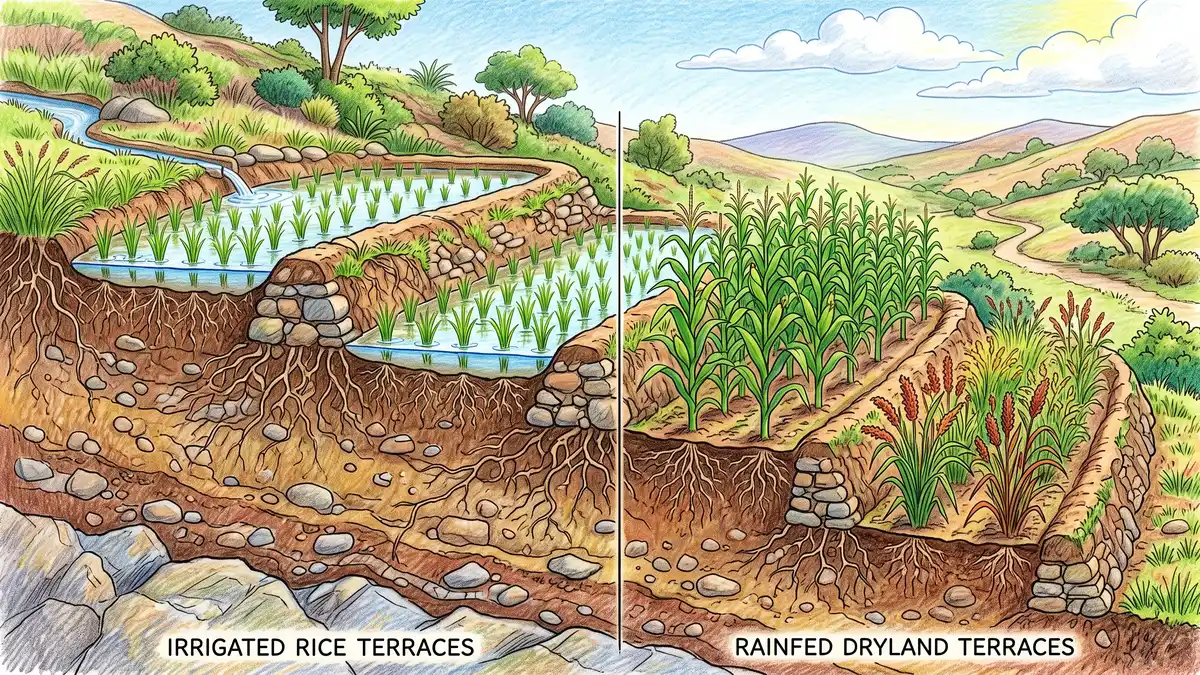
The single biggest variable is water. Where gravity can deliver a spring or stream, farmers build khet: level, bunded terraces that hold standing water for monsoon rice, followed by wheat or another winter crop. Where there is no irrigation, they build bari: rainfed terraces cropped with maize and finger millet, usually intercropped with legumes such as cowpea, soybean or beans.
| Feature | Khet, irrigated | Bari, rainfed |
| Water source | Gravity-fed spring or stream | Rainfall only |
| Bed shape | Level, bunded to hold water | Gently outward sloping to shed excess |
| Main season crop | Rice | Maize, finger millet |
| Second crop | Wheat or winter cereal | Legumes intercropped, then fallow |
| Bench width | Typically 6 to 10 ft (2 to 3 m) | |
| Riser height | Often 13 to 16 ft (4 to 5 m) | |
Sources: Chapagain, Agronomic Challenges for Smallholder Terrace Agriculture (2017), Chapagain et al., Agronomy for Sustainable Development (2019), DiCarlo et al., post-disaster agricultural transitions (2018).
Read those last two rows together. A bench six to ten feet wide sits above a riser thirteen to sixteen feet high, so most of the surface area in the system is vertical. That is why Chapagain's 2019 trials asked whether the walls themselves could be cropped, and it is the same insight a designer reaches when they start counting edge rather than area.
Does Terracing Actually Stop Erosion?
It reduces erosion. It does not stop it, and the numbers are sobering. A 2023 study of Nepali Himalayan watersheds estimated soil loss ranging from zero to 273 tonnes per hectare per year, with a mid-hill average around 38.4 t/ha/yr. In the Aadhikhola watershed the average was 41.4 t/ha/yr with local maxima above 1,300. For scale, 38 t/ha is roughly 17 tons per acre of topsoil leaving the hillside annually.
Those figures come from landscapes that are almost entirely terraced, so terracing is holding back far more than it lets go. But the highest local losses sit exactly where risers have failed and slopes have slipped. That is the honest version: erosion control is a maintenance practice, not a structure you install once.
How Does Fertility Actually Move on a Hill Farm?
Downhill, deliberately, through an animal. This is the part of the system that a visitor misses and a designer should not. Fodder is cut from forest and from trees planted on terrace edges. It is fed to buffalo and cattle housed near the homestead. Their bedding and manure become farmyard manure, and that goes onto the terraces. Nutrients move from the uncultivated upper slope to the cultivated bench, carried by livestock.
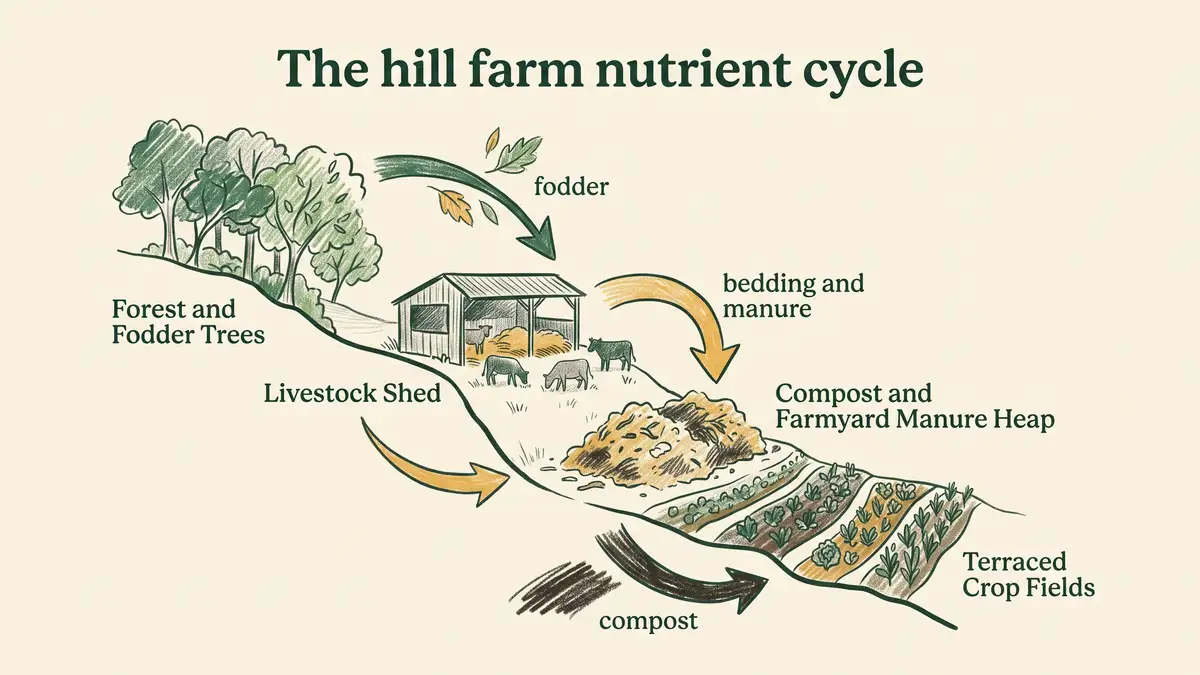
It is elegant and it is not sufficient. FAO analysis of hill rice and wheat rotations found that 10 tonnes per hectare of farmyard manure plus 50 kg N, 30 kg P and 30 kg K per hectare still failed to maintain a nutrient balance. The system runs a deficit even when fully staffed. Grass and legumes on the risers do double duty, stabilising the wall and producing fodder, alongside the check dams and brushwood barriers farmers build against monsoon floods.
Why This Works: Stacking Functions on the Riser
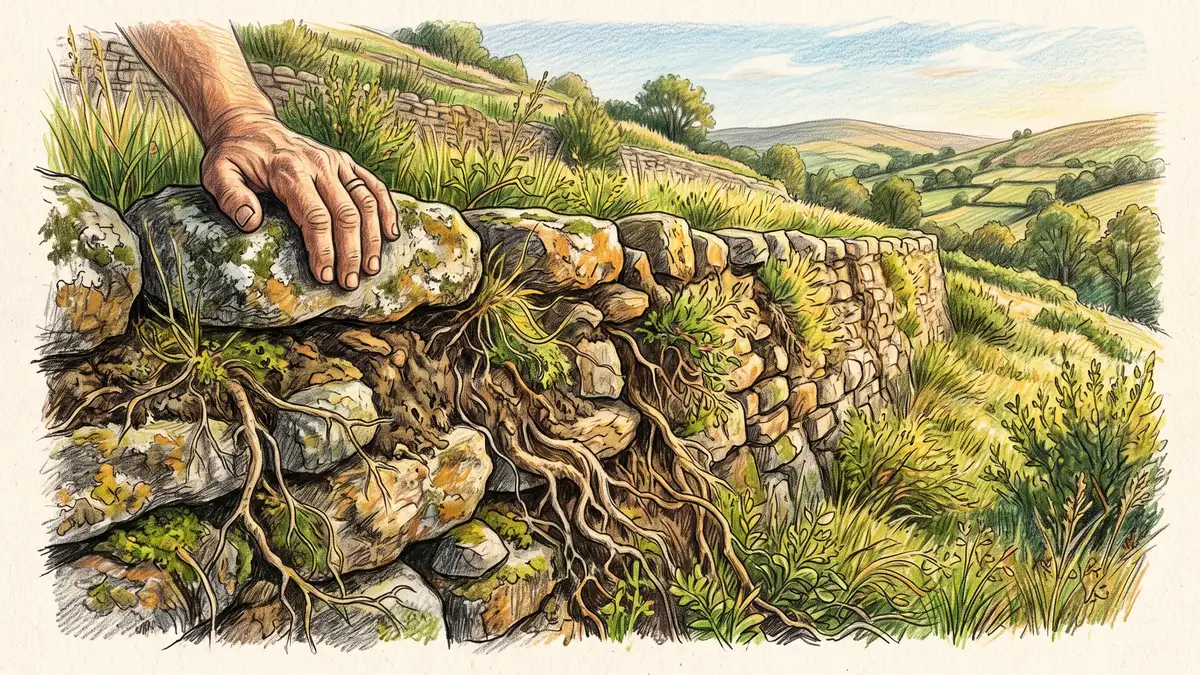
Look at what one planted terrace riser is doing. It holds the wall against slumping. It grows fodder that feeds the animal that makes the manure that feeds the bench above. It shades and cools the soil edge. It provides habitat for predators. In permaculture language that is stacking functions, and it is the reason the riser is planted rather than left bare. It also explains why abandonment is so destructive: stop cutting the fodder and the whole loop opens, because the element carrying four jobs stops doing any of them well. The same logic drives chop and drop in a temperate garden.
Why Are Nepal's Terraces Being Abandoned?
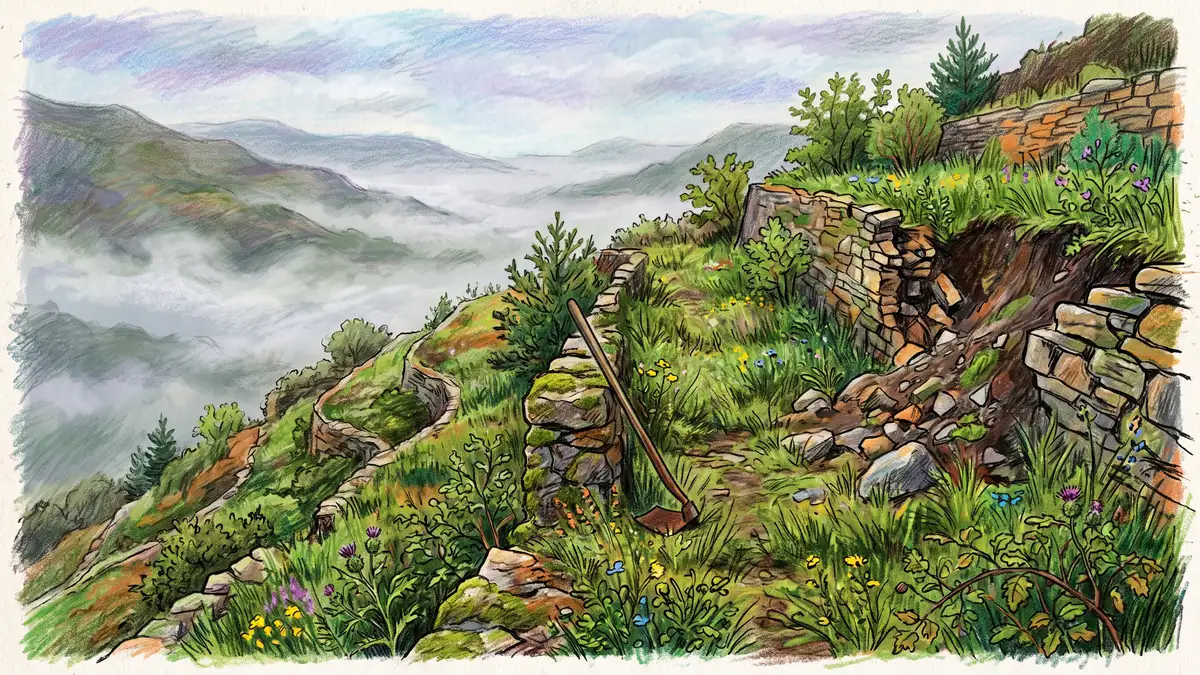
Because they are enormously labour-expensive and the labour has left. A 2021 survey of 374 households across three hill districts found that around 40% of agricultural land in Nepal's hill agro-ecological region had been abandoned, and 60% of farmers had left at least one parcel unfarmed.
The drivers the study identified split into two groups. Biophysical: distance from the homestead to the parcel, slope, land fragmentation, land quality, and whether irrigation is available. Socio-demographic: family size, higher education among household members, domestic migration and out-migration. Wildlife damage compounds it, with monkeys, deer and rabbits reported as major crop losses. The 2015 earthquakes added cracks and holes to both khet and bari surfaces and rerouted the springs that fed some irrigated systems.
What Abandonment Actually Does
An abandoned terrace does not gently return to forest. It holds its shape for a few seasons, then a riser fails somewhere, water concentrates through the breach, and the failure propagates downhill through the benches below. The structure that was slowing water becomes a channel that focuses it. This is the mechanism behind those local soil-loss maxima above 1,300 t/ha/yr, and it is the single strongest argument that terraces are a maintenance commitment rather than an asset.
What Transfers to a Sloping Backyard?

Four things, and one warning. Permaculture arrived in Nepal recently, through organisations like the Himalayan Permaculture Centre working in Surkhet and Humla. The terraces predate it by centuries. Reading them as permaculture is a useful lens, not a history.
Work on contour, not on grid
Find the level line across your slope with a hose level or an A-frame and lay beds along it. On a gentle grade this alone converts sheet flow into soaking. It is the same principle behind swales and berms, at a smaller scale.
Plant the riser, always
Never leave a cut face bare. Deep-rooted grasses, comfrey, or a low shrub hedge hold the soil and give you cuttable biomass. In Nepal the riser feeds the animal. In your garden it feeds the compost heap or goes straight down as mulch.
Keep the bench narrow enough to reach
Six to ten feet is not a limitation of hand tools, it is a choice about how much wall you are willing to build and maintain per unit of bed. In a backyard, 4 ft (1.2 m) benches with 18 in. (45 cm) risers are far easier to keep standing than one heroic 5 ft wall.
Close a nutrient loop somewhere on the property
You do not need a buffalo. You need one place where biomass is grown and one place where it is returned. A coppiced hedge, a comfrey patch, a chicken run: the point is that fertility circulates rather than arriving in a bag.
The warning: do not build terraces on ground you are not prepared to maintain. Nepal's hillsides are the best available demonstration of what happens when a terrace system is left. For more on how different regions solved the same problems, see our permaculture around the world overview and the companion piece on permaculture in India.
Frequently Asked Questions
What is terrace farming?
Terrace farming cuts a steep slope into a series of level or gently sloping benches, separated by vertical or near-vertical faces called risers. Each bench holds soil and water that would otherwise wash downhill. In Nepal's middle hills the benches are typically 6 to 10 ft wide and run 165 to 260 ft across the slope, with risers often 13 to 16 ft high standing at 75 to 90 degrees. The technique appears independently across mountain agriculture worldwide, from the Andes to the Philippines to the Mediterranean, because the hydrology it solves is universal.
How does terrace farming work?
By shortening and flattening the path water takes down a hillside. Water running down a long steep slope accelerates and picks up soil; break the slope into short level segments and it slows, ponds and infiltrates instead. A 2021 global review found that reducing hillslope gradient and length while increasing bench width raises infiltration and reduces surface runoff. The riser does the structural work, which is why it is usually planted with deep-rooted grasses or shrubs and reinforced with stone. Unmaintained risers fail and concentrate water rather than dispersing it.
Why is terrace farming important?
It makes steep land farmable that otherwise would not be, and it holds topsoil in place on slopes where erosion would strip it. In Nepal's mid-hills, measured soil loss still averages around 38 tonnes per hectare per year across largely terraced landscapes, which shows how severe erosion would be without the terraces. Terraces also store irrigation water, allow rice cultivation far above valley floors, and structure the whole farm system, since the fodder, livestock and manure cycle that maintains fertility is organised around them.
Who invented terrace farming?
Nobody, in the sense of a single origin. Terracing developed independently in many mountain regions over thousands of years, including the Andes, China, the Philippines, Yemen, the Mediterranean and the Himalaya. In Nepal the terraces were built incrementally by farming households over centuries, largely by hand and often through reciprocal labour exchange between neighbours. There is no design document and no founding designer, which is precisely what makes the convergence of the result with modern contour-earthwork theory interesting.
Where is terrace farming used?
Anywhere steep land has had to feed people. The best known systems are in Nepal's middle hills, the Philippine Cordilleras, the Peruvian Andes, southern China, Japan, Yemen and around the Mediterranean. In the United States, contour farming and bench terracing are used across parts of the Midwest and Southeast for erosion control on cropland. At garden scale the same idea works on any slope where sheet erosion or runoff is a problem, and it does not need to be dramatic to be effective.
Get the Weekly Dig
One practical permaculture guide a week, written for gardeners who do this on weekends: permaculture design for real backyards. Free, no spam, unsubscribe any time.
Join the Weekly DigResources
- Chapagain, Agronomic Challenges and Opportunities for Smallholder Terrace Agriculture: terrace dimensions and labour demands
- Chapagain et al., Intensifying the Underutilised Terrace Wall: riser heights, wall angles, cropping trials
- Joshi et al., Himalayan Watersheds in Nepal Record High Soil Erosion: modelled soil loss rates
- Subedi et al., Agricultural Land Abandonment in the Hill Agro-ecological Region of Nepal: the 40% abandonment figure
- DiCarlo et al., Post-Disaster Agricultural Transitions in Nepal: earthquake damage to terraces
- FAO: Forage and Livestock Production in Hill Agriculture: riser planting and the fodder cycle
- FAO: Improving Plant Nutrient Management for Better Farmer Livelihoods: hill nutrient budgets
- ENN Field Exchange: Nutrition-Sensitive Outcomes of a Permaculture Project in Nepal: documented permaculture work