
You spent a Saturday in May spreading 4 cubic yards (3 cubic meters) of wood chips. By August it is gone, weeds are back, and you are buying more. A living mulch fixes this by letting plants do the work of mulch. Done right, you seed it once and it covers the soil for years, suppressing weeds, fixing nitrogen, feeding pollinators, and pulling fewer dollars out of your wallet. undersowing brassica root crops with clover undersowing kale with clover insectary flower strips
This guide covers what living mulch is, the top 5 species that actually suppress weeds in a US home garden, exact seeding rates in pounds per 1,000 square feet, and how to manage living mulch so it does not steal water and nitrogen from your tomatoes. Numbers come from Cornell, Michigan State, University of Minnesota, USDA NRCS, and SARE.
Key Takeaway
Living mulch is a low-growing ground cover that occupies the soil surface so weed seeds cannot germinate and establish. The top performers for a US backyard garden are white clover and microclover for sun, creeping thyme for paths and dry sites, hairy vetch and crimson clover for fall-to-spring cover, and sweet alyssum as an annual pollinator-attracting filler. Seed clover at 0.25 lb per 1,000 sq ft (1.2 kg per 100 sq m) in spring or early fall, and mow 2 to 4 times per season to keep it shorter than the crop. Avoid invasive choices like English ivy, vinca, or crown vetch.
What is living mulch
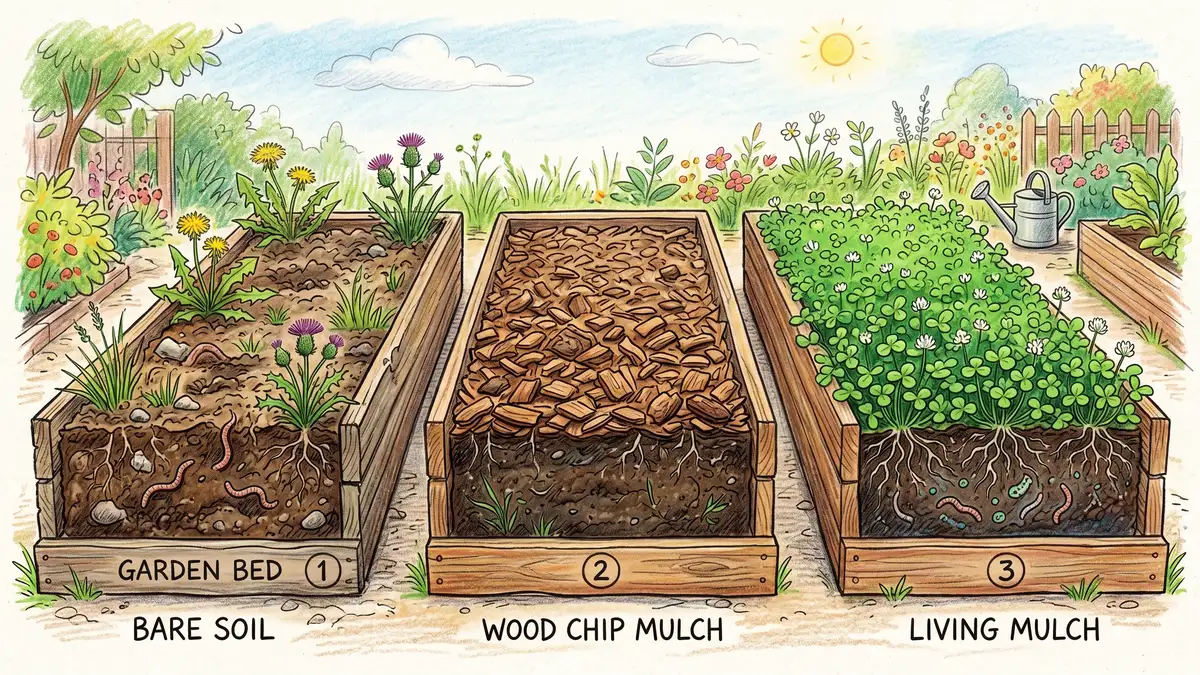
Living mulch is a living plant layer grown specifically to cover bare soil between cash crops. It differs from a few related ideas:
- Cover crop: usually annual, planted off-season, terminated before the cash crop goes in (like winter rye)
- Green manure: a cover crop turned under to release nutrients (a destination, not a permanent residence)
- Dead mulch: straw, wood chips, leaves, cardboard (not alive)
- Living mulch: stays alive alongside the cash crop, often perennial, often mowed but not removed
The University of Georgia integrated weed management group calls living mulch "the cover crop that never dies" because it grows continuously between crop rows year after year.
How living mulch suppresses weeds
Three mechanisms do the work, all at once:
| Mechanism | What happens | Example |
| Light blocking | Dense canopy stops sunlight from reaching weed seeds, blocking germination cue | White clover canopy blocks 90%+ of soil-level light |
| Resource competition | Living mulch consumes water, nutrients, and root-zone space that weeds would have used | Creeping thyme outcompetes crabgrass in dry sites |
| Allelopathy | Some species release compounds that chemically suppress nearby seed germination | Cereal rye and hairy vetch suppress small-seeded weeds |
Source: Mechanisms documented across University of Minnesota Extension's mulching guide and synthesized SARE cover crop research.
Why This Works (the permaculture lens)
Bare soil is unnatural. Walk into any meadow, forest edge, or pasture and you will not find an inch of bare ground that is not actively being colonized by something. Wood chip mulch buys you 6 to 12 months of artificial bareness, then weeds and grass move in. A living mulch fills the same ecological niche the weeds are trying to fill, but with a plant you chose. Stop fighting succession and put it to work, which is the same idea behind no-dig gardening and chop-and-drop mulching.
The top 5 living mulch species
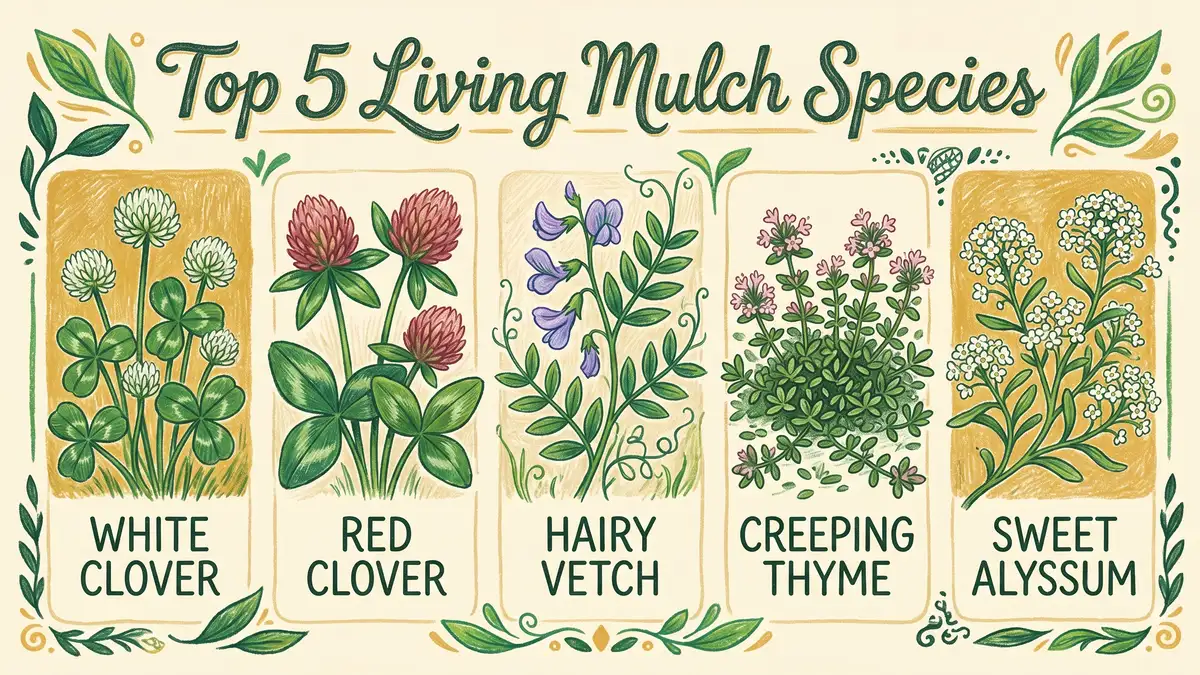
1. White clover (Trifolium repens)
The all-around best living mulch for a US home garden in full to part sun. Perennial in zones 3 to 9. Stays 4 to 8 in (10 to 20 cm) tall. Fixes 50 to 100 lb N per acre per year. Mowable and walkable. Microclover (the dwarf cultivar 'Pipolina') stays 2 to 4 in (5 to 10 cm) and tolerates heavier foot traffic. Seed rate: 0.25 lb per 1,000 sq ft (1.2 kg per 100 sq m) for pure stands; less when overseeded into existing turf or other ground cover.
2. Red clover (Trifolium pratense)
Taller cousin at 12 to 18 in (30 to 45 cm), more drought-tolerant than white clover, blooms longer for bees. Excellent in fruit tree understories where height is not a problem. Short-lived perennial (2 to 3 years), so reseed periodically. Seed rate: 0.3 lb per 1,000 sq ft (1.5 kg per 100 sq m). Chelsea Green's weed suppression guide cites red clover as the practitioner favorite for orchard floor management.
3. Hairy vetch (Vicia villosa)
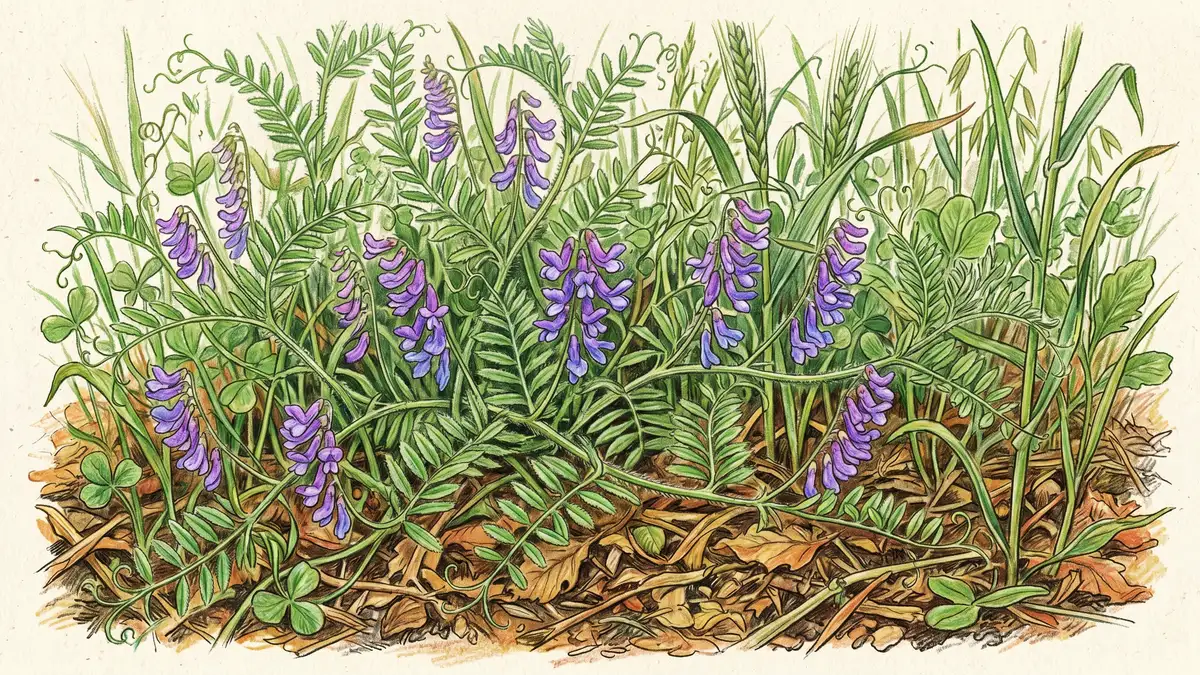
Winter-annual nitrogen fixer that overwinters in zones 4 to 9 when seeded by Labor Day. Produces purple-blue flowers in May and dies in early summer. Fixes 100 to 200 lb N per acre. Best as a between-season living mulch ahead of warm-season vegetables. Seed rate: 1 to 2 lb per 1,000 sq ft (5 to 10 kg per 100 sq m). Often mixed with cereal rye for better weed suppression.
4. Creeping thyme (Thymus serpyllum)
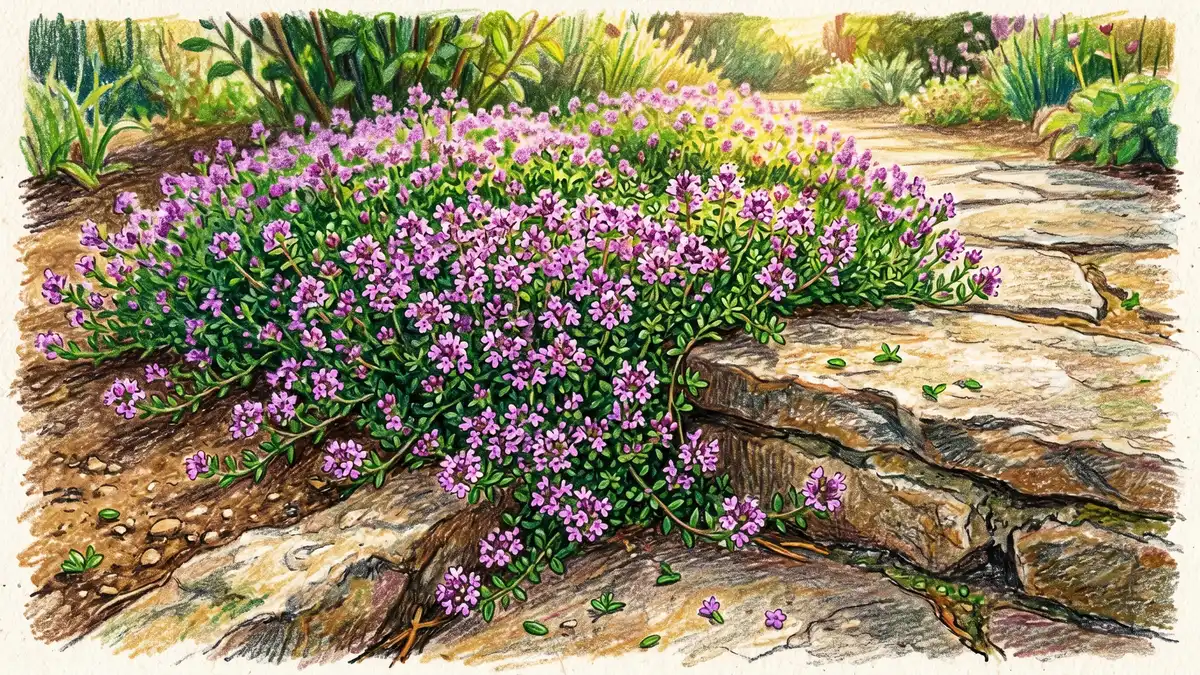
Best for paths, dry sites, and rocky edges where clover would struggle. Perennial in zones 4 to 9. Stays 2 to 4 in (5 to 10 cm) tall, takes light foot traffic, releases pleasant aroma when stepped on. Slower to establish (1 to 2 years from seed) but extremely long-lived once mature. Seed rate: 0.05 lb per 1,000 sq ft (0.25 kg per 100 sq m). Plug planting is often faster than seed for impatient gardeners.
5. Sweet alyssum (Lobularia maritima)
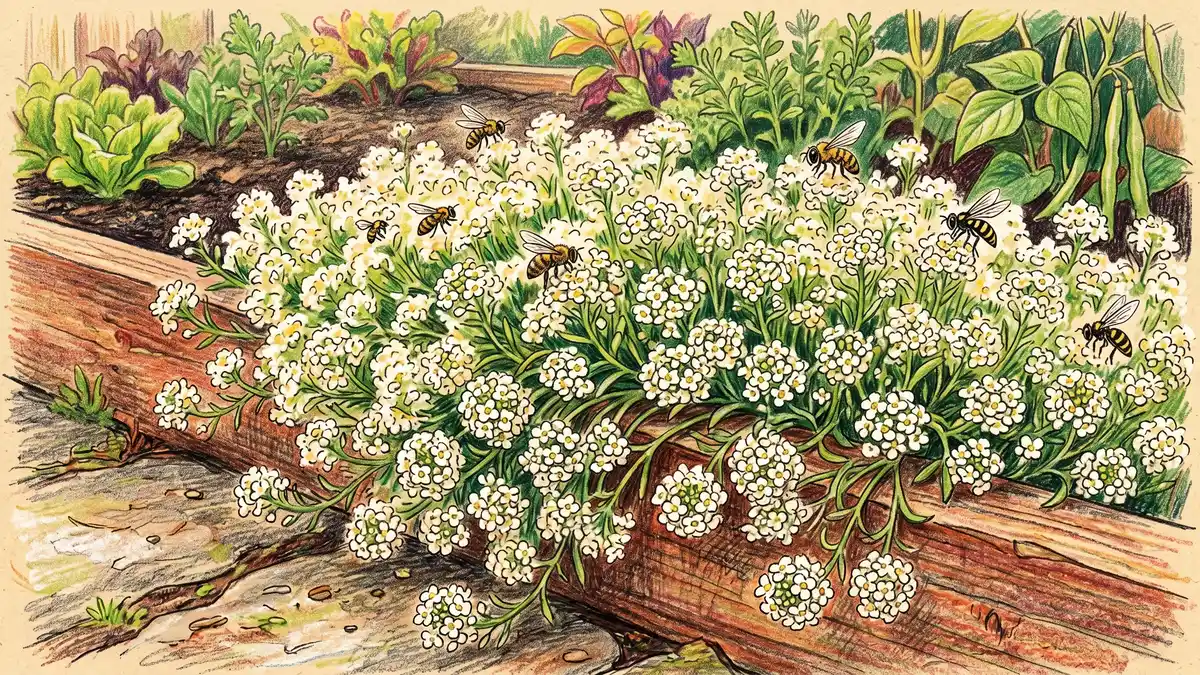
Annual filler that brings hoverflies (aphid predators) to the garden in droves. Stays 3 to 6 in (7.5 to 15 cm), self-seeds, fills gaps between perennial mulch establishment. Best in cooler weather in southern zones, all summer in the North. Seed rate: 0.05 lb per 1,000 sq ft (0.25 kg per 100 sq m) broadcast across beds.
Where each species works best
| Garden zone | Best living mulch | Why |
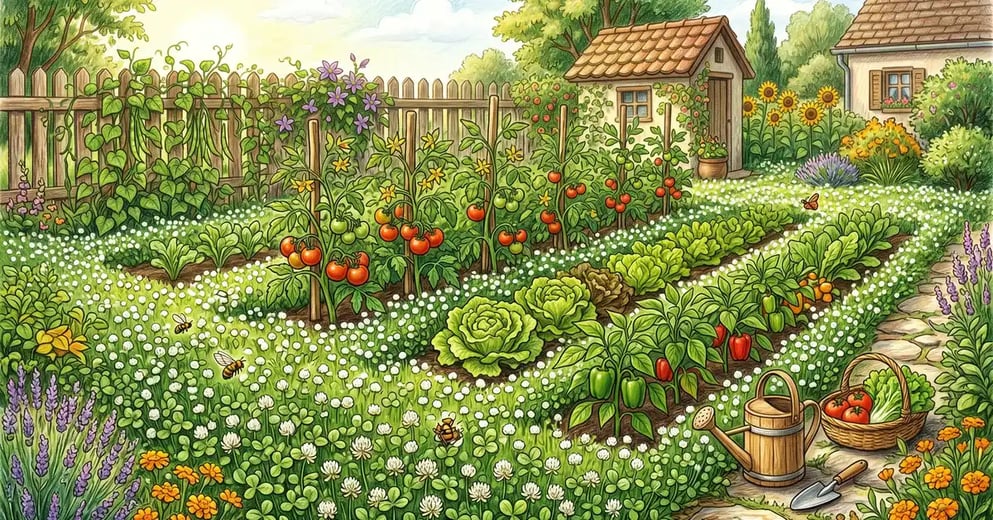
| Tomato/pepper bed | Sweet alyssum + white clover | Alyssum attracts aphid predators; clover fixes N |
| Fruit tree understory | White clover or red clover | N fixation feeds the tree; bee forage during bloom |
| Garden paths | Creeping thyme or microclover | Takes foot traffic, releases aroma when stepped on |
| Winter cover (late summer to spring) | Hairy vetch + cereal rye | Overwinters, fixes N, dies in time for warm-season crops |
| Brassica or corn rows | Avoid live mulch in row; use straw mulch | Heavy feeders compete with living mulch for N |
| Strawberry beds | Sweet alyssum or microclover | Low height, does not bury crowns |
Source: Compatibility recommendations cross-referenced with Cornell Small Farms' organic mulch guide and Michigan State Extension's vegetable mulch recommendations.
The 5-step plan to install living mulch
Clear and prep the area
Remove existing weeds. If the area is heavily weed-infested, smother with cardboard plus 4 in (10 cm) of compost for 60 days before seeding. Loosen the top 1 in (2.5 cm) of soil with a rake.
Seed at the right time
Spring (after last frost) or late summer (6 to 8 weeks before first fall frost) work best for clovers and creeping thyme. Hairy vetch needs late summer seeding, no later than 4 weeks before first frost.
Broadcast and rake in
Hand-broadcast at the seed rate above. Rake lightly to scratch seed into the top 0.25 in (0.6 cm) of soil. Do not bury too deep. Clover and thyme need light to germinate.
Water consistently for 2 to 3 weeks
Keep the surface moist (not soggy) until germination. Most clover and alyssum germinate in 7 to 14 days; creeping thyme can take 14 to 28 days.
Mow 2 to 4 times per season
Once the mulch reaches 4 to 6 in (10 to 15 cm), mow back to 2 to 3 in (5 to 7.5 cm). This keeps it shorter than your crops, stimulates dense growth, and prevents seed-set (for managed clover lawns) or allows it (for bee forage). Leave clippings in place as additional mulch.
Time to install: about 2 to 3 hours for 1,000 sq ft (93 sq m). Cost: $20 to $40 in seed for the same area, compared to roughly $200 to $400 in delivered wood chips.
Managing the competition problem
Living mulch can reduce cash-crop yield if it competes for water or nitrogen during critical growth stages. Washington State University's living mulch screening trial PDF documents that vigorous mulches like fescue and ryegrass can cut tree fruit yields by 10 to 25 percent in dry years without irrigation.
Three management tactics handle this:
- Mow before the crop hits its peak demand stage. For tomatoes, mow when they first set fruit. For corn, mow before tasseling. The cut mulch stays as a smother layer but stops actively transpiring.
- Keep a 6 to 12 in (15 to 30 cm) bare ring around each plant. This is the "donut" pattern: living mulch fills the rest of the bed but does not touch each crop stem.
- Irrigate during dry stretches. A 1 in (2.5 cm) water per week target keeps both the mulch and the crop happy.
What NOT to plant as living mulch
Avoid These Aggressive or Invasive Species
Crown vetch (Securigera varia). Invasive in much of North America; smothers everything including the crop. English ivy (Hedera helix). Climbs into trees, structurally damages buildings, invasive in many US states. Vinca (periwinkle). Listed as invasive in zones 5 to 9; impossible to remove once established. Lily-of-the-valley. Aggressive spreader, toxic to pets and children. Bermuda grass and quack grass. They are weeds wearing a "ground cover" name tag; they will steal your garden. Mint (unconstrained). Works in a sunken bottomless pot, never in the open garden.
Living mulch versus other methods
| Method | 5-year cost per 1,000 sq ft | Weed reduction | Other benefits |
| Living mulch (perennial) | $20 to $50 seed once | 70-90% | N fixation, pollinators, soil structure |
| Wood chip mulch (annual reapply) | $500 to $1,200 over 5 yr | 80-95% | Soil organic matter, water retention |
| Straw mulch (annual) | $300 to $600 | 70-85% | Easy to apply, decomposes into soil |
| Landscape fabric | $200 to $400 | 95%+ year 1, less after | Long-lasting; damages soil biology, ugly when exposed |
| Bare soil + manual weeding | $0 plus 50 to 100 hr of labor | 0% without ongoing work | None |
Source: Cost ranges built from USDA People's Garden mulch overview and current retail seed and bulk mulch pricing in the United States.
Climate and zone considerations
Most clover species (white, red, microclover) thrive in USDA zones 3 to 9. In southern zones (8 to 10), white clover may go dormant in mid-summer; subterranean clover (Trifolium subterraneum) is the better choice. In the desert Southwest, creeping thyme and native sedums outperform clover. UF/IFAS gardening solutions recommends perennial peanut (Arachis glabrata) as a heat-tolerant living mulch alternative for Florida and the Gulf Coast.
Frequently Asked Questions
What is living mulch?
Living mulch is a low-growing ground cover plant intentionally grown alongside vegetable, fruit, or ornamental crops to cover the soil surface. It suppresses weeds by blocking light and competing for water and nutrients, while often adding benefits like nitrogen fixation, pollinator support, and erosion control. Unlike a cover crop, it stays alive year-round and is not turned under.
What is the best living mulch for a vegetable garden?
For most US backyard vegetable gardens, microclover or white clover (Trifolium repens) is the all-around best choice. It fixes nitrogen, stays short enough to walk on, mowable, and works in full to part sun across USDA zones 3 to 9. Sweet alyssum makes a strong annual complement, attracting hoverflies that prey on aphids.
Does living mulch really suppress weeds?
Yes. Established living mulches like white clover and creeping thyme can reduce weed germination by 70 to 90 percent compared to bare soil. The mechanism is dense canopy blocking light from reaching the soil surface, combined with root-zone competition for water and nutrients. It does not eliminate every weed, but dramatically reduces the volume of weeding.
Will living mulch steal nitrogen from my vegetables?
It depends on the species. Legume mulches (white clover, red clover, hairy vetch) fix their own nitrogen and contribute extra to the soil, so they tend to benefit nearby crops. Grass-family mulches (rye, fescue) compete for nitrogen and can reduce yields. Use legume living mulches with heavy feeders like tomatoes and avoid planting grass-family mulches directly against vegetable rows.
Do you have to mow a clover lawn or clover living mulch?
Yes, 2 to 4 times per season. Mowing keeps clover at 2 to 3 in (5 to 7.5 cm), stimulates dense growth, prevents it from overtopping shorter vegetables, and produces a cut-mulch layer of clippings that further suppresses weeds. If you let clover bloom, mow after the bloom drops to keep the stand vigorous.
When should I plant living mulch?
Spring (after last frost) or late summer 6 to 8 weeks before first fall frost works for clovers and creeping thyme. Hairy vetch needs late-summer seeding by Labor Day in zones 4 to 6. Sweet alyssum can be sown anytime after last frost and self-seeds for following years.
Does clover go dormant in winter?
In zones 3 to 6, white clover goes semi-dormant after the first hard frost and resumes growth in early spring. The plants stay alive under snow cover. In zones 7 to 9, white clover may stay green most of the winter, occasionally going dormant in mid-summer heat instead.
Is white clover safe for pets?
White clover is generally considered safe for dogs and cats in normal yard quantities. It is not on the ASPCA toxic plant list. Large quantities can cause mild stomach upset in dogs. Avoid red clover in pastures where horses graze heavily, as it can occasionally cause photosensitivity in horses with prolonged consumption.
Get the Weekly Dig
One practical permaculture guide a week, written for gardeners who do this on weekends: building living soil without buying it in bags. Free, no spam, unsubscribe any time.
Join the Weekly DigResources
- The Cover Crop That Never Dies: Scientists Explore Living Mulch (Grow IWM, University of Georgia)
- Mulch for Organic Vegetables Grown in Place (Cornell Small Farms)
- Vegetable Gardeners Make Use of Organic Mulch (Michigan State Extension)
- Mulching for Soil and Garden Health (University of Minnesota Extension)
- Mulching Your Vegetable Garden (UF/IFAS Gardening Solutions)
- Mulching Guide PDF (USDA NRCS)
- Mulch and Soil Health (USDA People's Garden)
- Screening Annual and Perennial Ground Covers as In-Row Living Mulches (Washington State University PDF)
- Weed Suppression: Choosing Cover Crops and Living Mulches (Chelsea Green)
- Living Mulches Overview (Natures Way Resources)