

A pale, wandering line appears on a chard leaf overnight. It looks like someone drew on the leaf with a white pencil, and it widens as it goes. Most gardeners assume disease, reach for a spray, and get nothing for their trouble.
That squiggle is a leaf miner tunnel. In the great majority of cases it means almost nothing, and the correct response is to do nothing. There is one exception, and knowing which one you are looking at is the whole job.
What Are Leaf Miners, and What Do the Trails Actually Mean?
Leaf miner is not a species. It is a feeding habit shared by larvae in four different insect orders: flies, moths, beetles and sawflies, according to Colorado State University Extension. The larva hatches between the upper and lower skin of the leaf and eats the soft tissue in the middle, leaving both surfaces intact. That is why the trail looks translucent: you are seeing daylight through two empty layers of leaf.
The practical consequence is the part most advice skips. A larva inside a leaf is inside a sandwich. A contact spray lands on the bread. UC IPM makes the same point about commercial systems: the protection of the mine is exactly what defeats ordinary sprays, and the sprays that do reach inside are the ones you should be most careful with.
Here is what this guide covers:
- How to read mine shape to work out which insect made it
- Why leaf mines on tomatoes, beans and shrubs need no action at all
- The one leaf miner that genuinely reduces what you can eat
- Why spraying usually makes a leaf miner problem worse, with the mechanism
- How to time row cover so spinach leafminer never gets started
Key Takeaway
Colorado State Extension puts it plainly: the only insect that regularly mines the edible parts of garden plants is the spinach leafminer. Mines on tomato, bean, columbine, elm or aspen are cosmetic. If the mined leaf is not the thing you eat, leave it alone.
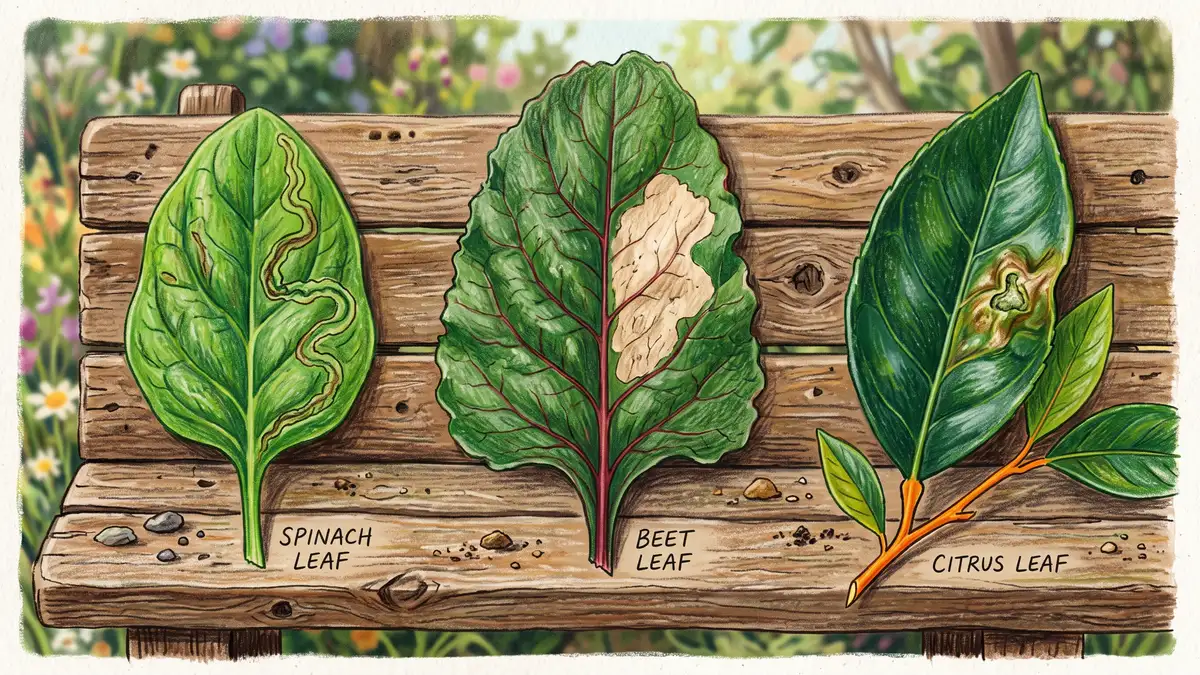
How Do You Tell Which Leaf Miner You Have?
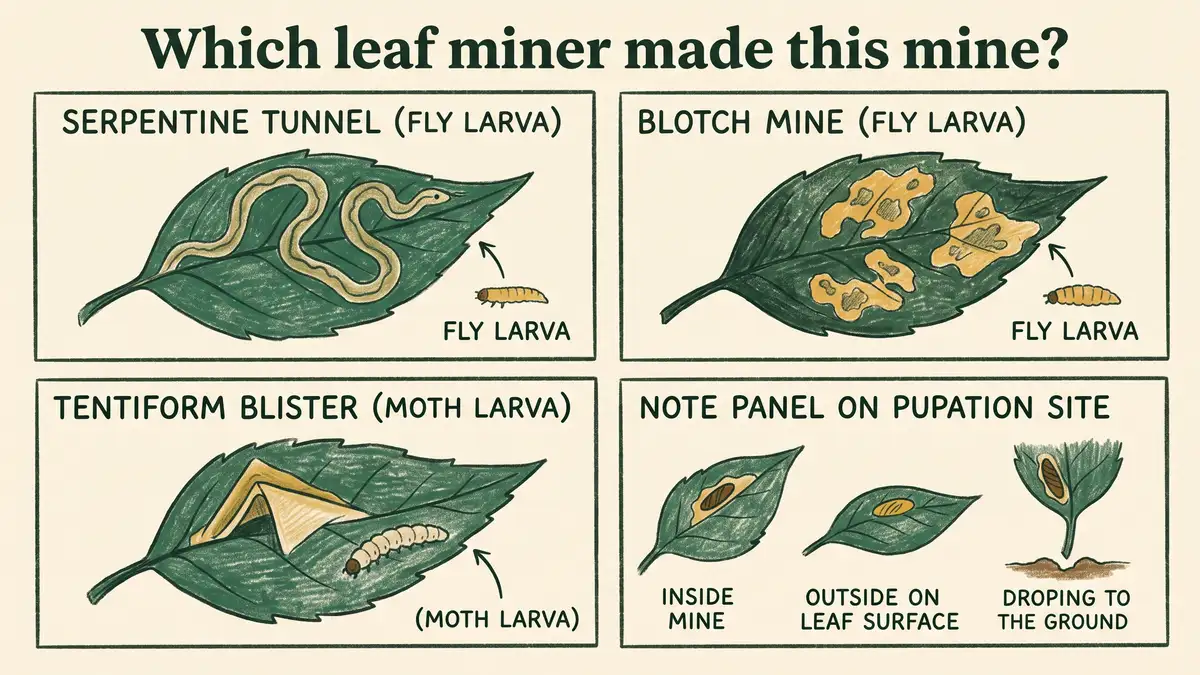
Read the shape of the mine, then check the host plant. Between those two facts you can usually name the insect without ever seeing it. Extension services sort mines into three families of shape: serpentine, blotch and tentiform.
| Mine shape | What it looks like | Likely culprit | Action |
| Serpentine | Narrow winding line that widens along its length | Liriomyza flies, citrus leafminer, aspen leafminer | None on most hosts |
| Blotch | Large irregular pale patch, often turning brown | Spinach leafminer, sawfly leafminers on elm and birch | Act if on greens |
| Tentiform | Puckered blister that lifts like a pup tent | Phyllonorycter moths on apple, willow, poplar | None |
| Blotch, boxwood | Yellow blistered pockets, persist over winter | Boxwood leafminer, one generation a year | Prune or treat at emergence |
Sources: Colorado State University Extension, University of Maryland Extension, Clemson HGIC.
One quick field test settles whether you are even looking at an insect. Pull the pale patch apart between finger and thumb. A mine is hollow and often holds the larva or a line of dark frass. A fungal leaf spot collapses flat with nothing inside it.
Does Leaf Miner Damage Actually Hurt Your Plants?
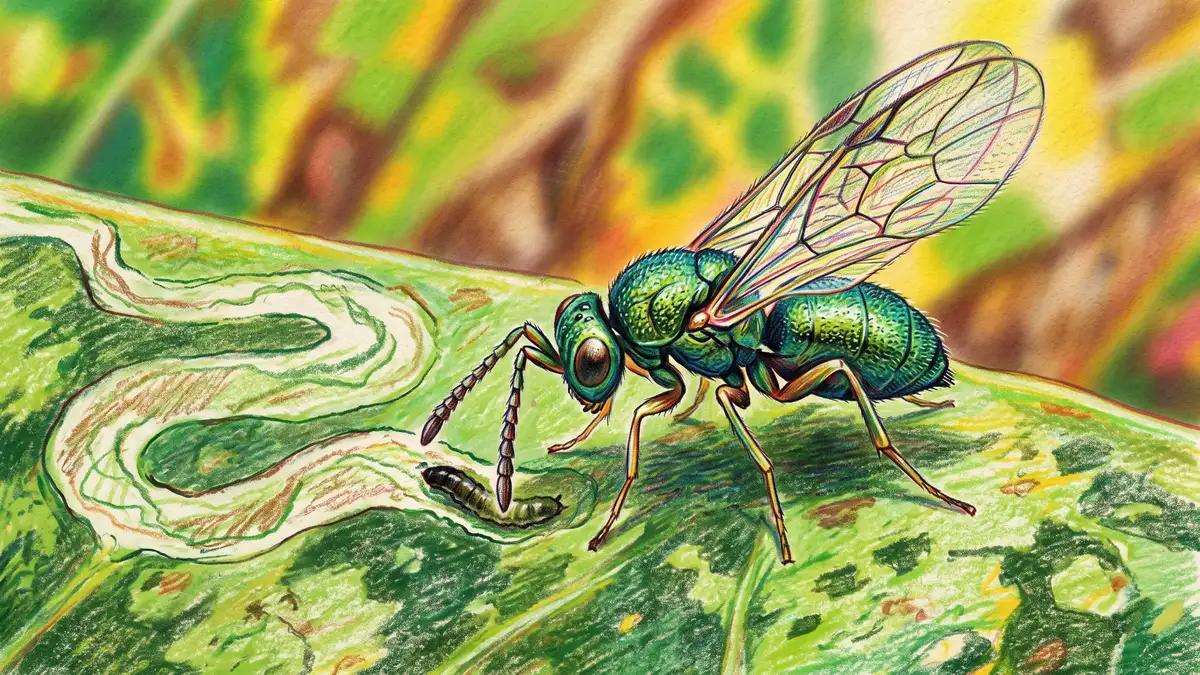
Almost never, and this is the part worth internalising. University of Maryland Extension notes that leafminers turn up on a wide range of shade trees, shrubs, perennials and vegetables while rarely affecting growth or survival. Colorado State says outright that it is rare for mining to significantly affect plant health, because most leaf miners are held in check by their own natural enemies before the damage adds up.
Those natural enemies are tiny parasitoid wasps in genera like Diglyphus, Dacnusa, Opius and Chrysocharis. They find the larva through the leaf surface and lay an egg on it. If you have ever opened a mine and found a dead, shrunken larva or a small dark pupa that clearly is not a maggot, you have watched this working. Those wasps are the same crew that keeps cabbage worms in check, and they need the same thing from you: no broad-spectrum sprays.
The exception is any crop where you eat the leaf. Spinach, chard and beet greens with brown blotches through them are still perfectly safe to eat, but nobody wants to. That is a real loss of usable harvest, not a cosmetic complaint, and it is the one case that justifies acting.
What Actually Works Against Leaf Miners?
Four things, in this order. Notice that spraying is not on the list until the very end, and even then it is conditional.
Decide whether you eat the leaf
If the answer is no, stop here. Mines on tomato foliage, bean leaves, columbine, elm or apple need nothing. Colorado State recommends no control at all for vegetable leafminers, because treatment usually makes things worse.
Crush the eggs on greens
Spinach leafminer lays neat white eggs in small rows on the leaf underside. Check twice a week from mid-May and rub them off with a thumb. This is the single most effective home-garden control, and it costs nothing.
Pick mined leaves and take them away
Remove and destroy leaves with active mines. Do not drop them on the bed. Colorado State warns that larvae in picked leaves left on the ground simply finish developing and drop into the soil to pupate. Bag them or run them through a hot compost pile.
Use spinosad only on greens, only at egg hatch
Spinosad has translaminar movement, meaning some of it crosses into the leaf where the larva is. UC IPM lists it among the effective options for leafminers, with the caveat that species differ in susceptibility. Time it to egg hatch, not to visible mines, because by the time you see a tunnel the damage is already done.
Why Spraying Usually Backfires
Colorado State is blunt about it: many insecticides have poor activity against leaf miners, and applications often make the problem worse by differentially destroying natural enemies. Liriomyza leafminers became serious pests of greenhouse chrysanthemums in exactly this way, when repeated broad-spectrum spraying wiped out the parasitoid wasps and left resistant flies with nothing holding them back. UC IPM still warns growers to choose selective products specifically to avoid inducing leafminer outbreaks.
How Do You Stop Spinach Leafminer Next Spring?

Row cover, on early, over ground that did not grow spinach last year. The spinach leafminer overwinters as a pupa in the soil and the adults emerge in April and May, per UNH Extension. Cover the bed before that flight starts and the flies never reach the leaves.
Two details make or break it. First, never cover a bed where spinach, beets or chard grew the previous season, because the flies emerge from the soil underneath and you have built them a shelter. Rotate first, then cover. Second, use hoops. University of Minnesota Extension notes that spinach leaves are tender enough to be abraded when fabric rubs on them in wind, so the cover should never rest on the crop.
Clear out lambsquarters and other chenopod weeds around the bed too. They are alternate hosts, and a patch of them beside your greens is a reservoir that keeps producing flies all season. The same tidy-edge thinking helps with cool-season greens generally.
Why This Works: Letting the System Do the Work
The strongest leaf-miner strategy is mostly restraint. Parasitoid wasps regulate these insects for free, and every broad-spectrum spray you skip is a season of that labour retained. Exclusion and egg-crushing work because they solve your problem without touching the wasps. That is the permaculture move: intervene at the narrowest point rather than across the whole system, and the corrective feedback stays intact. Our companion planting chart and the guide to attracting beneficial insects cover how to feed those wasps year-round.

Frequently Asked Questions
How do you get rid of leaf miners?
For most plants, you do not need to. Colorado State Extension recommends no control at all for vegetable leafminers, because sprays reach the larva poorly and kill the parasitoid wasps that were doing the job for you. On leafy greens, where the mined leaf is the harvest, crush the white egg rows on the leaf undersides twice a week, pick and remove leaves with active mines rather than leaving them on the bed, and reserve spinosad for the point of egg hatch. Timing matters far more than product choice, because a visible tunnel means the damage has already happened.
How do you prevent leaf miners?
Floating row cover put on before the adults fly is the only reliable prevention, and it matters mainly for spinach, beet and chard. Adults emerge from soil pupae in April and May, so the cover has to be in place before then. Two rules make it work: never cover a bed where the same crops grew last season, since the flies will emerge underneath the fabric, and support the cover on hoops so it never rubs the tender leaves. Clearing lambsquarters and other chenopod weeds near the bed removes the alternate hosts that keep populations going.
Does neem oil kill leaf miners?
Not reliably. Neem and azadirachtin products act mainly as antifeedants and insect growth regulators, and extension guidance treats them as acceptable within organic programmes rather than as strong controls. The core problem stands: the larva is sealed between two leaf surfaces, so a product that works on contact has limited access to it. Published percentage control figures for neem against leaf miners in garden conditions are thin. If you want a material with real translaminar movement into the leaf, spinosad is the better-evidenced choice, and even then timing to egg hatch is what determines the result.
Are leaves with leaf miner trails safe to eat?
Yes. Leaf miner larvae carry nothing harmful to people and the mined tissue is simply dead plant material. Spinach or chard with a few mines can be washed, trimmed and eaten normally. The reason mining matters on greens is appetite and appearance rather than safety, since brown blotches running through a salad leaf are unappealing even when harmless. On fruiting crops such as tomatoes and beans, mining is confined to foliage you were never going to eat, so it has no bearing on the harvest at all.
What do leaf miners turn into?
It depends which order made the mine. Most vegetable leaf miners are the larvae of small grey or black flies, roughly half the size of a house fly, that emerge from pupae in the soil. Citrus leafminer and the tentiform miners on apple and poplar are the larvae of tiny moths. Elm, birch and hawthorn leafminers are sawfly larvae, which become small non-stinging wasp relatives. Some species pupate inside the mine itself, while others cut their way out when fully grown and drop to pupate in the soil, which is why soil cultivation and rotation help.
Get the Weekly Dig
One practical permaculture guide a week, written for gardeners who do this on weekends: permaculture design for real backyards. Free, no spam, unsubscribe any time.
Join the Weekly DigResources
- Colorado State University Extension: Leafmining Insects (5.548): mine shapes, species by host, and why control usually backfires
- UC IPM: Leafminers on Celery: life cycle timing, translaminar products and parasitoid conservation
- University of Maryland Extension: Leafminers on Ornamental Plants: identification and why ornamental mining is cosmetic
- UNH Extension: Beet and Spinach Leafminer: emergence timing, egg scouting and row cover
- University of Minnesota Extension: Spinach Leafminer: home-garden diagnosis and row cover technique
- Wisconsin Horticulture: Vegetable Leafminers: serpentine, vegetable and spinach leafminer life cycles
- University of Florida IFAS: Citrus Leafminer: flush-linked egg laying and young versus mature tree impact
- Clemson HGIC: Boxwood Diseases and Insect Pests: boxwood leafminer life cycle and treatment timing