
A school food forest does what a vegetable garden cannot. It produces fruit in the fall when students are back in class, survives summer break without daily watering, lives 20 to 50 years on the same square footage, and integrates into every K-12 subject from science to social studies. Here is how to design one that earns its place on a US school campus, the plant list that is safe for children, the funding sources that actually approve school applications, and the curriculum tie-ins that make this a teaching tool rather than a grounds maintenance liability.
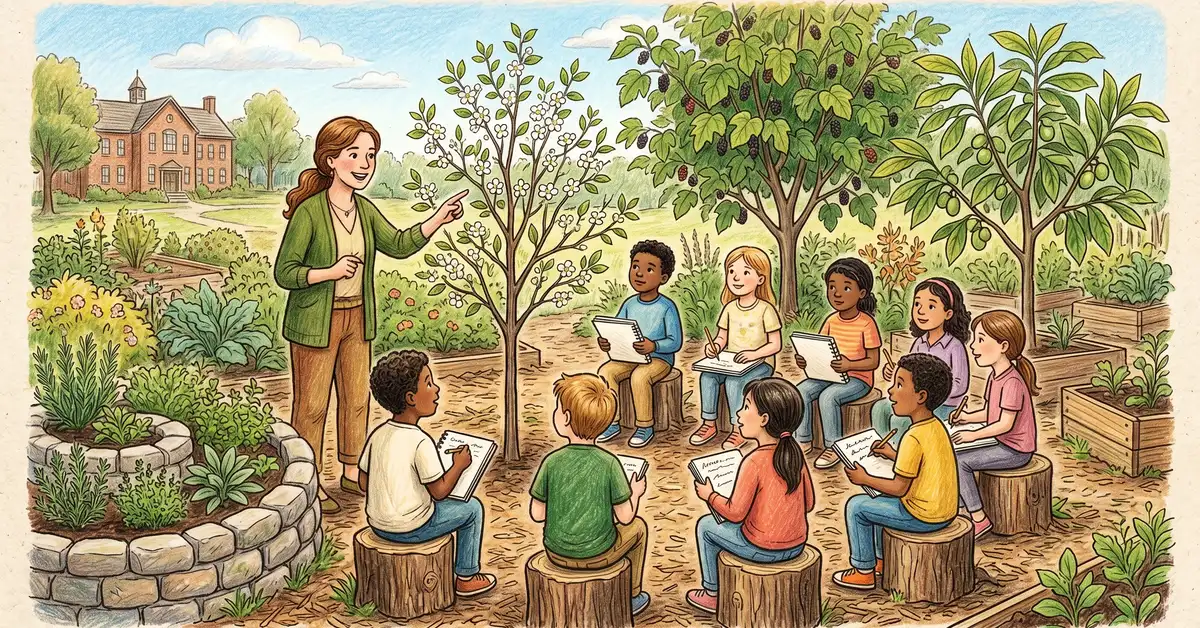
The model that started all of this is the Edible Schoolyard Project, founded by chef Alice Waters at Martin Luther King Jr Middle School in Berkeley, California in 1995. One acre of converted asphalt became an integrated garden and kitchen classroom that has now influenced roughly 8,000 K-12 garden programs worldwide. The lesson from three decades of replication: a school food forest works when you design for the academic calendar (not the gardening calendar), choose perennials over annuals, and integrate the garden into the curriculum from day one rather than treating it as an extracurricular hobby.
What you will get below: the 6-step design process from first committee meeting to first harvest, the 4-zone layout that fits a typical schoolyard, the child-safe perennial plant list with US zone hardiness, the four funding sources that fund 80 percent of US school gardens, the curriculum tie-ins that justify the garden to the principal, and the summer maintenance models that prevent the project from dying during break.
Sources:.
Why food forest beats vegetable garden in a school setting
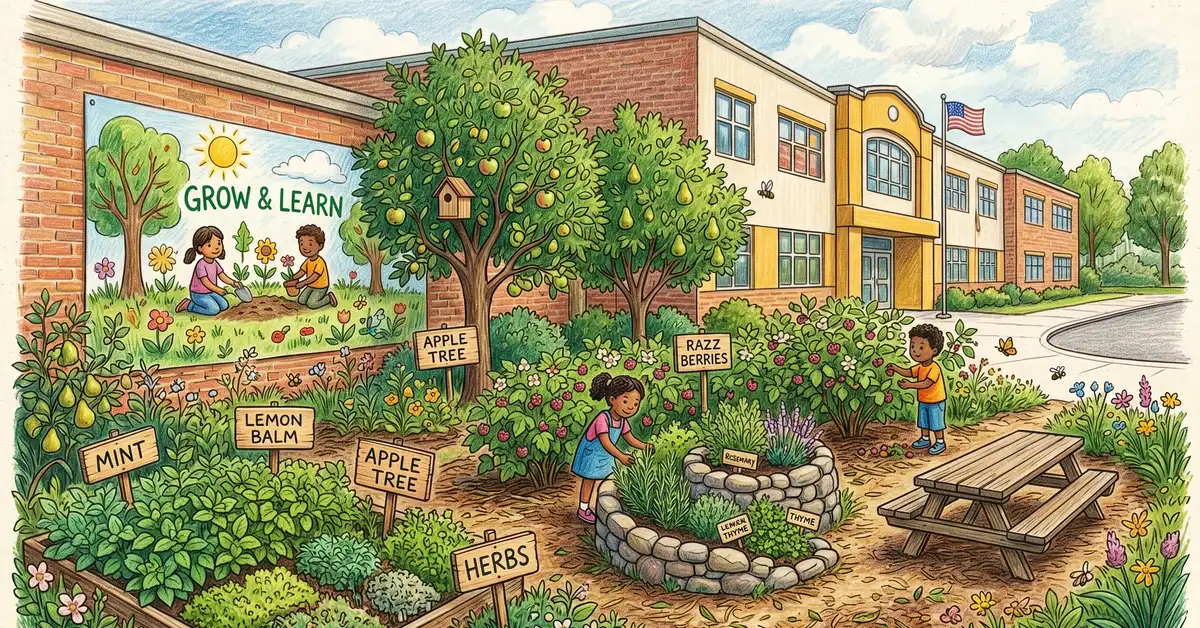
The standard US school garden is an annual vegetable plot. It looks great in May, struggles in July, and is half-dead by the time students return in September. The plants that ripen during the school year (lettuce, peas, broccoli) finish before summer break. The plants that ripen during summer break (tomatoes, peppers, beans, squash) drop their fruit when nobody is there to harvest. The cycle mismatches the calendar.
A perennial food forest reverses this. Most temperate fruit trees and bushes ripen in late summer through fall (August through November), exactly when teachers are back at school. Berries fruit across multiple windows: strawberries in June and again in September (everbearing types), raspberries in July and again in October (primocane varieties), blueberries from June to August, mulberries in June, apples and pears September through November, pawpaws and persimmons October through November. The garden produces during the school year, not against it.
Maintenance follows the same logic. A vegetable bed needs weekly weeding, watering, and replanting. A mature food forest needs one cleanup day in spring, one in fall, and occasional summer watering during droughts. Teachers can integrate garden time into a 30-minute lesson without committing to a daily watering chore. Read our piece on food forest succession year by year for the maintenance timeline a school should expect.
The 6-step design process from committee to harvest
Form a planning committee (month 1 to 3)
Minimum 4 to 6 people: at least one teacher (ideally a science teacher), one administrator (principal or assistant principal with budget authority), one parent (PTA representative), and one community partner (Master Gardener, local nursery owner, or community garden organizer). Meet monthly. The single biggest predictor of long-term success is having more than one staff champion so the garden survives staff turnover.
Select the site (month 2 to 4)
Required: 6+ hours direct sun, water access within 50 ft (15 m), security (visible from classrooms or admin office, fenced perimeter), ADA accessible path, away from main play areas and traffic. Avoid: deep shade, drainage problems, septic systems, utility easements, and asphalt with unknown contaminants (test soil before planting if site was paved or industrial). Most US schools use a corner of the playground, a strip along the school exterior, or an unused front-yard lawn area.
Design 4 zones (month 3 to 6)
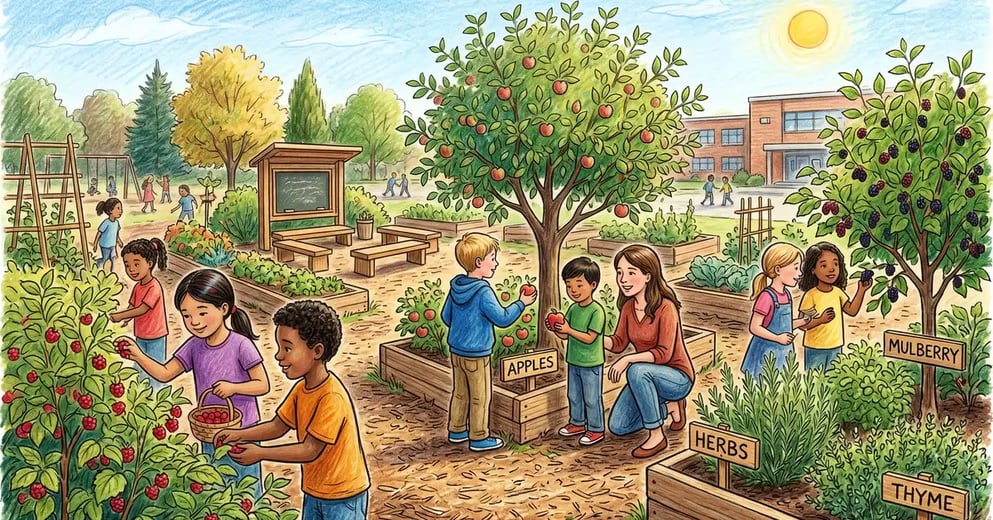
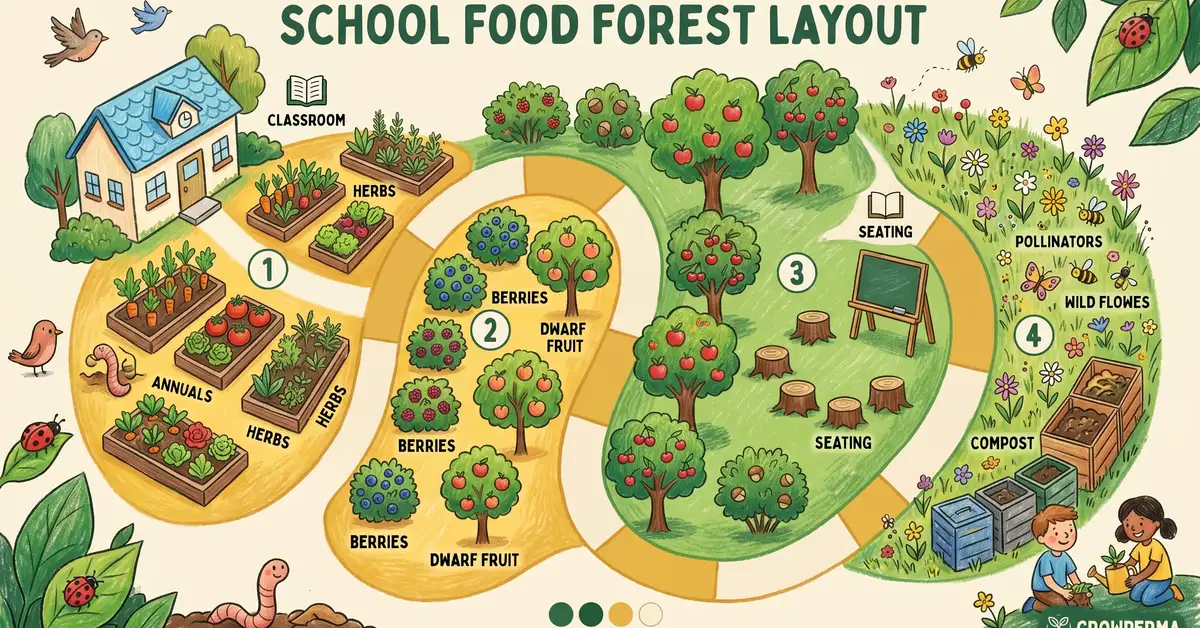
Zone 1 closest to classroom door: annual beds and herb spirals for daily lessons. Zone 2 transitional: berry shrubs (raspberry, blueberry, currant, strawberry) and dwarf fruit trees at kid-height. Zone 3: full-size fruit trees (apple, pear, mulberry, persimmon, pawpaw), hazelnut bushes, outdoor classroom seating area on log stumps or benches. Zone 4 farthest edge: pollinator meadow with native wildflowers, compost area, tool storage. See our piece on food forest design for the broader zoning logic.
Secure funding (month 4 to 9)
Stack three or more sources. The big federal grant: USDA Farm to School Grants ($75,000 to $500,000 over 1 to 3 years, applications open every fall). Smaller grants: Whole Kids Foundation Garden Grants ($3,000 each, annual cycle), KidsGardening.org Youth Garden Grant ($500 plus a Gardener's Supply gift card). Local: PTA fundraising, district education foundation grants, and corporate sponsors (Home Depot, Lowe's, Whole Foods, regional credit unions).
Plant the orchard (month 9 to 12, fall or early spring)
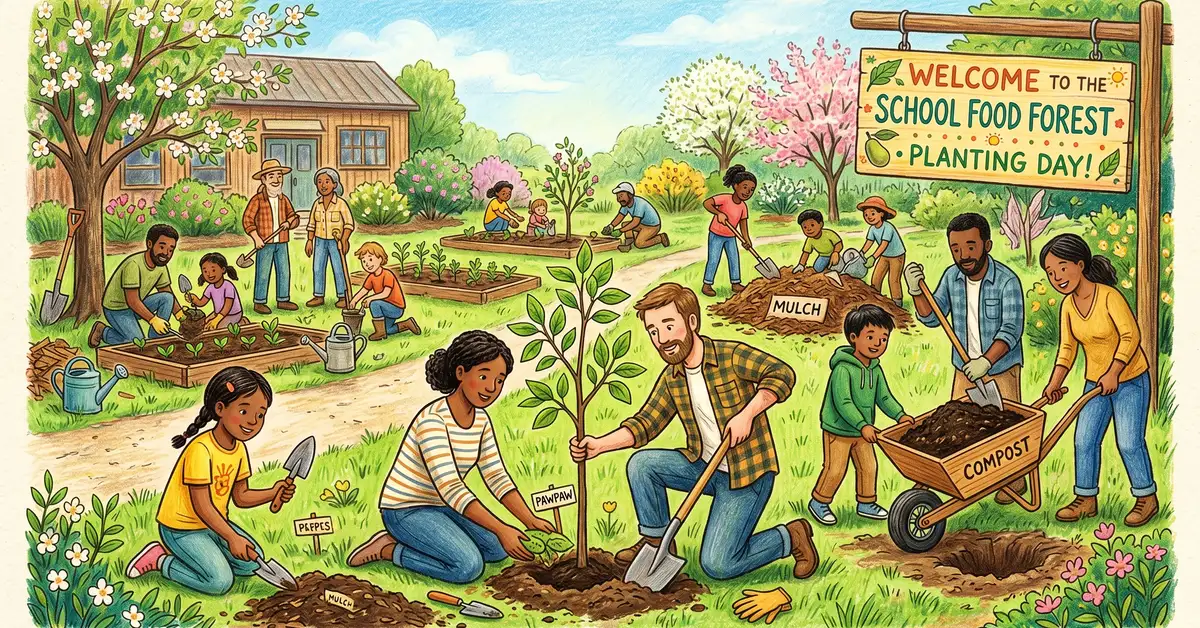
Plant fruit and nut trees in late October to early November in zones 4 to 7, or late February to March in zones 8 to 9. Host a community planting day with parents, students, teachers, and community partners. Aim for 30 to 50 volunteers. Plant water-tolerant pioneer species (black locust nitrogen fixer 15 ft / 4.5 m from fruit trees, comfrey at the base of each tree) the same day. Mulch heavily (4 to 6 inches / 10 to 15 cm of wood chips). Install drip irrigation before planting.
Integrate curriculum and maintain (year 1+)
Recruit teacher champions in 3 to 5 subjects: science, math, social studies, language arts, and art. Use the garden for at least 30 minutes per week per class. Train summer parent volunteers and partner with a local Master Gardener program for off-season maintenance. Document everything for next year's grant reports. Add new plants and infrastructure each year as the budget allows.
The child-safe plant list (US zones 4 to 9)
School plant selection has stricter constraints than home food forest plant selection. Every species needs to be non-toxic in the parts children might touch or taste, low on the major allergen lists, free of sharp thorns at student-accessible heights, and either resistant to common pests (since chemical sprays are not allowed) or willing to share with wildlife.
| Zone | Layer | Recommended species (US zones 4 to 9) |
| Zone 1 | Annuals + herbs | Lettuce, spinach, peas, cherry tomatoes, radishes, sunflowers, marigolds, chives, parsley, basil, mint, lemon balm, oregano, calendula, nasturtium (edible flowers) |
| Zone 2 | Berry shrubs and dwarf trees | Strawberry (everbearing), blueberry (low-bush and high-bush), raspberry (thornless varieties only), currant (red and black), gooseberry (thornless), honeyberry, dwarf apple, dwarf pear, dwarf cherry |
| Zone 3 | Full-size fruit and nut trees | Standard apple (Liberty, Goldrush, Enterprise disease resistant), pear, mulberry, serviceberry (Amelanchier), American persimmon (Diospyros virginiana), pawpaw, hazelnut (hybrid bush) |
| Zone 4 | Pollinator meadow + compost | Bee balm, milkweed (Asclepias incarnata, A. tuberosa), purple coneflower, black-eyed Susan, native goldenrod, switchgrass, little bluestem |
Sources:; KidsGardening.org plant recommendations for school gardens.
Curriculum integration: making the garden a teaching tool
The single biggest difference between a school food forest that becomes a permanent fixture and one that gets paved over after 3 years is whether teachers use the garden for required curriculum versus elective enrichment. Required curriculum survives administrative turnover. Elective enrichment does not.
Science (Next Generation Science Standards alignment). NGSS life science strands (LS1 structure and function, LS2 ecosystems, LS3 heredity, LS4 evolution) map directly onto food forest observation. Elementary students study plant parts and life cycles. Middle school students study ecosystem interactions and pollinators. High school students study genetics through fruit tree grafting and selection.
Math (Common Core). Bed measurement (geometry), plant counting and yield tracking (data analysis), seasonal temperature graphing (statistics), budget calculations (real-world applications). The garden makes abstract math measurable.
Social studies and history. Food cultures and immigration patterns, Indigenous foodways (Three Sisters planting, persimmon traditions), agricultural history, sustainability and climate change. The harvest connects to social topics naturally.
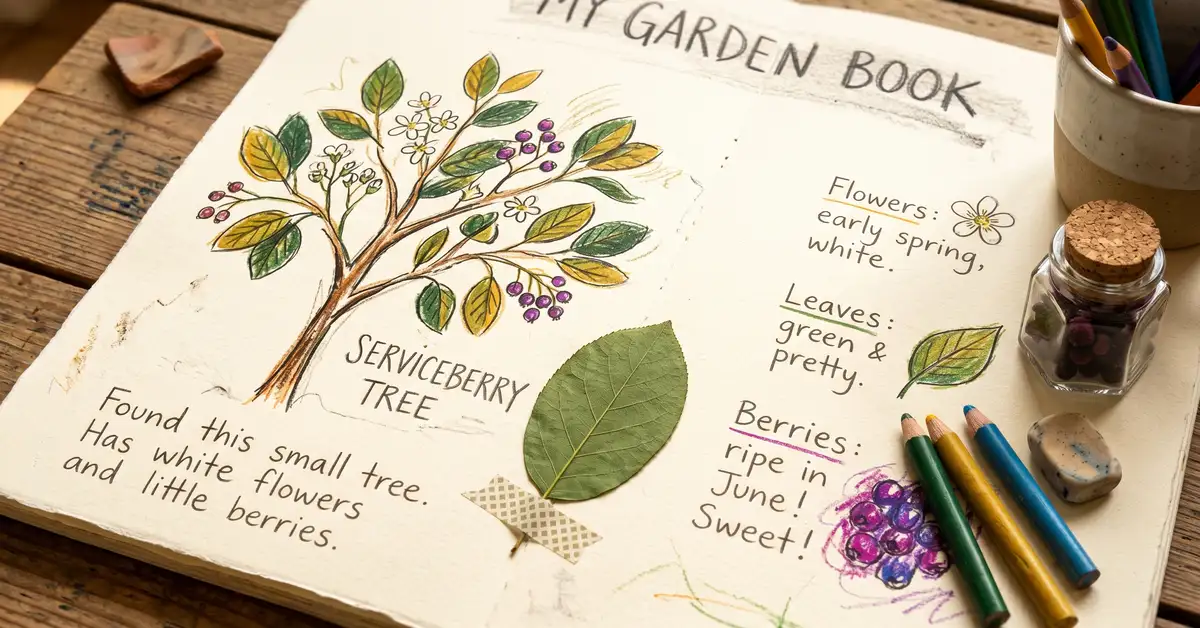
Language arts. Garden journaling, observation writing, persuasive writing for fundraising letters, descriptive writing about smells and tastes, research papers on individual species.
Why integrated curriculum protects the garden
School gardens that exist outside the academic calendar are luxury items that vie with budgets for technology and athletics. School gardens that deliver NGSS science standards, Common Core math practice, and language arts work are infrastructure. The shift from luxury to infrastructure is the difference between a garden that lasts 3 years and one that lasts 30. Teacher buy-in across 3 to 5 subjects is the protective layer.
Funding: the 4 sources that fund most US school gardens
A typical first-year US school food forest budget runs $5,000 to $15,000. That covers site prep, 30 to 50 fruit and nut trees and shrubs, irrigation, mulch, tools, and a small contingency. Multi-year ambitious projects with paid coordinators and full kitchen classrooms run $50,000 to $500,000 over 3 to 5 years.
USDA Farm to School Grants. The largest federal funder. $75,000 to $500,000 per project, 1 to 3 year terms. The annual application opens each fall via the USDA Food and Nutrition Service. Schools, school districts, and nonprofits serving schools can apply.
Whole Kids Foundation Garden Grants. $3,000 each, awarded annually. Open to K-12 schools and nonprofits supporting K-12 garden education. The application is simpler than the federal grant. See Whole Kids Foundation.
KidsGardening.org Youth Garden Grant. $500 cash plus a Gardener's Supply gift package. Multiple cycles per year. Application is lightweight, good first grant for a new program. See KidsGardening.org grants.
Local sources. School district education foundations, PTA capital campaigns, corporate sponsors (Home Depot Community Impact Grants, Lowe's School Grants, Whole Foods Community Giving), local Master Gardener chapters, and regional credit unions all fund school gardens at the $500 to $5,000 level.
The fundable stack: $3,000 from Whole Kids, $500 from KidsGardening, $2,000 from local PTA, $1,500 from corporate sponsor, $1,500 from school district sustainability budget equals $8,500 in first year funding with relatively low application burden.
Summer maintenance: the make-or-break detail
More school gardens die during summer break than for any other reason. Three operational models work in US districts:
Drip irrigation with timer. A simple battery-powered hose-end timer plus 1/2 inch drip line plus emitters at each tree and shrub costs $200 to $500 and waters reliably for 8 to 10 weeks without supervision. Check the system weekly for clogs.
Parent and community volunteer rotation. A weekly signup sheet covers 8 to 10 weeks with 8 to 10 families, each committing 1 hour. Pair with summer camp programs using the space and you have on-site presence most weekdays.
Master Gardener or community garden partnership. Many USDA Extension Master Gardener programs need volunteer hours and will adopt a school garden in exchange for harvest rights or hands-on training space. This is the most reliable model for schools without strong parent volunteer culture.
Pair drought-tolerant perennial design with one of the above and the garden survives.
Case studies from US school food forests
Three documented US programs worth studying:
The Edible Schoolyard at MLK Jr Middle School (Berkeley CA, founded 1995). Alice Waters' founding project. 1 acre garden plus kitchen classroom. Now in year 30. Has trained roughly 8,000 educators worldwide through the Edible Schoolyard Academy.
Boston Schoolyard Initiative outdoor classrooms. A district-wide program that converted 88 Boston Public Schools schoolyards into integrated outdoor classrooms from 1995 to 2015. The institutional model for how a city can scale school garden programs across an entire district.
Beacon Food Forest education programs in Seattle. Public food forest that partners with several Seattle Public Schools for field trips and curriculum integration. Demonstrates how a community food forest can serve schools without each school needing its own garden.
Get the Weekly Dig
One practical permaculture guide a week, written for gardeners who do this on weekends: food forest and guild designs that produce. Free, no spam, unsubscribe any time.
Join the Weekly DigFrequently Asked Questions
What is a school food forest?
A perennial edible garden designed for K-12 use, combining fruit trees, berry bushes, herbs, and pollinator plants in a layered low-maintenance system. Survives summer break without daily watering, supports outdoor classroom teaching, produces food when school is back in session.
How do I design a food forest for a school?
Six steps: form a planning committee, select a sunny secure site, design four zones from classroom door outward, choose child-safe species, secure funding through Farm to School and Whole Kids grants, plant in fall or early spring with a community day. Plan on 1 to 2 years from first meeting to first harvest.
What plants are best for a school food forest?
Serviceberry, pawpaw, persimmon, mulberry, dwarf apple and pear, hazelnut, raspberry (thornless), strawberry, blueberry, currant, gooseberry (thornless), and sensory herbs (mint, lemon balm, oregano, chives). Avoid black walnut, raw elderberry, thorny species, and toxic lookalikes.
How do schools fund a food forest?
USDA Farm to School Grants ($75K to $500K), Whole Kids Foundation Garden Grants ($3K), KidsGardening.org Youth Garden Grant ($500), local PTA and corporate sponsors. Typical first-year budget $5K to $15K.
How do school gardens improve learning?
12 to 15 percent improvement in science test scores, 2 to 3x higher vegetable consumption, improved social-emotional regulation. Integrates with NGSS science standards, Common Core math, social studies, and language arts.
Who maintains a school food forest in summer?
Three strategies: drought-tolerant perennial design, timer-based drip irrigation, parent and community volunteer rotation. Many schools partner with USDA Extension Master Gardener programs.
Are there liability issues with school food forests?
Covered by standard district insurance. Best practices: avoid toxic and thorny plants, hand-washing stations near the garden, USDA food safety guidelines, parent permission slips for tasting, and signage for food allergies.
What is the difference between a school food forest and a school vegetable garden?
A vegetable garden uses annuals that need replanting each spring and intensive summer care. A food forest uses perennials that establish once and produce for 20 to 50 years with minimal maintenance, ripening in fall when school is back in session.
Resources
- The Edible Schoolyard Project (Alice Waters founding model)
- USDA Farm to School Grant Program
- Whole Kids Foundation Garden Grants
- KidsGardening.org Youth Garden Grant
- Life Lab garden curriculum and teacher training
- National Farm to School Network
- Boston Schoolyard Initiative outdoor classrooms
- Beacon Food Forest education programs
- USDA Extension Master Gardener Program (volunteer partner)
- USDA Farm to School Census