
A desert food forest is a multi-strata edible perennial system designed for arid climates with 5 to 15 in of annual rainfall, often supplemented by earthworks that catch and store rainwater in soil rather than tanks. The model works in the US Sonoran Desert (Tucson, Phoenix), Mojave (Las Vegas, Palm Springs), Chihuahuan (El Paso, southern New Mexico), and high deserts of the Colorado Plateau. Once established, a desert food forest uses 20 to 50 percent of the water a conventional fruit orchard needs and produces food for 30+ years. a greywater system for the garden growing at higher elevation in the Southwest how long to run drip lines what a shaduf is
Sources: Brad Lancaster, Rainwater Harvesting for Drylands and Beyond; University of Arizona Cooperative Extension; Native Seeds/SEARCH; USDA-NRCS Southwest.
The US Southwest is the fastest-warming, fastest-drying region in the country. Phoenix averages 110 days above 100 degrees F per year. Tucson has cut municipal water allocations twice in the last decade. Las Vegas and Palm Springs face Colorado River cutbacks. For a permaculture-curious gardener in this landscape, the question is not whether to grow food differently but how. The desert food forest is the most mature, most proven answer.
This guide covers the earthworks foundation, the 7-layer plant design adapted for arid heat, the native and introduced species that thrive, the two flagship case studies (Geoff Lawton's Greening the Desert in Jordan and Brad Lancaster's Tucson model), and a realistic timeline from bare yard to producing food forest.
The earthworks come first
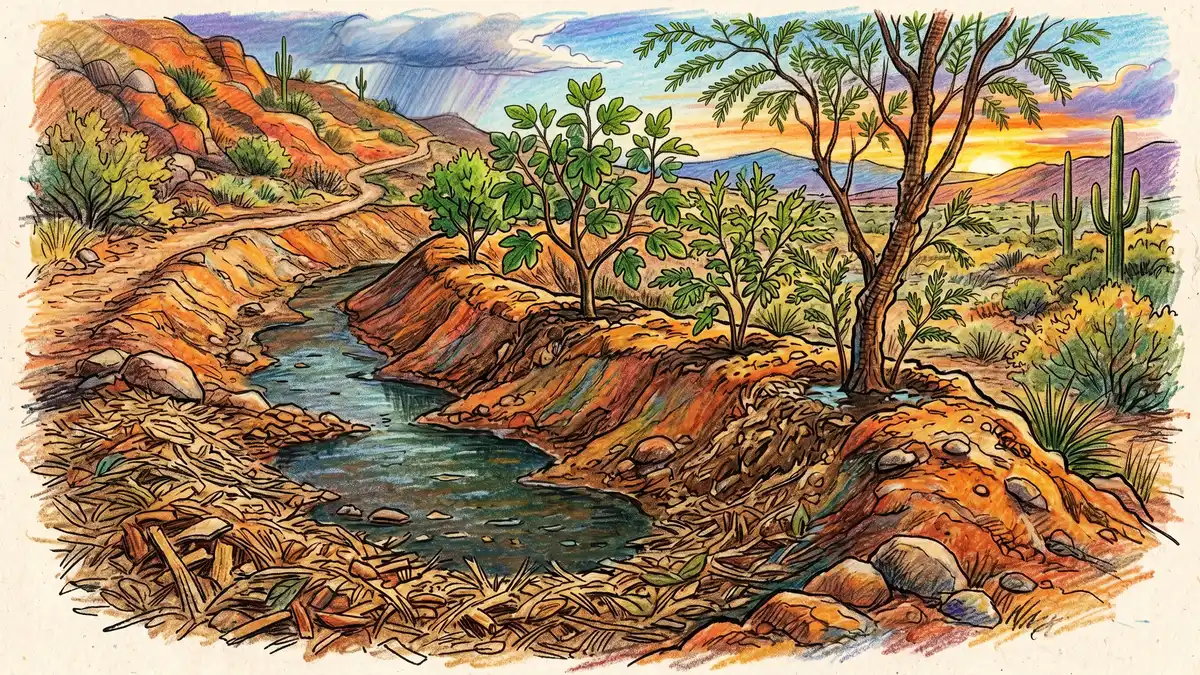
In a wet climate, you plant trees and worry about water later. In the desert, you build the water-holding earthworks first, then plant into them. The earthworks are the system. Without them, you are just running an irrigated orchard.
The five earthworks that matter most:
- Swales on contour. Level trenches with a downhill berm that catch sheet flow and store it as soil moisture. A 30 ft swale captures roughly 700 gal from a single 1 in rainfall on a typical Tucson 1/4 acre lot.
- Boomerang berms. Half-moon catchments built around individual trees on flat or gently sloping ground. Each berm holds 20 to 100 gal of stormwater per inch of rain.
- Net and pan systems. Geoff Lawton's signature Jordan technique: a grid of small basins connected by shallow channels that slow and infiltrate water across an entire site.
- Gabions and rock dams. Wire-cage rock barriers across washes that slow flood flow and force water to deposit silt, building soil.
- Mulch basins. Deep wells of woody mulch (6 to 12 in thick) around root zones that hold moisture for weeks after each watering.
The principle behind all five: catch the rainwater where it falls. Tucson averages 12 in of rain per year. A 1,500 sq ft roof captures 14,000 gal of that. A 1/4 acre lot captures 80,000 gal. Earthworks turn this from runoff that floods the street into infiltration that feeds trees for months.
Why this works (the permaculture insight)
Permaculture principle 2 is "catch and store energy". The desert has plenty of solar energy (too much, really) but very little water. The earthworks turn occasional 1 in rainstorms into months of soil-stored moisture. The trees you plant into those earthworks tap that moisture year-round. You are not fighting the desert. You are working with the natural rhythm of long dry spells and brief intense rains.
The 7-layer desert food forest
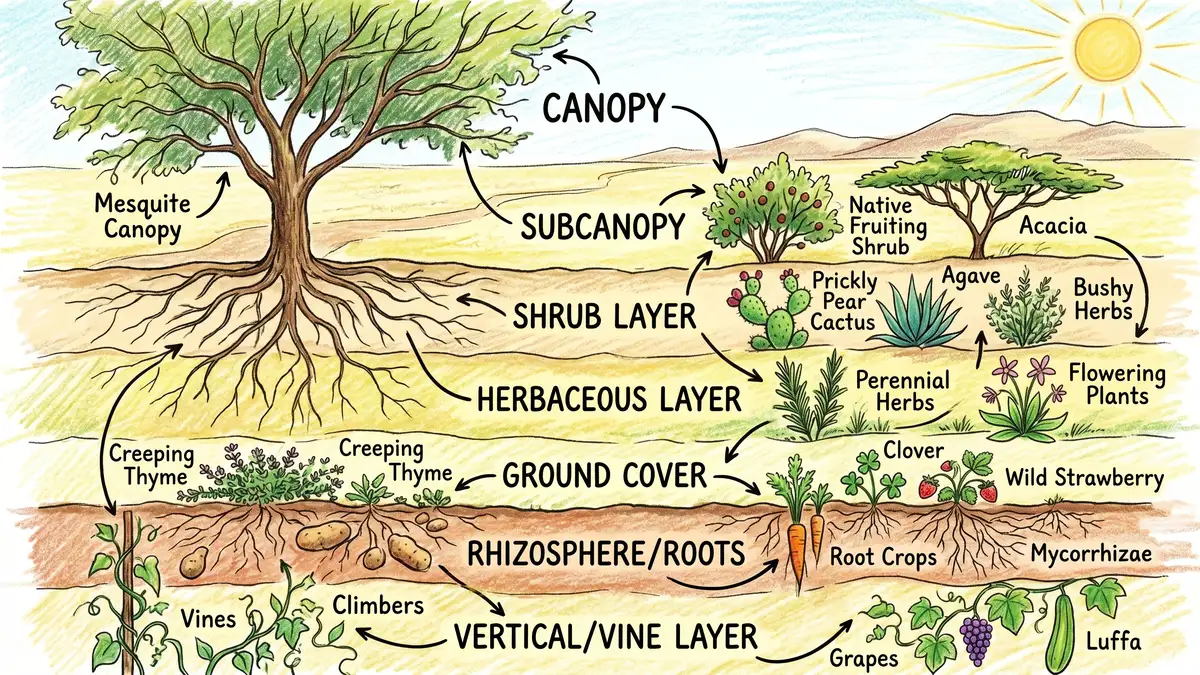
The classic 7-layer food forest model still applies, but the species change radically.
| Layer | US desert species | Function |
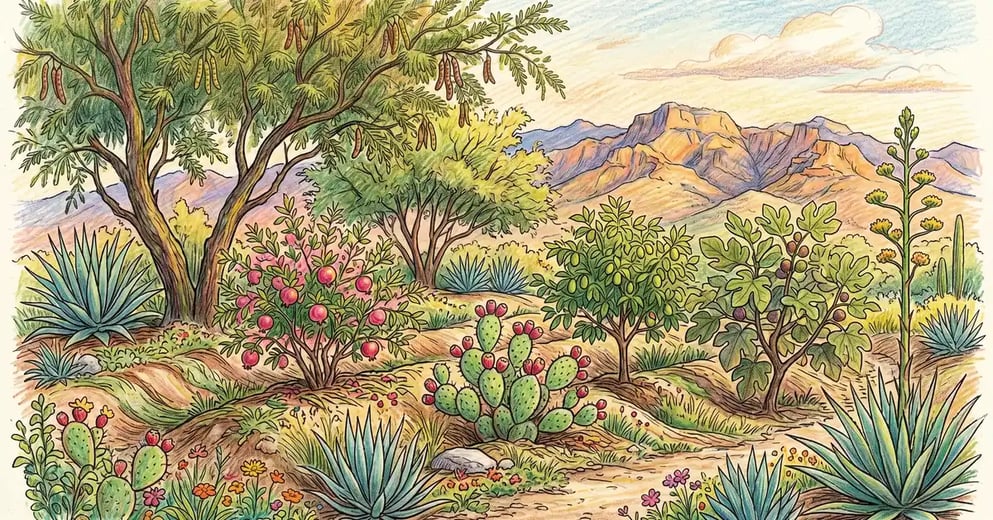
| Canopy | Velvet mesquite (Prosopis velutina), honey mesquite (P. glandulosa), carob, jujube, fig, pomegranate, native palo verde, ironwood | Nitrogen fixation, shade, edible pods or fruit |
| Understory tree | Low-chill peach, apricot, almond, Asian pear, Anna apple, date palm (zones 9 to 11) | Stone fruit and high-value harvest |
| Shrub | Olive, pomegranate, wolfberry, jojoba, hackberry, desert ironwood (young) | Wind protection, additional fruit, soil binding |
| Vine | Passionfruit (Passiflora spp), grape (Mission, Black Spanish), chayote in cool microclimates | Vertical fruit production on trellis or canopy |
| Herbaceous | Artichoke, asparagus, Egyptian walking onion, oregano, rosemary, thyme, lavender, agave (multiple species) | Edible greens and Mediterranean herbs |
| Ground | Chiltepin pepper, Tepary bean (Phaseolus acutifolius), devil's claw, native chia, amaranth, purslane | Living mulch, native edible coverage |
| Root | Jicama, sunchoke (with care), ground nut, prickly pear roots (medicinal) | Underground food storage |
Source: Brad Lancaster Tucson plantings; University of Arizona Cooperative Extension; Native Seeds/SEARCH species catalog.
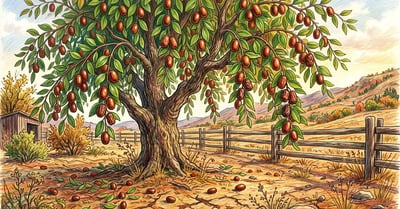
Mesquite is the keystone species. Three reasons: it fixes nitrogen (boosting fertility for everything around it), its pods are food (sweet flour, syrup), and its canopy creates the partial shade other fruit trees need to survive desert summers. The Tohono O'odham harvested mesquite as a staple food for centuries before colonization. A single mature mesquite can yield 50 to 200 lb of pods per year.
Native US Southwest food forest species
The most water-efficient desert food forest leans heavily on plants that evolved in your specific region. The Sonoran Desert Indigenous foodways tradition (Tohono O'odham, Akimel O'odham, Hia C-ed O'odham) gives the foundation:
- Mesquite: Pods ground for flour, syrup, beer. Nitrogen fixer. Tap roots go 50+ ft deep.
- Prickly pear (Opuntia spp): Edible pads (nopales) and fruit (tunas). Drought-proof. Adds organic matter.
- Saguaro: Fruit harvest (June-July, Tohono O'odham tradition). Long-lived structural anchor of the desert ecosystem.
- Cholla cactus: Buds harvested in spring, fruit later. Multiple species.
- Wolfberry (Lycium): Red berries, like a native goji. Drought-hardy shrub.
- Tepary bean (Phaseolus acutifolius): Native nitrogen-fixing legume. Yields with 4 to 8 in of summer rain.
- Devil's claw: Edible seeds and pods. Drought-tolerant ground layer.
- Chiltepin: Wild native chile pepper. Drought tolerant shrub.
- Amaranth and chia: Native annual seed crops that thrive in monsoon rains.
Native Seeds/SEARCH in Tucson is the seed bank for many of these. The Desert Botanical Garden in Phoenix and the Arizona-Sonora Desert Museum near Tucson curate living collections you can visit before deciding what to plant.
Case study 1: Greening the Desert (Jordan)
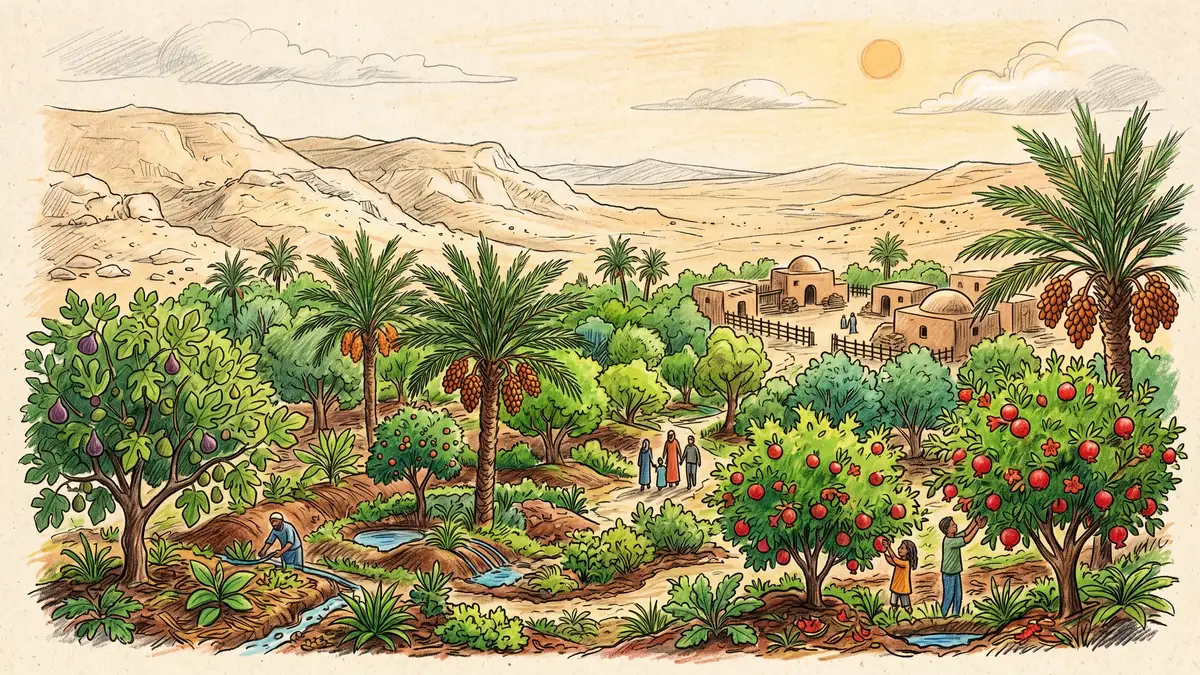
Australian permaculture teacher Geoff Lawton's 10-acre demonstration in the Wadi Rum area of Jordan is the world's most cited desert food forest case study. Site conditions: 2 in of annual rainfall, salty soil, no electricity grid, no piped water, no organic matter. Lawton's team built swales by hand, planted nitrogen-fixing legumes, then layered in figs, dates, pomegranates, and mulberries over 5 years.
Three lessons transfer directly to the US Southwest:
- Swales catch every drop of the rare rainfall. The 2 in of annual rainfall, captured into soil rather than allowed to run off, kept the trees alive without supplemental irrigation after year 3.
- Nitrogen-fixing canopy goes first. The team established acacia, mesquite (locally Prosopis cineraria), and tagasaste before any food trees. The food trees were then planted into the shade of the legumes.
- Heavy mulch was non-negotiable. The team built mulch wells 6 to 12 in deep around every tree using on-site woody material. Mulch reduced surface evaporation by 60 to 70 percent and built soil organic matter from near zero.
The transformation was filmed and is publicly available through the Permaculture Research Institute. After 5 years, the site produced figs, olives, pomegranates, dates, and vegetables, all on rainwater alone.
Case study 2: Brad Lancaster (Tucson)
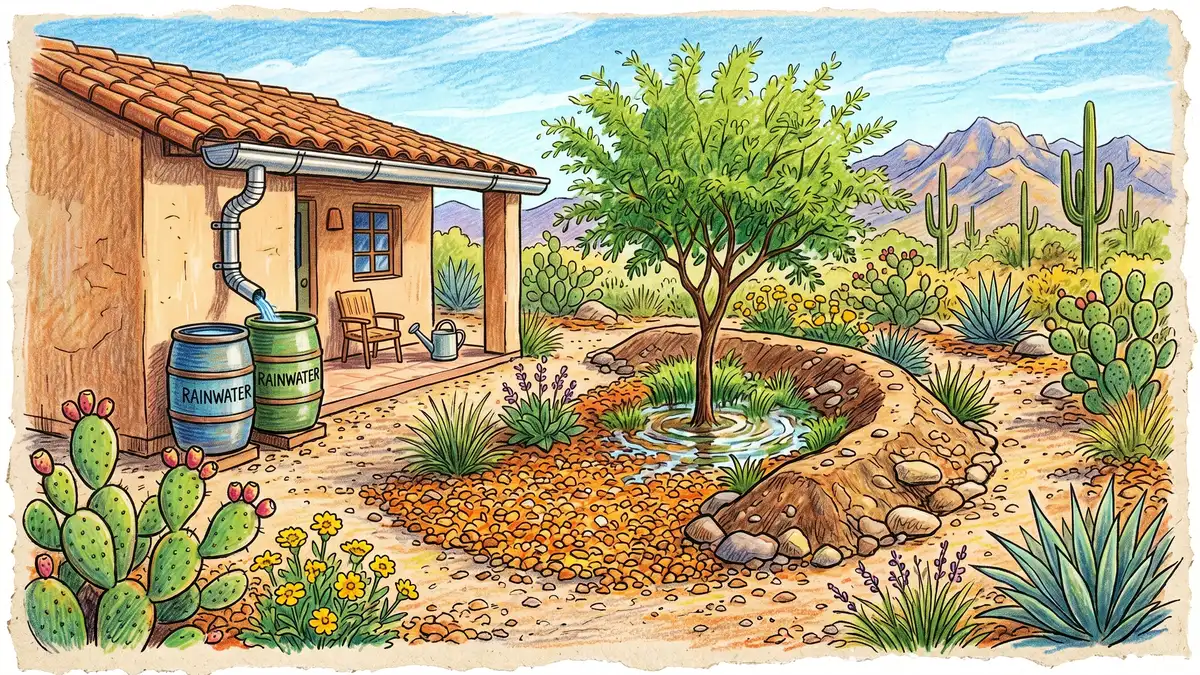
Brad Lancaster's 1/8 acre lot in Tucson is the most studied US desert permaculture site. Starting in the 1990s, Lancaster transformed a bare desert lot into a productive food forest using only on-site harvested water (rainwater from the roof and street) plus household greywater.
His "8 Principles of Successful Rainwater Harvesting" (from his book Rainwater Harvesting for Drylands and Beyond) are the operating manual for any US desert food forest:
- Begin with long and thoughtful observation. Watch the water flow on your site through a real storm.
- Start at the top of your watershed and work downhill.
- Start small and simple. One berm, one tree, one storm.
- Slow, spread, and sink the water. Never let it leave the site.
- Always plan an overflow route. Storms will exceed your earthworks at some point.
- Maximize living and organic groundcover. Bare soil bakes, mulched soil holds moisture.
- Maximize beneficial relationships and efficiency by stacking functions. Each plant should serve 3+ purposes.
- Continually reassess your system. Adapt over years as plants grow and rains shift.
Lancaster's lot now produces mesquite flour, olives, pomegranates, figs, citrus (in pockets), vegetables, and herbs from a system that uses no city water for the established trees. The street outside his lot was redesigned in collaboration with the city of Tucson to direct curb flow into right-of-way swales planted with shade trees, a model now copied throughout the Sonoran Desert.
The water plan over time
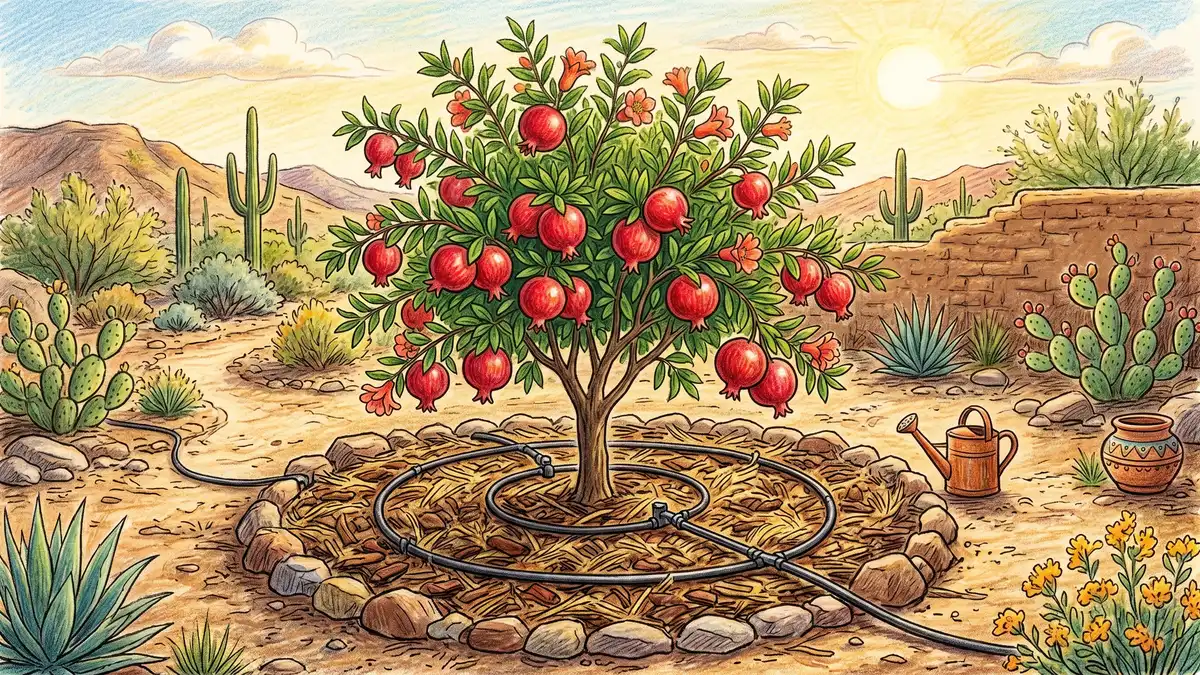
The amount of supplemental water a desert food forest needs decreases steeply over time as trees develop deep roots that tap into the soil moisture stored by swales and berms.
| Year | Watering frequency | Volume per young tree |
| Year 1 | Once or twice per week (May to September) | 5 to 10 gal per tree per watering |
| Year 2 | Once per week in heat, every 2 weeks in cool | 10 to 20 gal per tree per watering |
| Year 3 | Every 10 to 14 days | 15 to 30 gal per tree per watering |
| Year 4 | Every 2 to 3 weeks | 20 to 40 gal per tree per watering |
| Year 5+ | Every 3 to 4 weeks in extreme heat; rainfall and stored moisture otherwise | 30 to 60 gal per tree per watering or zero |
Source: Brad Lancaster watering schedule; University of Arizona Cooperative Extension water-wise tree care guides.
Three water sources reduce or eliminate the need for city water:
- Rainwater harvesting: Roof catchment with cistern overflow into landscape, plus earthworks across the yard. A 2,000 sq ft roof catches 1,200 gal per inch of rain.
- Greywater: Tucson Water utility allows direct landscape use of greywater from showers, washing machines, and bathroom sinks (not kitchen sinks). A family of 4 produces 70 to 130 gal of greywater per day, enough to irrigate 6 to 10 mature trees indefinitely.
- Storm runoff: Street curb cuts (legal in Tucson with permit) direct flowing water from the street into right-of-way swales planted with native trees.
Critical micro-climate moves
Desert summers crush new transplants. Three design moves dramatically increase establishment success:
- Shade cloth for years 1 to 3: 30 to 50 percent shade cloth strung over young trees in May to September. Removed once the canopy reaches enough size to self-shade.
- North and east aspect: Plant the most heat-sensitive species (fig, peach, apple) on the north and east sides of structures, large rocks, or established mesquite canopy. Reserve the south and west exposures for hardier species (jujube, pomegranate, prickly pear).
- Deep mulch: 6 to 12 in of woody mulch (wood chips, mesquite prunings) around every tree, kept clear of the trunk by 4 to 6 in. Mulch reduces surface evaporation by 60 to 70 percent and moderates soil temperature.
A realistic 5-year timeline
Year 1: earthworks and canopy
Survey the site through one full monsoon to see where water flows. Build the main swales and boomerang berms. Plant nitrogen-fixing canopy (mesquite, palo verde, ironwood). Install drip irrigation as a backup. Mulch everything.
Year 2: shrub layer and earthworks refinement
Add pomegranate, olive, jojoba, wolfberry as the shrub layer. Watch your earthworks through the next monsoon and adjust where water did not infiltrate. Begin connecting greywater from the house if not already done.
Year 3: understory fruit trees
Plant low-chill peach, apricot, fig, jujube into the partial shade of the established nitrogen fixers. These need the shade and the nitrogen the mesquite has been depositing.
Year 4: herbaceous and ground layer
Fill the bed beneath trees with artichoke, asparagus, rosemary, oregano, thyme, agave, and the native ground layer (tepary bean, chiltepin, devil's claw).
Year 5+: mature production
Mesquite pods, pomegranates, figs, peach, jujube, olive, prickly pear all producing. Begin tapering city water. Monitor and adjust over time as climate and the system evolve.
Regional adaptations
The general design works across all four US desert regions but the species and timing shift:
- Sonoran (Tucson, Phoenix): Mesquite, palo verde, ironwood as canopy. Fig, peach, jujube, pomegranate as understory. The richest native species pool of any US desert.
- Mojave (Las Vegas, Palm Springs): Date palms thrive here. Fig, pomegranate, jujube also work. Lower rainfall (4 to 6 in) means more emphasis on greywater and stored cistern water.
- Chihuahuan (El Paso, southern NM): Slightly more summer rain than other US deserts. Add chile peppers (heritage cultivars from Native Seeds/SEARCH), nopales, mesquite, jujube.
- High desert / Colorado Plateau: Cooler nights expand the species range to apple, plum, sweet cherry (low-chill varieties), as well as the standard desert species.
Get the Weekly Dig
One practical permaculture guide a week, written for gardeners who do this on weekends: food forest and guild designs that produce. Free, no spam, unsubscribe any time.
Join the Weekly DigFAQ
What is a desert food forest?
A desert food forest is a multi-strata edible perennial system designed for arid climates with 5 to 15 in annual rainfall, supplemented by earthworks (swales, berms) that catch and store rainwater in soil rather than tanks. The system mimics native desert woodland succession and uses 20 to 50 percent of the water of a conventional fruit orchard once established.
Can you grow a food forest in the desert?
Yes. Geoff Lawton's Greening the Desert demonstration in Jordan (2 in annual rainfall) and Brad Lancaster's Tucson lot (12 in annual rainfall) both prove the concept at the small to medium scale. The key is to build the rainwater earthworks before planting and to lead with nitrogen-fixing canopy species (mesquite, palo verde, acacia) that build soil and shade for fruit trees.
What are the best fruit trees for the desert?
Drought-tolerant and heat-tolerant species include: pomegranate, fig, jujube, low-chill peach (300 to 500 chill hours), almond, olive, mulberry, date palm (warm desert only), Anna apple, Asian pear, and low-chill apricot. Mesquite is the most water-efficient food tree of all, producing 50 to 200 lb of edible pods per year on essentially zero supplemental water once mature.
How much water does a desert food forest use?
Once established (year 5+), a properly designed desert food forest uses 20 to 50 percent of the water a conventional fruit orchard uses. A 1/4 acre desert food forest in Tucson can be maintained on harvested rainwater plus household greywater for established trees, with city water needed only for new plantings and during multi-year drought.
What is the Greening the Desert project?
Geoff Lawton's permaculture demonstration on 10 acres of degraded land in the Wadi Rum area of Jordan, starting in 2001. The site has 2 in of annual rainfall and salty soil. Using swales, nitrogen-fixing trees, and heavy mulch, Lawton's team transformed it into a producing food forest of figs, dates, pomegranates, olives, and vegetables within 5 years. The transformation is documented in films available through the Permaculture Research Institute.
Who is Brad Lancaster?
Brad Lancaster is a Tucson, Arizona permaculture practitioner and author of Rainwater Harvesting for Drylands and Beyond. He transformed his 1/8 acre lot from bare desert into a productive food forest using only harvested rainwater and household greywater. His "8 Principles of Successful Rainwater Harvesting" are the operating manual for US Southwest desert permaculture.
How long does it take to establish a desert food forest?
5 to 8 years from bare site to a mature, low-water producing system. Year 1 to 2 build earthworks and canopy nitrogen fixers. Year 3 to 4 add understory fruit trees and shrubs. Year 5+ taper supplemental water as roots tap stored swale moisture. The food forest then produces for 30+ years with minimal inputs.
Can I use greywater for a desert food forest?
Yes, and in Arizona and many Southwest states it is legal and encouraged. Tucson Water utility allows direct landscape use of greywater from showers, washing machines, and bathroom sinks (not kitchen sinks or toilets). A typical 4-person household produces 70 to 130 gal of greywater per day, enough to irrigate 6 to 10 mature fruit trees indefinitely.
Resources
- Brad Lancaster: 8 Principles of Successful Rainwater Harvesting
- Permaculture Research Institute: Greening the Desert Project Update
- University of Arizona Cooperative Extension: Low-Water-Use Plants for Southern Arizona
- Native Seeds/SEARCH: Sonoran Desert Native Seed Collection
- Arizona-Sonora Desert Museum: Desert Plant List
- New Mexico State Extension: Backyard Orchards in New Mexico
- USDA-NRCS: Agroforestry and Silvopasture (Southwest applications)