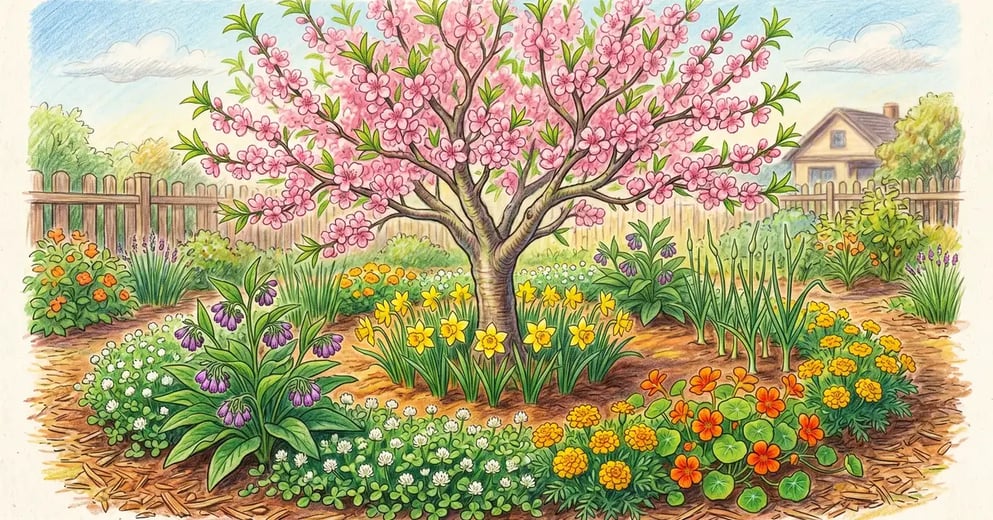

A peach tree guild is a ring of companion plants that does four jobs the tree cannot do for itself: garlic and chives in a band at the trunk against peach tree borer, daffodil bulbs at the drip line against rodents and deer, two comfrey crowns for chop-and-drop mulch, and white clover across the understory for nitrogen. Keep raspberries, blackberries, tomatoes, peppers and potatoes out of the ring altogether, because they carry the same Verticillium wilt your peach does. The spacing is what makes it work, and most of it sits closer to the trunk than people expect.
Most backyard peaches go into a tidy patch of grass and then spend every spring fighting leaf curl and borers. The fix is not another spray. It is what grows around the tree. If yours is a cherry rather than a peach, the same pattern applies on a tighter radius: see what to plant under a cherry tree.
Quick takeaway
The proven backyard peach guild is a ring of garlic and chives at the trunk (alliums against borer and fungal disease), a ring of daffodil bulbs at the drip line (rodent and deer deterrent), comfrey at two o'clock and ten o'clock positions for chop-and-drop mulch, white clover or crimson clover as ground cover (nitrogen fixation), and a perimeter of nasturtium, marigold, and yarrow for pest control and pollinators. Avoid raspberries, blackberries, tomatoes, peppers, and potatoes anywhere near the tree because they share Verticillium wilt.
What is a peach tree guild?
A guild is a deliberate community of plants grown around a central fruit tree so each plant performs at least one function for the system. Bill Mollison and David Holmgren formalized the concept in the 1978 Permaculture One, but the underlying pattern (companion-planted orchards) appears in traditional Asian, European, and Indigenous American agriculture going back centuries. For a peach tree (Prunus persica), the guild solves three structural problems mainstream backyard planting ignores: pest pressure, soil fertility cycling, and pollinator timing for an early bloomer that flowers when little else is in flower.
For a deeper introduction to the framework, read our 12 permaculture principles explained with garden examples, which sets up why the guild pattern works at all.
The 7 layers of a peach tree guild
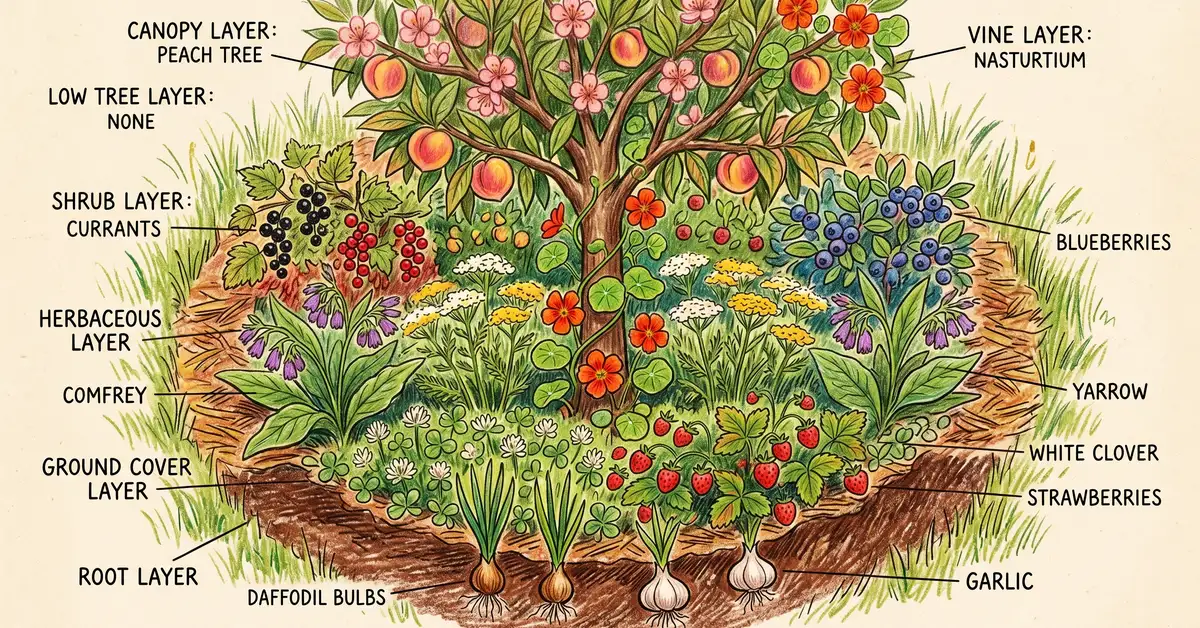
A full food-forest guild has seven vertical layers. A backyard peach tree, which tops out at about 15 ft (4.6 m), uses a simplified version because the canopy is lower than a standard fruit forest.
Canopy layer: the peach tree itself
Semi-dwarf peach trees (8 to 12 ft / 2.4 to 3.7 m) are easier to manage in a guild than standards. Stark Bro's Reliance, Contender, and Redhaven are widely planted in the Midwest and Mid-Atlantic for cold hardiness.
Shrub layer: blueberries or currants at the perimeter
Plant at 6 to 8 ft (1.8 to 2.4 m) from the trunk so they sit just outside the drip line. They share no major peach diseases. Skip raspberries and blackberries because they harbor Verticillium wilt that devastates peaches (NC State Extension).
Herbaceous layer: comfrey, yarrow, dill, fennel
Comfrey (Symphytum officinale) at two and ten o'clock positions 3 ft (90 cm) from the trunk. Cut twice per season and drop the leaves as mulch. Yarrow, dill, and fennel umbel flowers feed parasitic wasps that control oriental fruit moth and peach twig borer.
Ground cover: white clover or crimson clover
Replaces the grass lawn that competes with the tree for water and nitrogen. Clover fixes 50 to 150 lb of nitrogen per acre per year (22 to 67 kg per ha) according to USDA NRCS, while sheltering soil and feeding pollinators.
Root layer: daffodils and garlic
Daffodil bulbs (Narcissus) in a ring at the drip line. The lycorine alkaloid in the bulbs deters voles, mice, and rabbits. Plant 30 to 50 bulbs per mature tree in fall, 4 inches (10 cm) deep, 6 inches (15 cm) apart.
Vine layer: nasturtium (annual, optional)
Nasturtium (Tropaeolum majus) is technically herbaceous but trails like a vine. Sow seeds at the drip line after last frost. Acts as an aphid decoy that pulls aphids away from the peach foliage.
Edge layer: pollinator strip
A 3 ft (90 cm) strip of marigolds (Tagetes patula), borage, alyssum, and tansy along the outer edge of the guild. Marigolds suppress root-knot nematodes (Cornell research showed 70 to 90 percent reduction in subsequent crops). The flowers feed bees, hoverflies, and the parasitic wasps that control peach twig borer.
Why this works (the permaculture angle)
Each plant fills at least two roles. Comfrey is mulch and fertilizer and pollinator food. Clover is ground cover and nitrogen fixer and pollinator food. Daffodils are spring color and rodent deterrent. The Stefan Sobkowiak Permaculture Orchard (Miracle Farms, Quebec) operationalizes this at commercial scale with documented yields matching conventional orchards using zero synthetic fertilizer or fungicide after year 3.
The 12 best companion plants for peach trees
| Plant | Primary function | Where to plant |
| Garlic, chives, onions | Sulfur compounds deter peach tree borer and fungal disease | Ring at trunk, 12 to 18 in (30 to 45 cm) from bark |
| Comfrey | Dynamic accumulator (K, Ca), chop-and-drop mulch | Two plants 3 ft (90 cm) from trunk |
| White or crimson clover | Nitrogen fixation, ground cover, pollinator food | Broadcast as understory carpet |
| Daffodils | Rodent and rabbit deterrent (lycorine), early bloom | Bulb ring at drip line |
| Nasturtium | Aphid decoy, edible flowers and leaves | Drip line, replant annually |
| Marigolds (Tagetes patula) | Root-knot nematode suppression (alpha-terthienyl) | Edge ring, replant annually |
| Yarrow | Beneficial insect food, dynamic accumulator | Two or three plants at edge |
| Dill, fennel, coriander | Umbel flowers feed parasitic wasps | Edge of guild, allow to flower |
| Borage | Pollinator magnet during peach bloom | Two plants at edge |
| Tansy | Fly and ant deterrent (controversial, see below) | Edge only, never inside guild |
| Strawberries | Edible ground cover, harvest in June | Sunny edge of drip line |
| Sweet alyssum | Hoverfly food, ground cover | Throughout edge ring |
Sources: Penn State Extension, Cornell Fruit Resources, UMass IPM, USDA NRCS conservation cover guidance.
The protective allium ring
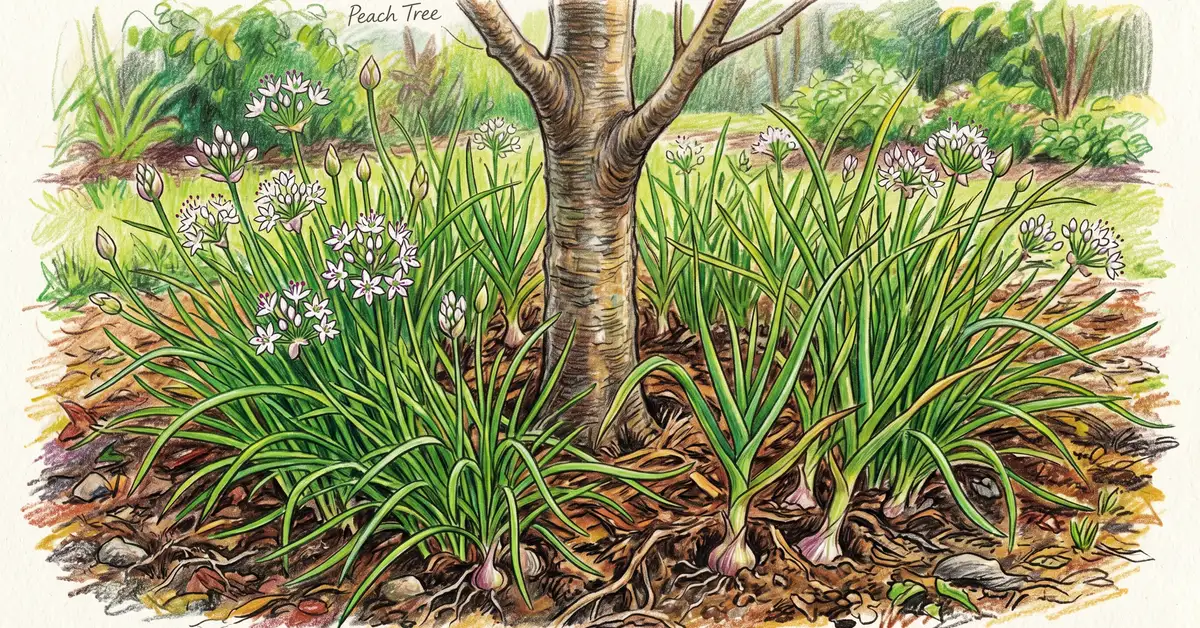
If you do only one thing from this guide, plant the allium ring. A 12 inch (30 cm) wide band of garlic and chives planted 12 to 18 inches (30 to 45 cm) out from the trunk does two jobs at once. The sulfur compounds released by alliums (allicin and related thiosulfinates) disrupt the chemical cues that adult peach tree borer moths (Synanthedon exitiosa) use to find the trunk for egg-laying. The same compounds suppress the fungal spores that cause peach leaf curl when rain splashes them up onto the lower branches.
Penn State Extension lists peachtree borer as the most damaging single pest of backyard peaches, capable of killing a young tree within two seasons of infestation. Avoiding bark damage and applying mulch only away from the trunk (no volcano mulching) is the second prevention layer. The allium ring is the first.
Plant garlic cloves in October at 3 inch (7.6 cm) spacing. Plant chives any time. Leave both in place permanently. Harvest garlic green tops in spring; let some bulbs flower for pollinators.
The daffodil bulb ring
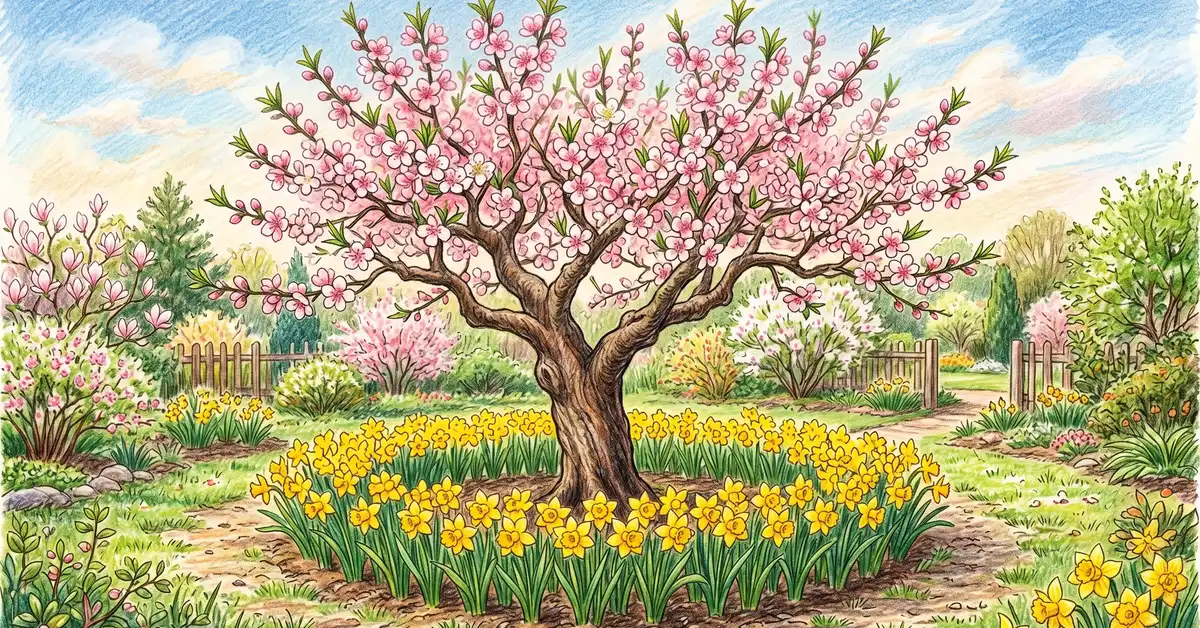
Voles and mice girdle young peach trees by gnawing the bark at the soil line during winter. A solid ring of daffodil bulbs at the drip line creates a chemical barrier rodents will not cross. The lycorine alkaloid in Narcissus tissue is acutely toxic to small mammals, and they learn to avoid it within one or two exposures.
The daffodil ring has a second job. Peach blooms in February to April depending on US zone, weeks before most pollinators have built population. Daffodils bloom in the same window and feed early bumblebees and solitary bees that then move to the peach flowers. The yellow color of daffodils also visually signals the bloom zone to bees flying over.
Plant 30 to 50 bulbs per mature tree in October, 4 inches (10 cm) deep, 6 inches (15 cm) on center. Skip the small daffodils. Plant true daffodils (King Alfred, Ice Follies, Carlton) for size and lycorine content. Tulips do not work because they lack lycorine and squirrels eat the bulbs.
Comfrey: the dynamic accumulator
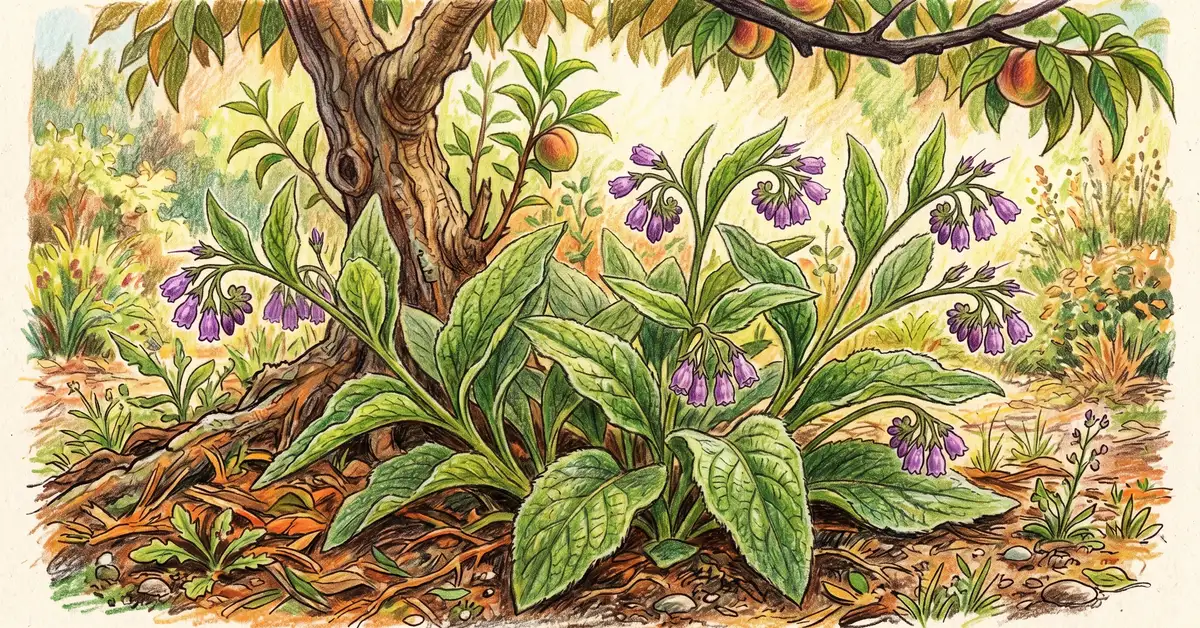
Comfrey (Symphytum officinale or the sterile Bocking 14 cultivar) sends a taproot 6 to 10 ft (1.8 to 3 m) deep and pulls potassium, calcium, magnesium, and trace minerals up from the subsoil. The Russian comfrey Bocking 14 is the preferred cultivar because it produces high biomass but does not seed (regular comfrey can become weedy).
Plant two comfrey crowns 3 ft (90 cm) from the trunk on the south or sun-facing side of the tree. Cut at the base three to four times per season when stems reach 18 inches (45 cm) and drop the cut foliage as mulch directly under the peach drip line. The high-potassium leaves break down within 4 to 6 weeks and feed the tree at the exact moment it needs potassium for fruit development.
Penn State Extension reports that mature comfrey produces 15 to 25 lb (6.8 to 11.3 kg) of cut biomass per plant per season. Two plants per peach tree supplies roughly half the tree's potassium needs without any imported fertilizer.
What NOT to plant near a peach tree
Avoid these plants within 25 ft (7.6 m) of a peach tree
Raspberries, blackberries, and brambles share Verticillium wilt with peaches. Tomatoes, peppers, eggplant, and potatoes share Verticillium and several fungal pathogens. Black walnut (Juglans nigra) releases juglone toxin that kills peaches within two years even at 50 ft (15 m) distance. Aggressive grasses like Kentucky bluegrass and Bermuda grass compete heavily for water and nitrogen. Other stone fruits (cherry, plum, apricot, almond) within 18 ft (5.5 m) compete for the same root zone and share peach tree borer, oriental fruit moth, and brown rot pressure.
One controversial entry: tansy. Older permaculture literature recommends tansy as a fly and ant deterrent. Newer research (NC State Extension) flags tansy as mildly allelopathic to peach roots when planted within 4 ft (1.2 m). Plant tansy only at the outer edge of the guild, never inside the drip line.
Spacing and layout for a single peach tree
A standard semi-dwarf peach reaches 12 ft (3.7 m) wide. Map the guild as concentric rings around the trunk:
| Zone | Distance from trunk | Plants |
| Trunk ring | 0 to 6 in (0 to 15 cm) | Bare soil only. No mulch volcano. No plants touching bark. |
| Allium ring | 12 to 18 in (30 to 45 cm) | Garlic, chives, onions in a continuous band |
| Inner ring | 2 to 4 ft (60 to 120 cm) | Comfrey, white clover ground cover |
| Drip line ring | 4 to 6 ft (120 to 180 cm) | Daffodil bulbs, nasturtium, strawberries |
| Edge ring | 6 to 10 ft (180 to 300 cm) | Yarrow, dill, marigold, borage, alyssum, blueberries |
Sources: Cornell Fruit Resources, Penn State Extension home fruit planting, Stark Bro's permaculture fruit tree guild.
Year-by-year buildout plan
Established guilds take three seasons to mature. Build in stages rather than all at once.
Before any of it goes in, deal with the sod. Lawn grass at the drip line competes hard for water and nitrogen, and a rotary tiller that close to a young peach shreds the feeder roots the tree needs most. Loosen the ring with a fork that lifts without inverting, then plant straight into it. Our broadfork picks by garden size covers which tine width suits a planting ring of 6 ft (1.8 m) or so.
Year 1 (planting year): Plant the peach. Add the garlic/chive allium ring immediately. Broadcast white clover seed under the canopy. Add 30 daffodil bulbs at the drip line in October. Sow nasturtium and marigold seeds at the drip line in spring. That is enough for year 1.
Year 2: Add two comfrey crowns. Add yarrow, dill, and fennel at the edge. Start cutting and dropping comfrey foliage as mulch when stems reach 18 inches.
Year 3: Add blueberries or currants at the perimeter (6 to 8 ft from trunk). Add strawberries as ground cover at the sunny edge. By the end of year 3, the system needs almost no external inputs.
For more on building the broader food forest around the peach guild, read our guide on how to start a food forest step by step for beginners.
Pest and disease pressure managed by the guild
Backyard peaches face four major pest and disease pressures. The guild reduces each substantially without sprays.
Peach leaf curl (Taphrina deformans)
Allium ring reduces splash-up of fungal spores from the soil during spring rains. Penn State Extension still recommends a dormant copper spray once per year for severe pressure, but the allium ring meaningfully reduces fungal load.
Peach tree borer (Synanthedon exitiosa)
The most damaging backyard pest. Allium ring at the trunk plus clean mulch zone (no bark damage, no volcano mulching) reduces borer establishment by 60 to 80 percent in trials at UMass IPM and Penn State Extension.
Brown rot (Monilinia fructicola)
Yarrow, dill, and fennel umbel flowers feed Trichogramma and Macrocentrus parasitic wasps that control oriental fruit moth, the main vector that opens wounds for brown rot. Daily harvest of ripe fruit (no fallen fruit) is still required.
Oriental fruit moth (Grapholita molesta)
Edge plantings of dill, fennel, and yarrow attract parasitic wasps. Nasturtium serves as aphid decoy. Pheromone mating disruption (commercially available as twist ties) is more effective than companion planting alone for heavy pressure.
Get the Weekly Dig
One practical permaculture guide a week, written for gardeners who do this on weekends: food forest and guild designs that produce. Free, no spam, unsubscribe any time.
Join the Weekly DigCross-fruit guilds: multi-stone-fruit blocks
If you have space for two or three stone fruit trees (peach, plum, apricot, sweet cherry), plant them at 18 to 20 ft (5.5 to 6.1 m) on center with shared edge plantings between the trees. Each tree gets its own allium ring at the trunk. Comfrey, clover, and pollinator strips can shared across the cluster. This pattern (a stone fruit "block" sharing pollinator infrastructure) is the foundation of Sobkowiak's Miracle Farms commercial permaculture orchard model in Quebec.
Avoid pairing peach with apple, pear, or quince in the same block because they share fire blight risk and need different spray schedules. Apples and pears go in their own block, ideally 30 ft (9 m) away from the stone fruit cluster.
Frequently asked questions
What is the best companion plant for a peach tree?
Garlic planted in a ring 12 to 18 inches (30 to 45 cm) from the trunk. The sulfur compounds in garlic and other alliums (chives, onions) deter peach tree borer egg-laying and suppress peach leaf curl fungal spores. Garlic is the single highest-impact companion if you only have time for one.
What should you not plant near a peach tree?
Raspberries, blackberries, and brambles (shared Verticillium wilt). Tomatoes, peppers, eggplant, and potatoes (shared Verticillium). Black walnut (juglone toxin kills peaches even at 50 ft / 15 m). Aggressive lawn grasses like Kentucky bluegrass. Other stone fruits within 18 ft (5.5 m) of trunk.
Can I plant fruit trees next to each other?
Yes, with rules. Peach, plum, apricot, and sweet cherry pair well at 18 to 20 ft (5.5 to 6.1 m) on center. Apple and pear pair well together at similar spacing. Do not mix stone fruit and pome fruit (apple/pear) within 30 ft (9 m) because they need different spray schedules and have different disease profiles.
What flowers should I plant under a peach tree?
Daffodils in a ring at the drip line (30 to 50 bulbs per mature tree) for rodent deterrent and early pollinator support. Nasturtium and marigold seeded in spring at the drip line for aphid trapping and nematode suppression. Borage and sweet alyssum at the edge for bee support during the early peach bloom.
Why does my peach tree get peach leaf curl every year?
Peach leaf curl (Taphrina deformans) overwinters on the bark and infects new leaves during cool wet springs. An allium ring reduces splash-up of fungal spores. Penn State Extension and UC IPM recommend a single dormant copper spray in late January or early February for severe cases, applied before bud swell.
Do peach trees need pollinators or are they self-fertile?
Most peach varieties are self-fertile, meaning one tree can fruit alone. But yields rise 20 to 40 percent with bee visits during the early February to April bloom. Daffodils, crocus, and early-flowering herbs in the guild bring bees on site weeks before peach blooms open.
How far should companions be from the peach tree trunk?
The trunk area (0 to 6 inches / 0 to 15 cm) stays bare. Alliums sit at 12 to 18 inches (30 to 45 cm). Comfrey and clover fill the 2 to 4 ft (60 to 120 cm) zone. Daffodils, nasturtium, and strawberries go at the drip line (4 to 6 ft / 120 to 180 cm). The edge ring with marigold, yarrow, and dill sits at 6 to 10 ft (180 to 300 cm).
Do I still need to spray a peach tree with a guild?
For organic backyards in most US zones, a single dormant copper application in late winter handles peach leaf curl. The guild handles most other pressures. Heavy oriental fruit moth pressure may still warrant pheromone disruption ties. Spraying schedules are dramatically reduced compared to conventional management.
Do coffee grounds help peach trees?
Composted, yes. Spread raw, no. Used grounds come out close to neutral (pH 6.5 to 6.8), so they will not acidify anything, and laid on thicker than about half an inch (1 cm) they mat into a crust that sheds water instead of letting it through. Peaches want pH 6.0 to 6.5 and steady nitrogen, and the clover understory already supplies the nitrogen. Put the grounds through the compost heap, then spread the finished compost at the drip line.
How many years until a peach tree bears fruit?
Two to four years from a bare-root nursery tree, with the first real crop usually in year three. A tree grown from a pit takes four to six years and will not come true to the parent variety. The guild does not speed up first fruiting. What it does is stop years three onward being lost to borer and leaf curl.
Resources
- Penn State Extension: Peachtree Borer
- Penn State Extension: Peachtree Borer in Home Fruit Planting
- UMass IPM: Synanthedon exitiosa Peachtree Borer
- Colorado State University Extension: Peachtree Borer
- Stark Bro's: How to Build a Permaculture Fruit Tree Guild
- The Giving Grove: Identify and Treat Greater Peach Tree Borer
- Gardenia: Best Peach Companion Plants and Ones to Avoid