
 sack gardens and vertical growing best plants for window boxes growing vegetables vertically
Your balcony has 50 square feet, a tomato plant in a pot, and zero spare room for a second crop. The good news: that one pot can hold three crops at once if you pick the right companions. Container companion planting is not the same as in-ground companion planting, because root competition inside a fixed volume of potting mix changes the rules. Get the pairing wrong and both plants stunt. Get it right and a single 18-inch pot produces tomatoes, basil, and lettuce all summer.
This guide gives you five proven container combinations, the pot sizes they need, the watering and feeding rhythm to keep them productive, and the combinations to avoid. Everything here comes from horticultural extension trials and peer-reviewed intercropping research, adapted for a balcony, patio, or windowsill.
Key takeaway
Container companion planting works when three things line up: identical watering schedules, complementary root depths, and matching light needs. Mismatch any one and the weaker plant collapses. Match all three and a single 5-gallon pot can produce two to three crops at once.
Why container companion planting follows different rules
In a raised bed or in-ground garden, roots can reach down 24 to 36 inches and pull moisture from depth. In a pot, every root is competing inside the same six to twelve inches of mix. The Royal Horticultural Society points out that plants in containers need more watering and feeding than those in the ground, because there is simply less soil to draw from. Add a second plant and you double the demand on a fixed resource.
That constraint flips the priority order for matching partners. In a bed, the question is "does plant A repel pests that bother plant B?" In a pot, the first question is "do they want the same amount of water on the same day?" If the answer is no, no amount of pest synergy will save them. Basil and rosemary illustrate this perfectly. Both are Mediterranean herbs that share garden zones happily, but in a single pot rosemary rots when you water for basil's needs, and basil wilts when you let rosemary dry between waterings.
The thriller-filler-spiller framework, applied to edibles
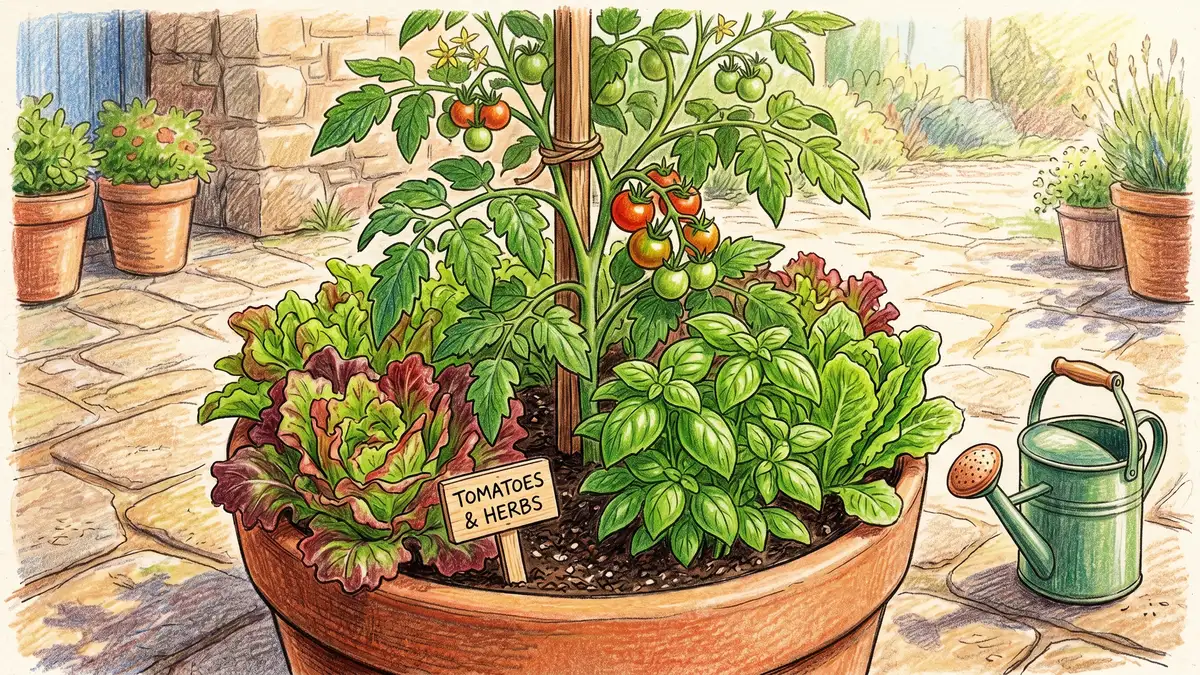
Extension services across the United States and the UK use a three-tier design that solves root competition before it starts. The University of California Cooperative Extension describes the pattern this way: a tall central plant (the thriller), medium plants filling around it (fillers), and trailing plants spilling over the edge (spillers) create an attractively-planted container whose companions also share a mutually beneficial relationship.
The reason this matters for edibles: each tier occupies a different soil zone. The thriller's roots dominate the center. Fillers fill the middle ring. Spillers run their roots in the upper outer layer where moisture cycles fastest. Stack plants this way and they compete less for the same physical soil. Stack them at the same depth and they compete for everything.
Why this works (the permaculture lens)
Thriller-filler-spiller is a vertical guild compressed into one pot. It applies the same principle as a forest edge: tall canopy, mid-story shrubs, ground-cover layer. Each layer occupies a distinct niche of light, root depth, and microclimate. The pot is a tiny ecosystem when you design it that way.
Five proven container combinations
These are the trios that show up repeatedly in trials at Texas A&M's AgriLife extension, Iowa State, Penn State, and EarthBox's commercial container research. Each is matched for water, nutrients, and light.
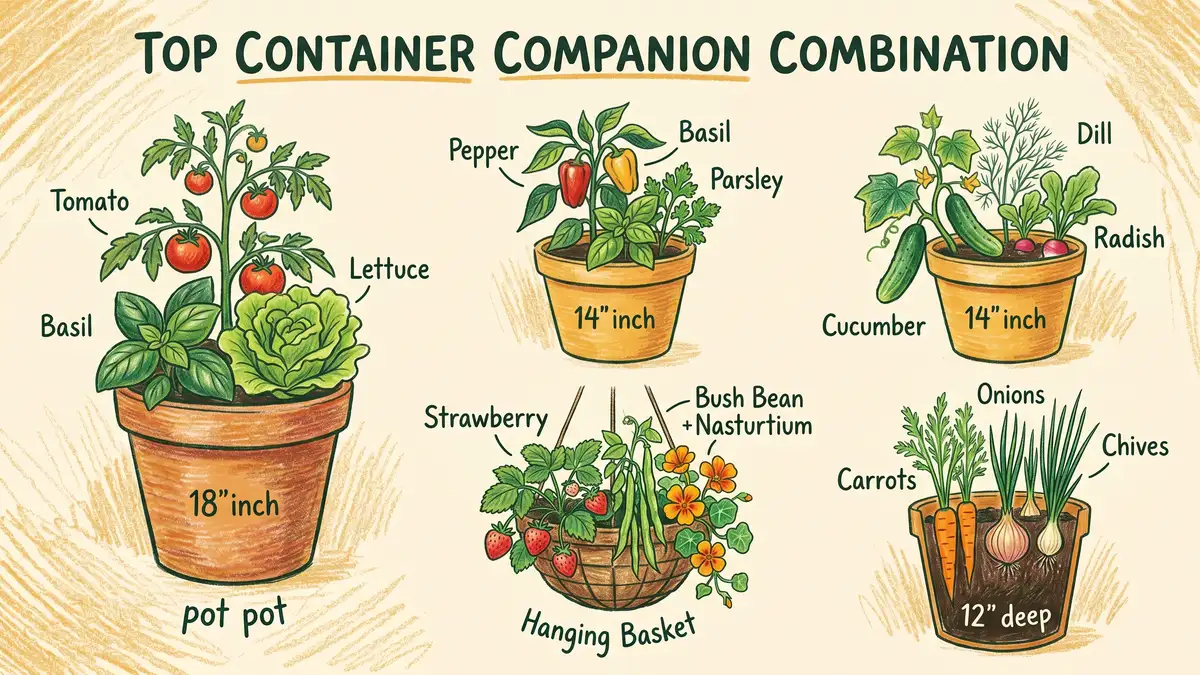
Tomato + Basil + Lettuce (18-inch / 5-gal pot)
One determinate or patio tomato (Patio Princess, Celebrity, or Bush Early Girl), one bush basil plant tucked at the base, and two or three loose-leaf lettuce plants around the rim. Tomato is the thriller, basil the filler, lettuce the spiller. All three want full sun, daily watering in summer, and moderate feeding. Lettuce finishes by July and gives the tomato more root space for fruiting. LSU AgCenter trials of twelve container tomato cultivars show Italian Ice, Patio Princess, and Health Kick as the top producers by fruit count in 3-gallon pots.
Pepper + Basil + Parsley (14-inch / 3–5 gal pot)
One bell or chili pepper as thriller, three bush basil plants as filler, parsley around the rim. All three tolerate partial shade better than tomatoes, making this the right trio for east- or west-facing balconies that get four to six hours of sun. The EarthBox container system documents 1 pepper plus 3 basil as a standard configuration, and adds parsley as a flexible fourth.
Cucumber + Dill + Radish (14-inch pot with trellis)
This is the time-staggered trio. Sow radish seed on day one. Sow dill the same day. Transplant a bush cucumber once the last frost is past. Radishes finish in 30 to 45 days and you pull them, freeing soil for the cucumber to fill out. Dill flowers attract hoverflies that prey on cucumber-beetle eggs, and cucumber climbs the trellis instead of sprawling. The Farmers' Almanac companion planting guide notes cucumbers distract beetles that would otherwise feed on radishes.
Strawberry + Bush Bean + Nasturtium (hanging basket or 7-gal tub)
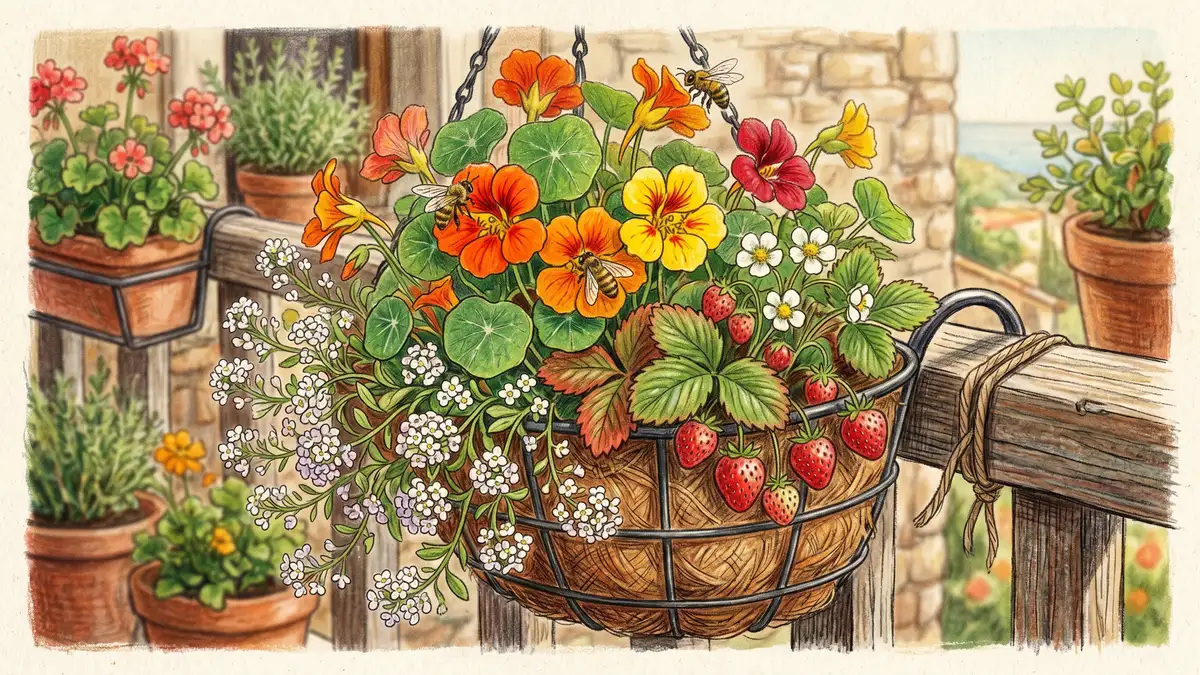
Bush bean fixes nitrogen for the strawberry. Strawberry's runners cascade over the edge as the spiller. Nasturtium is the third spiller and a trap crop: aphids hit the nasturtium before they reach the strawberry. The RHS confirms nasturtium leaves, flowers, and seed pods are all edible, so the trap crop is also a salad.
Carrot + Onion (or Leek) + Chives (12-inch deep pot)
The pest-management classic, sized down for containers. Pick a short-rooted carrot variety like Thumbelina, Little Finger, or Paris Market that only needs 6 to 8 inches of depth. Onions and chives mask the carrot's volatile signals that carrot root fly uses to find its target. BBC Gardeners' World documents alliums as a reliable olfactory deterrent against this pest.
Pot size, soil depth, and the math of root competition
Container size is the first lever to pull. The peer-reviewed literature on intercropping shows that high-proportion intercropping treatments in restricted volumes did not increase yield over single-species cultivation, because root competition outweighed the companion benefit. The translation for a pot: undersized containers cancel the companion advantage. The fix is straightforward.
| Combination | Minimum size | Best size | Depth needed |
| Tomato + basil + lettuce | 5 gallons (18 inches) | 7–10 gallons | 14 inches |
| Pepper + basil + parsley | 3 gallons (14 inches) | 5 gallons | 12 inches |
| Cucumber + dill + radish | 5 gallons (with trellis) | 7 gallons | 14 inches |
| Strawberry + bean + nasturtium | 5 gallons / 14-inch basket | 7 gallons | 10 inches |
| Carrot + onion + chives | 3 gallons (12 inches) | 5 gallons, shallow-wide | 10–12 inches |
Source: San Diego Seed Company container size chart and Texas A&M AgriLife: Vegetable Gardening in Containers.
Match the pot to the deepest-rooted plant in the trio. Vegetables fall into three root-depth groups: shallow (lettuce, radish, chives, basil) at 12 to 18 inches; medium (peppers, beans, chard) at 18 to 24 inches; deep (tomatoes, eggplant, carrots of full size) at 24 inches or more. In a pot you cannot deliver the deep group's full preferred depth, so you trade with dwarf or determinate varieties. Container-specific potting mix (not garden soil) is essential here; a fresh look at composting in an apartment shows why incorporating bokashi or worm castings into peat-free mix raises water retention and slow-release nutrients without compacting the pot.
Watering and feeding: the rhythm that keeps trios alive
The single biggest reason container companions fail is irregular watering. A pot drains within 24 to 48 hours in summer. Two or three plants in the same pot accelerate that timeline. University of Minnesota Extension recommends checking daily in hot weather and twice daily for hanging baskets, then feeding every two to four weeks with a soluble balanced fertilizer.
The mechanism: every time you water, soluble nitrogen leaches out the drainage holes. Container mix has no reservoir of soil-bound minerals like in-ground soil does. Skip a feeding and the leaves yellow within a fortnight. Stick to the cadence and a 5-gallon pot supports a tomato-basil-lettuce trio from late spring through first frost.
For mixed plantings, water to the most demanding plant in the trio. In the strawberry-bean-nasturtium combination that is the strawberry, because nasturtiums tolerate dry spells better than berries. In tomato-basil-lettuce it is the lettuce until it bolts in July, then it becomes the tomato. The plant that wilts first sets the schedule.
Vertical solutions for tiny footprints
When floor space runs out, build up. Stackable planters, wall-mounted pockets, railing planters, and trellises convert empty air into productive square footage. Gardenary's vertical garden guide lists vining crops like cucumbers, pole beans, peas, and indeterminate cherry tomatoes as the best candidates for vertical training, because they were bred to climb.
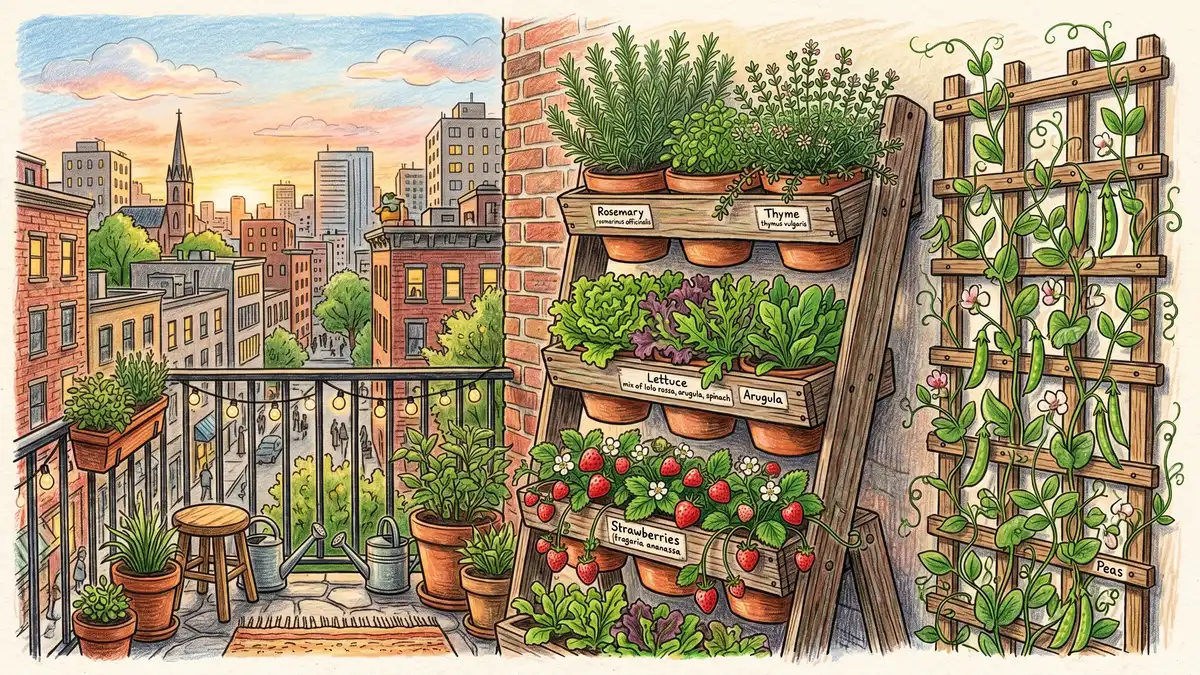
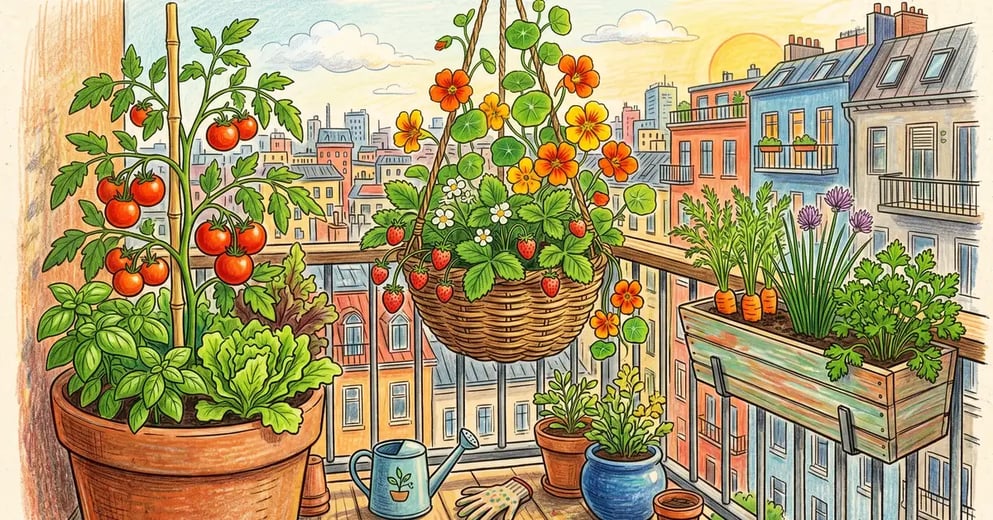
A 50-square-foot balcony can hold a five-tier tower (herbs and lettuces), two 5-gallon thriller pots (tomato trio and pepper trio), one hanging basket (strawberry trio), and a trellis-backed pot (cucumber trio). That is fourteen crops in ten square feet of footprint, which matches the yield extension agents describe for serious 200-square-foot in-ground patches.
Pollinator stacking on a balcony
Self-pollinated crops like tomatoes, peppers, and beans set fruit without insect help. Cucumbers, squash, and strawberries need bees and hoverflies to move pollen between flowers. On a balcony with no neighboring garden, you have to bring the pollinators yourself. Nasturtium, calendula, alyssum, and dill flowers are the four reliable balcony attractors documented across pollinator-plant lists.
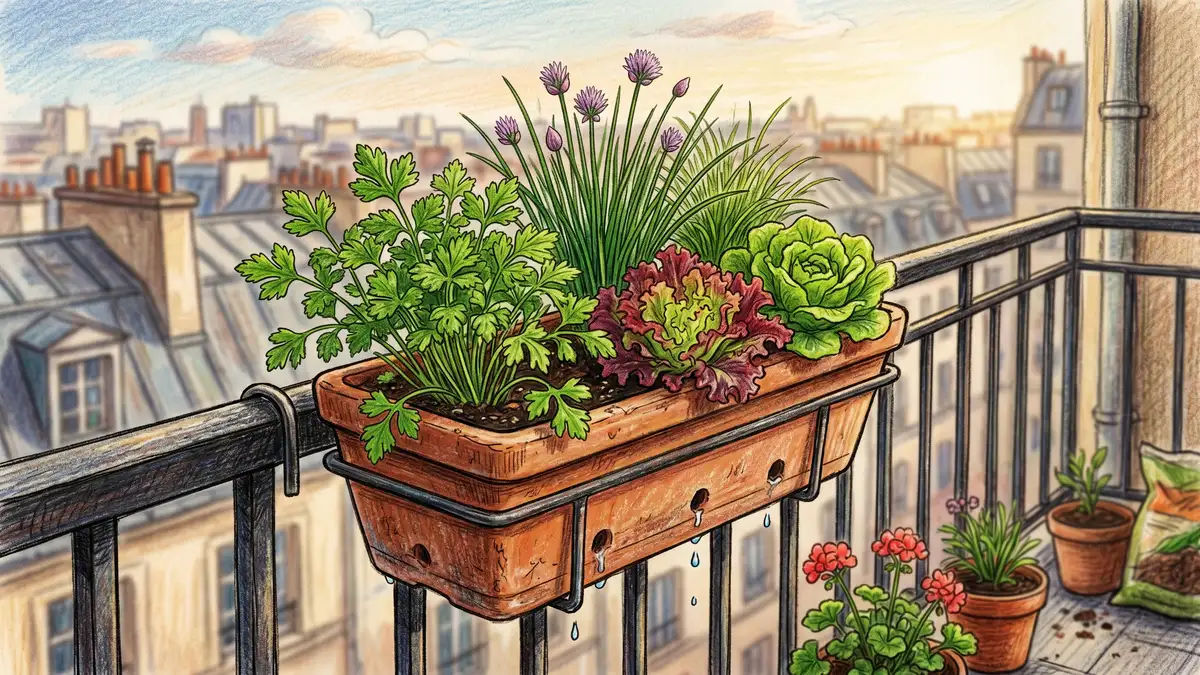
Plant one pollinator container alongside your edibles and the visitation rate climbs within a week. A 12-inch pot with nasturtium, calendula, and trailing alyssum will draw bees and hoverflies from several blocks away in an urban setting. Sustained bloom from late May to first frost is the goal, so combine an early bloomer (calendula), a mid-season bloomer (nasturtium), and a continuous bloomer (alyssum).
The principle here connects directly to the broader logic of companion planting: every plant should serve at least two functions. The pollinator pot is also an edible-flower pot and a trap crop. The carrot-chive pot is also a pest deterrent. The tomato-basil pot is also a flavor pairing for the kitchen. Stack functions and small spaces become surprisingly abundant.
Combinations to avoid in containers
Containers that fail
Mint with anything (mint colonizes every cubic inch of soil within six weeks). Basil with rosemary (incompatible watering schedules). Tomato with cucumber (cucumber outpaces tomato and steals the trellis). Two heavy feeders in one pot (nitrogen runs out faster than you can replace it). Fennel with anything (fennel suppresses neighbors through allelopathy).
For the full picture of pairings that work and ones that backfire, see companion planting mistakes, which goes deeper into the failure modes you want to design around. For the most documented edible pairing of all, see the dedicated guide to what to plant with tomatoes, which expands the tomato-basil science used in the first combination above.
Costs and starting expectations
A starter container companion garden (three 5-gallon pots, potting mix, seeds, and two starter plants) costs $80 to $140 in the United States and around £70 to £120 in the UK. A full balcony setup with a vertical tower, six pots, irrigation, and a season of fertilizer runs $250 to $400 / £200 to £350. Most beginners recover the cost in fresh herbs and lettuces within the first season.
Expect a learning curve. The first season you will overwater, underfeed, or pair the wrong companions in one pot. That is normal. By the second season your trios will run themselves with a daily 30-second water check and a fortnightly feeding. The third season you will be running double the productive crops in the same square footage.
Start your container companion garden this weekend
Pick one of the five proven trios. Buy or repurpose one 5-gallon pot. Pick up the seedlings at your nearest garden center. Plant them this Saturday and you will be harvesting basil within three weeks and lettuce within five. The hardest step is starting; the second hardest is keeping the water can in reach.
Explore companion plantingFrequently asked questions
What is the best companion plant for tomatoes in a container?
Basil. Both want the same daily watering and the same full-sun position, basil's aromatic compounds deter common tomato pests, and the pair is the most documented edible companion combination in container trials. Add a shallow-rooted spiller like lettuce or trailing thyme for a complete trio.
How many plants can you put in a 5-gallon container?
Two to three for fruiting crops. A 5-gallon pot supports one determinate tomato plus one basil plus two lettuces, or one pepper plus three bush basils plus a ring of parsley. For leafy greens alone, you can fit four to six lettuce plants in a 5-gallon container.
Can I plant herbs together in one pot?
Yes, but match them by water needs. Basil, parsley, chives, and cilantro all want consistent moisture and pair well. Rosemary, thyme, oregano, and sage prefer drier soil and pair well together. Never mix the two groups, or one set will rot while the other wilts.
Do container companion plants attract pests?
Some companions are deliberate trap crops that pull pests away from the main crop. Nasturtium attracts aphids before they reach strawberries or peppers. Marigolds repel root-knot nematodes. The key is to position trap crops at the container edges where they can be inspected and pulled if pest pressure rises too high.
How often should I water container companion plantings?
Daily in summer for any pot under 7 gallons, twice daily for hanging baskets in heat over 85°F (29°C). Cooler weather and larger pots can stretch to every two to three days. The reliable check is to stick a finger one inch into the mix; if it comes out dry, water.
What size container is best for companion planting?
Aim for 5 to 7 gallons for fruiting trios (tomato, pepper, cucumber, strawberry combinations) and 3 to 5 gallons for herb-and-greens trios. A minimum of 12 inches in diameter and 10 inches in depth supports two-plant pairings; 18 inches and 14 inches deep supports a full thriller-filler-spiller trio.
Can companion planting really increase yield in containers?
Yes, when the trio is matched correctly and the container is appropriately sized. Horticultural extension research shows that compatible pairs and trios in adequately sized pots produce more total biomass than container monocultures, because each plant occupies a distinct soil and light niche. The wrong pairings in undersized pots reverse this and reduce yield.
Resources
- Royal Horticultural Society: Growing Plants in Containers
- Farmers' Almanac Companion Planting Guide
- Texas A&M AgriLife: Vegetable Gardening in Containers (PDF)
- University of Minnesota Extension: Fertilizing and Watering Container Plants
- LSU AgCenter: Container-Grown Tomatoes Variety Trial
- UC Cooperative Extension: Container Gardening (Thriller-Filler-Spiller)
- BBC Gardeners' World: 10 Ways to Avoid Carrot Root Fly
- PMC: Intercropping with legumes at different rates (peer-reviewed)
- Gardenary: Vegetables for a Vertical Garden
- San Diego Seed Company: Vegetable Container Size Chart