
You have three years of permaculture under your belt. Raised beds are humming. The food forest is starting to look like itself. Now you are thinking about bees: not as a hobby with a white box on stilts, but as a full guild member of your design. This is the permaculture approach to beekeeping, and it changes most of what you read in the standard beekeeping books.
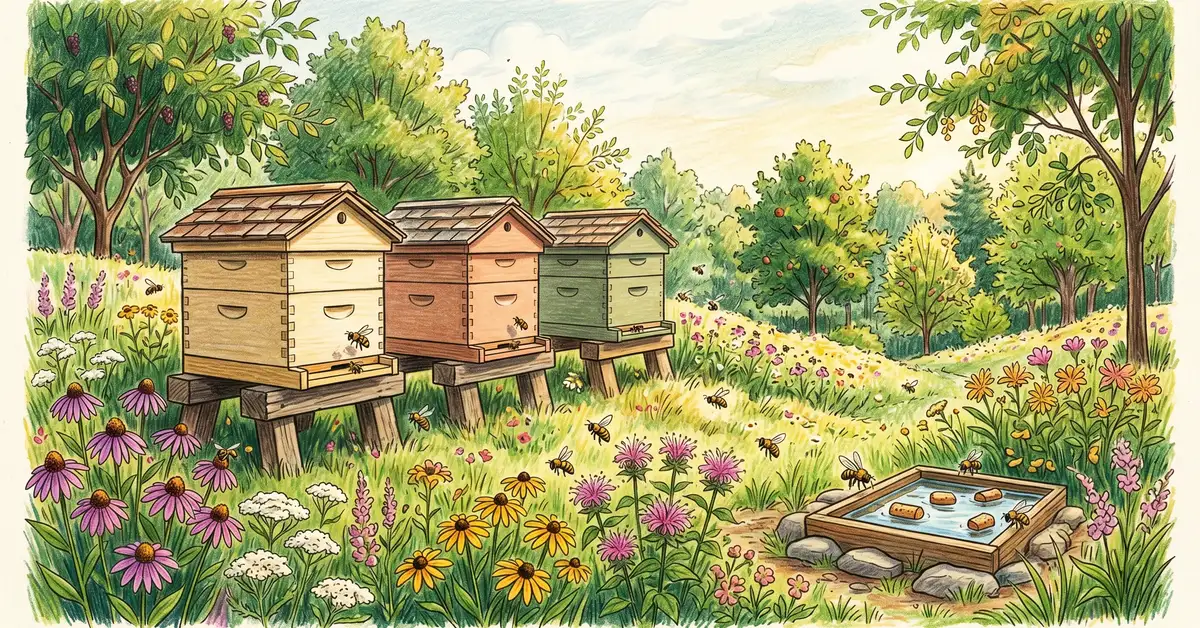
Honeybees are a guild member, not a livestock unit
Most modern beekeeping was built around mobile commercial pollinators: thousands of colonies trucked between almonds, blueberries, and clover for paid pollination services. The cultural inheritance from that world is heavy treatment, frequent inspection, and a single output (honey).
Bill Mollison framed the homestead apiary differently. In Permaculture: A Designers' Manual he treats bees as part of the polyculture: a pollinator that also produces wax, propolis, royal jelly, and an honest signal of how the whole system is doing. Michael Bush extends this in The Practical Beekeeper: minimal intervention, no synthetic treatments, small natural cell, and selection for survivor stock. Les Crowder, in Top-Bar Beekeeping, makes the same case from the top-bar tradition: build a hive that lets the bees build comb the way they want, not the way the equipment dictates.
Why this works
Conventional beekeeping optimises one output (honey) and one species (Apis mellifera). Permaculture optimises the relationships between the bee, the land, the gardener, and the surrounding wild pollinators. You get less honey per colony in year one, more pollination yield across your whole system, and colonies that survive year over year without weekly intervention. Toby Hemenway makes the same argument in the second edition of Gaia's Garden: the homestead apiary should be designed as part of the garden, not as a separate enterprise.
Pick a hive design that fits your design, not the catalogue
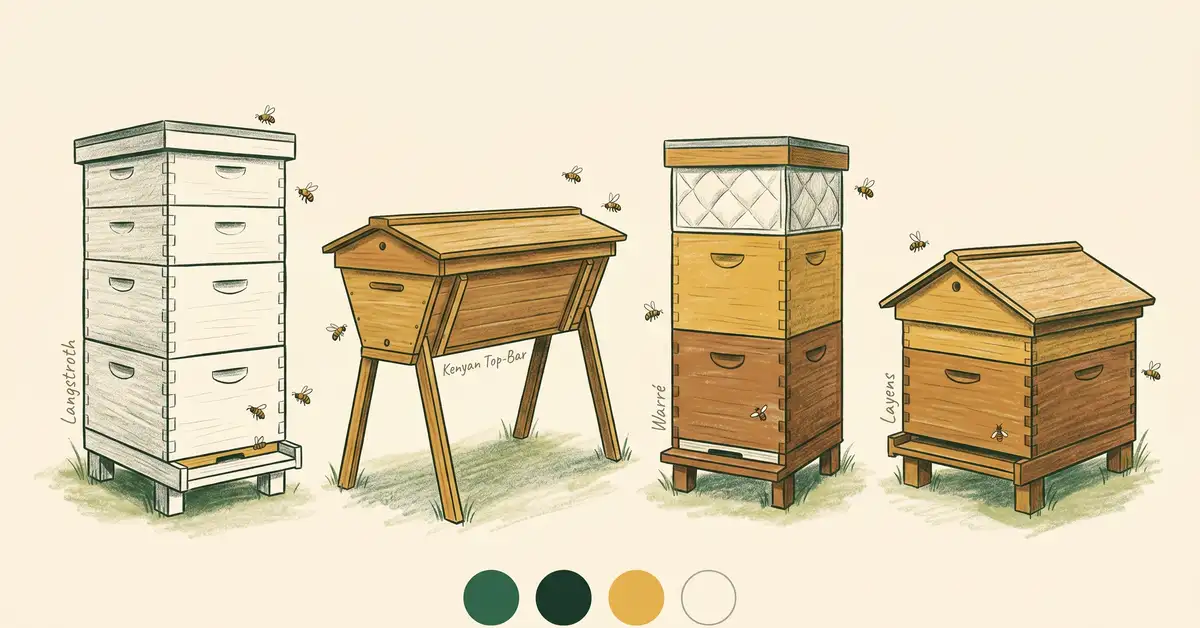
The four hive styles permaculture beekeepers most commonly choose each have different ergonomics, build costs, and biological assumptions. Pick the one that fits your body, your climate, and your design philosophy.
| Hive style | Best for | Cost (2026) | Trade-off |
| Langstroth | Standard US frames, easy parts sourcing, honey production | $350 to $500 with bees | Heavy lifting, stacked boxes (60+ lb full) |
| Kenyan top-bar | Build-it-yourself, gentle inspection, low-cost entry | $50 to $150 in lumber + $150 bees | Lower honey yield, harder to overwinter cold zones |
| Warré (vertical top-bar) | Minimal intervention, nest-down expansion mimics tree cavities | $200 to $350 DIY | Limited inspection access, smaller boxes |
| Layens (horizontal deep frame) | Cold climates, one-box overwintering, less lifting | $250 to $400 DIY | Heavy single box, less common parts |
Sources:; current US lumber and bee package prices.
For most committed practitioners we have worked with, the answer is two hives in two styles: one Langstroth (so you can buy local nucs and replacement parts anywhere) and one top-bar or Layens (so you have a low-intervention reference point to compare). If you can only start with one, a single eight-frame Langstroth is the safest learning hive in the United States.
Where the hive goes in your zone plan
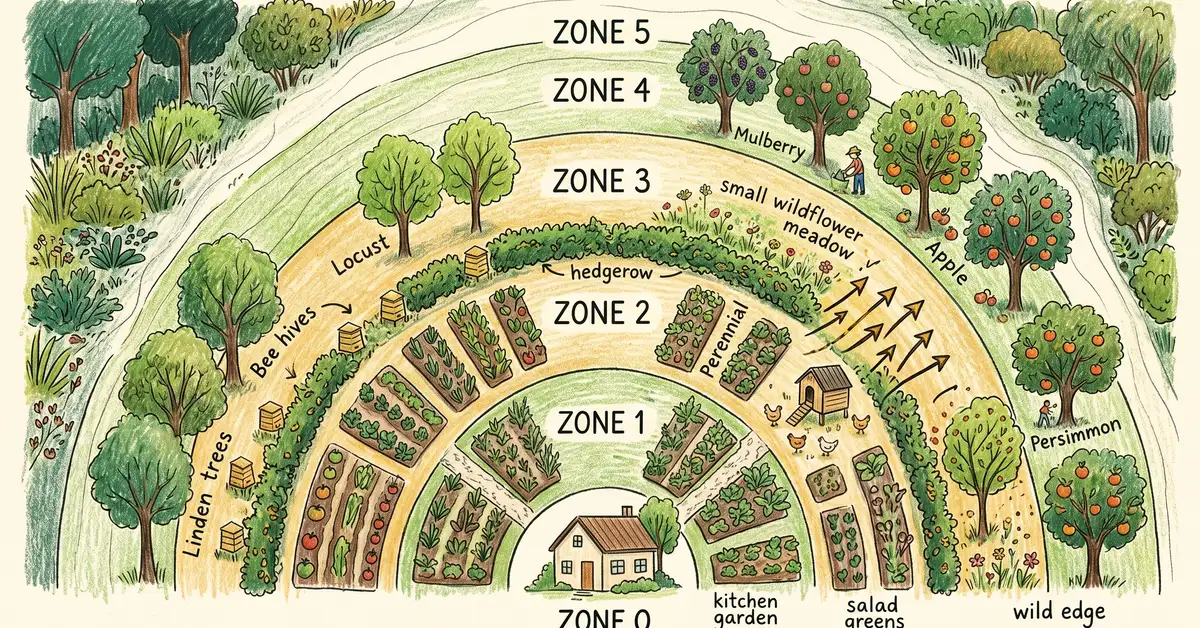
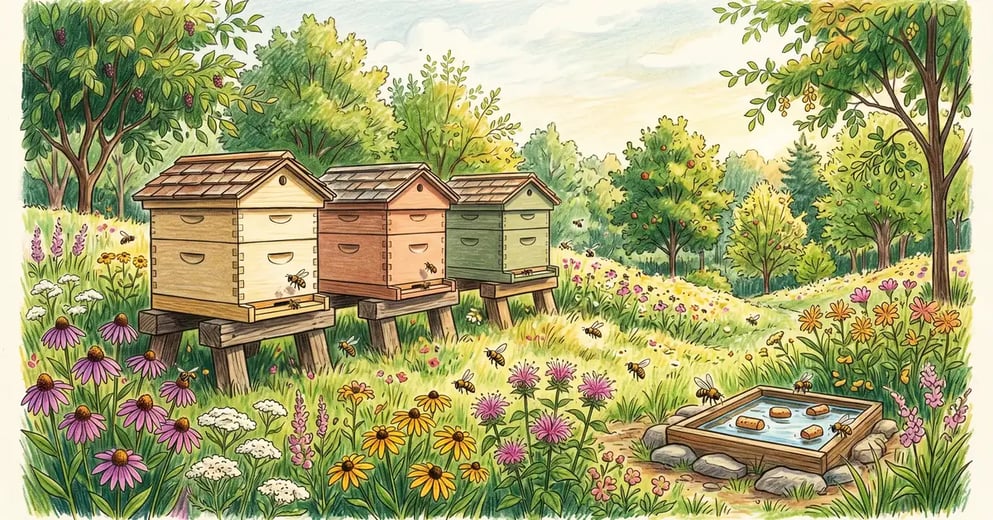
Standard beekeeping books place the hive "wherever it fits." Permaculture asks the design question: which zone, which microclimate, which neighbours? The default placement in a well-designed system is the boundary between Zone 2 and Zone 3, far enough from daily activity that bees and humans do not interfere, close enough that you walk past the entrance every few days and notice problems before they cascade.
Morning sun, afternoon shade
Face the entrance southeast. Morning sun warms the cluster and gets foragers out earlier; afternoon shade in summer prevents the hive from overheating and bearding excessively. In hot southern states this matters more; in northern states a full-sun position is fine.
Wind protection at the back
A hedgerow, cob wall, or row of evergreens 8 to 15 ft (2.4 to 4.6 m) behind the hives breaks cold winter winds and shields against summer storms. Sepp Holzer's hugelkultur berms make excellent windbreaks if you have them.
Drainage and dry ground
Hives on damp ground draw moisture into the colony in winter, which kills more bees than cold. Place hives on a slight rise or on stands at least 18 in (45 cm) off the ground.
Flight path clear and elevated
Place a tall barrier (fence, hedge, building) 6 to 10 ft (1.8 to 3 m) in front of the entrance so bees take off above human head height. This keeps the flight path away from paths, neighbours, and play areas.
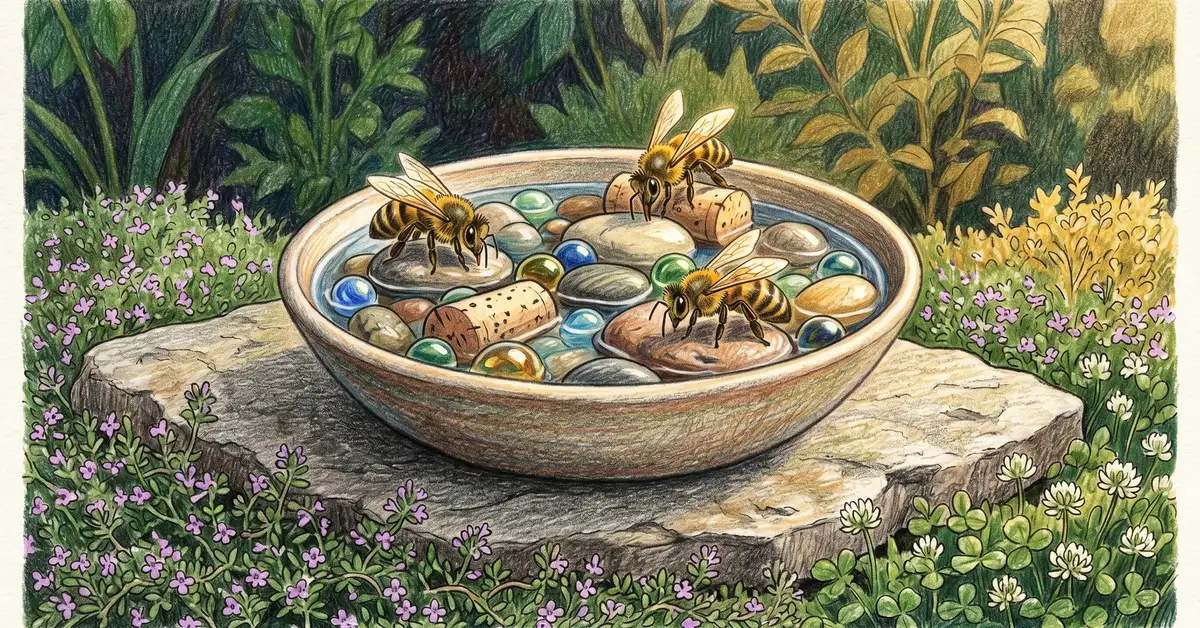
Water within 100 yards
If you don't provide water, bees find your neighbour's swimming pool or chicken waterer. Build a dedicated water source so the bees imprint on yours from day one.
Designing forage: the 1.5 mile question
A honeybee colony typically forages 1.5 to 3 miles (2.4 to 4.8 km) from the hive, with the most efficient harvest happening within 0.5 mi (0.8 km). USDA NASS honey-production data and the Bee Informed Partnership annual colony loss survey both indicate that forage diversity within that inner half-mile is the single biggest factor in overwintering survival. So the design question is: what is in flower within half a mile of your hive, in every month from March to October?
| Season | Top US forage species | Permaculture role |
| Early spring | Red maple, willow, dandelion, hazel, alder | Pioneer trees and "weeds" that feed colonies coming out of winter starvation |
| Late spring | Fruit trees (apple, plum, cherry), black locust (Robinia), tulip poplar, dutch clover | Food forest canopy and N-fixers double as nectar peaks |
| Summer | Linden (basswood/Tilia), sweet clover, milkweed, oregano, phacelia, sourwood (SE US) | Living mulch + N-fixing groundcover + nectar tree canopy |
| Fall | Goldenrod, aster, sunflower, sedum, Japanese knotweed (where present) | Wild edges become the winter-stores harvest |
Sources:; USDA NRCS pollinator plant lists.
Most permaculture sites already overlap heavily with this list., linden, fruit trees, clover groundcovers, dandelion "weeds" and goldenrod edges all show up in standard permaculture designs for reasons unrelated to bees. The work is auditing what you have, identifying gaps (especially August dearth in the eastern US), and planting to fill them.
The August dearth is the most common cause of colony decline in eastern US permaculture sites. Between linden's late June peak and goldenrod's September wave there is often six weeks of nothing. Bee-friendly summer-fillers include mountain mint (Pycnanthemum), anise hyssop (Agastache foeniculum), and pure-strain phacelia. Plant a 100 sq ft (9 sq m) patch of each within 0.5 mile of the hive and the dearth largely disappears.
Water: the half-day project that prevents the biggest neighbour problem
A colony of 50,000 bees drinks about a quart (one litre) of water on a hot day, mostly used for evaporative cooling of the brood nest. If you do not provide it on-site, foragers will find the closest reliable source: the neighbour's pool, the dog dish, the bird bath. By the time you find out, the pool owner is already annoyed.
A more permanent permaculture solution is a small bog filter overflow from a rainwater catchment: the bees get clean water continuously, your pond gets filtered, and the design serves two functions. Sepp Holzer-style on-contour swales with shallow ponds also work; the muddy edges where pioneer plants colonise are bee magnets.
The native bee question: when honeybees compete with the locals
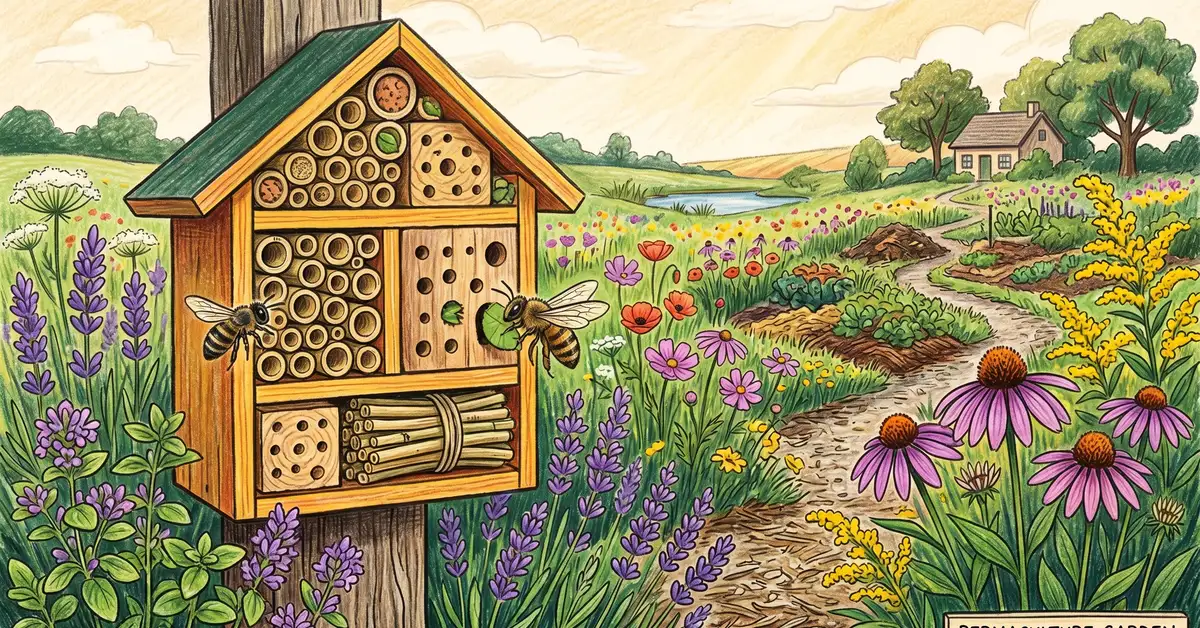
Honeybees are not native to North America. They arrived with European colonists in the 1600s. The 4,000+ native bee species in North America (bumblebees, mason bees, leafcutter bees, mining bees, sweat bees) co-evolved with native plants for millions of years before honeybees showed up.
The Xerces Society position paper is clear: honeybees are agricultural livestock, not a conservation species. In high-density urban or suburban settings, large managed honeybee populations can measurably reduce native bee foraging success. In rural permaculture sites with abundant forage diversity, the competition effect is small. The honest position is to plan for both.
Why this works
A permaculture site that designs for native bees first (bare ground for ground-nesters, hollow stems for cavity-nesters, late-season natives for bumblebees, dead wood for tunnel-nesters) and then adds 1 to 3 honeybee colonies gets the agricultural benefit of honeybees with minimal pressure on the wild population. This is exactly the inversion of the conventional approach, which adds bees first and never thinks about the wild pollinators.
Concrete habitat additions for native bees: a sun-facing patch of bare ground 4 ft (1.2 m) wide for mining bees, a bee hotel with bamboo (8 to 10 mm bore) and pithy elderberry stems for mason and leafcutter bees, a dead-wood pile or "stumpery" for tunnel-nesters, and an unmowed wildflower strip at least 6 ft (1.8 m) wide for bumblebees and butterflies. Total cost: under $50. Total impact: massive.
The legal layer: check before you order bees
Every US state allows beekeeping, but local restrictions vary widely. Major cities including Chicago, NYC, Seattle, Austin, Denver, and Los Angeles have explicit beekeeping ordinances allowing small backyard apiaries with conditions (typically 2 to 4 hives, setback from property line, water source on site, queen requeening). HOAs are a different problem: even where city code allows bees, a covenant can ban them. Read the HOA documents before you order.
Some states require an annual apiary inspection (Pennsylvania, North Carolina). Others have voluntary registration. The USDA pollinators portal links to state-level resources. Local beekeeping clubs (every US state has at least one) are the fastest way to find current rules in your county.
Treatment-free vs treatment-required: the varroa question
The central biological question in modern beekeeping is Varroa destructor, an external parasitic mite that came to the United States in 1987 and has driven most of the colony losses since. There are two camps among permaculture beekeepers.
The treatment-required school (most US beekeeping clubs, university extension, Honey Bee Health Coalition) recommends monitoring mite levels with sugar rolls or alcohol washes, treating with formic acid, oxalic acid, or thymol when thresholds are exceeded, and not allowing colonies to fail from preventable mite loads.
The treatment-free school (Michael Bush, Sam Comfort's Anarchy Apiaries, Kirk Webster, much of the Warré tradition) refuses synthetic and organic treatments, accepts higher annual losses, and selects survivor stock from colonies that beat varroa naturally. The argument is evolutionary: every treatment delays the selection pressure that produces mite-resistant honeybees.
Realistic year-one expectations
The Bee Informed Partnership annual colony-loss survey has tracked US beekeeping losses since 2006. Average annual loss across all operations runs 40% to 45%; backyard beekeepers in their first year lose colonies at closer to 50%. This is not a sign you are a bad beekeeper; it is the baseline.
| Year | Realistic honey yield | What to focus on |
| Year 1 | 0 lb (let them keep all 40 to 60 lb of stores for winter) | Survival, getting them through August dearth, varroa monitoring |
| Year 2 | 20 to 40 lb (9 to 18 kg) per healthy hive | Wax harvest, propolis, swarm prevention or capture |
| Year 3 | 40 to 80 lb (18 to 36 kg) per healthy hive | Queen breeding, splits, sharing nucs with neighbours |
Sources:; typical hobbyist yields reported by state beekeeping associations.
Honey is one output. Here are the others.
The permaculture mind asks "how many functions does this element serve?" An apiary in a well-designed permaculture system serves at least six.
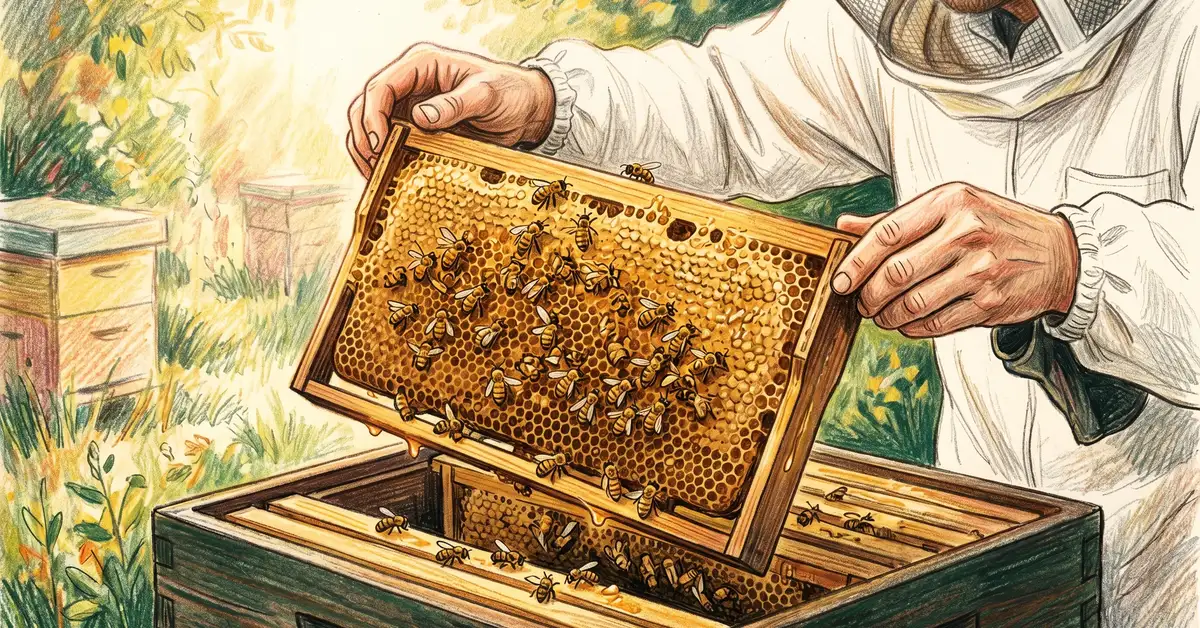
- Pollination. Penn State trials show 20% to 30% yield increases in adjacent vegetable, orchard, and berry plantings with honeybees on site. This is the largest single economic and biological output, and it is the one most homestead beekeepers undervalue.
- Beeswax. Three to five pounds (1.4 to 2.3 kg) per hive per year, useful for candles, salves, food wraps, leather conditioner, and waterproofing. Wax can also be cycled back as foundationless guide strips.
- Propolis. The antimicrobial resin bees gather from tree buds. A double tincture (propolis in ethanol) keeps for years and is a useful homestead first-aid product for cuts and sore throats. About 1 oz (28 g) per hive per year is reasonable.
- Royal jelly and pollen. Specialty harvests for experienced beekeepers; not recommended in year one or two.
- Swarm capture. A managed apiary attracts feral swarms (and produces them). Bait hives within 100 yards catch about half the swarms that emerge in spring.
- Ecosystem indicator. Colony health tells you about pesticide drift, forage diversity, and microclimate problems before any other element of the system flags them.
Five steps to your first hive
Read and scout (winter before)
Read Michael Bush's The Practical Beekeeper (or the Crowder/Sharashkin equivalent for your chosen hive style). Join your county beekeeping club. Visit at least 2 working apiaries. Check state, county, HOA rules.
Site prep (winter to early spring)
Pick the location using the zone-and-microclimate criteria above. Build or place hive stands. Install the water source. Plant any missing forage (especially August fillers).
Order equipment and bees (January to February)
Order equipment by January. Order bees by January or February for April or May delivery. A 3 lb (1.4 kg) package is the cheapest start ($150 to $200). A nuc (5-frame established colony) costs $200 to $275 and gets you a working colony 3 weeks faster.
Installation and first 8 weeks (April to June)
Install bees, feed 1:1 sugar syrup for 4 to 6 weeks while comb is drawn. Inspect every 10 to 14 days. Watch for queen-laying patterns. Do not harvest.
Year-one calendar (July to March)
July: monitor for swarming, varroa load check. August: emergency feed if dearth is severe. September: final varroa check, decide on treatment. October: insulate hive entrance, mouse guards on. November to February: leave them alone. March: first inspection, assess survival.
Three sanctuaries worth visiting
If you want to see permaculture beekeeping practiced at scale by people who have been doing it for decades, three US sites are worth the pilgrimage. Spikenard Honeybee Sanctuary in Virginia operates on biodynamic principles with 60+ colonies; their classes run spring through fall. Apis Arborea in California, founded by Michael Thiele, restores wild tree-hive populations and offers immersive workshops. Sandhill Farm in Missouri runs a long-standing communal apiary integrated with diversified vegetable and sorghum production.
Get the Weekly Dig
One practical permaculture guide a week, written for gardeners who do this on weekends: permaculture design for real backyards. Free, no spam, unsubscribe any time.
Join the Weekly DigFrequently Asked Questions
Can I keep bees in a permaculture garden if I don't have acres?
Yes. A single hive needs about 4 ft x 4 ft (1.2 m x 1.2 m) of dedicated footprint, plus a clear flight path. The forage radius extends 1.5 to 3 mi (2.4 to 4.8 km) from the hive, so as long as your neighbourhood has reasonable forage diversity (trees, gardens, wild edges) you do not need to grow it all yourself. Most successful US backyard beekeepers operate on 0.25 to 1 acre.
Will honeybees harm native bees in my garden?
In rural permaculture sites with diverse forage and low colony density (1 to 3 hives per 5 acres), competition with native bees is minimal. In urban or suburban sites with limited forage, dense honeybee populations can measurably reduce native bee foraging success. The Xerces Society position is to design for native bees first, add honeybees as agricultural livestock second. A bee hotel, bare-ground patch, and unmowed wildflower strip do more for pollinator conservation than any honeybee hive.
How much honey will I actually get?
Year one: 0 pounds. Let the colony keep all 40 to 60 lb (18 to 27 kg) of stores for winter. Year two: 20 to 40 lb (9 to 18 kg) per healthy hive. Year three onward: 40 to 80 lb (18 to 36 kg) per hive in average years, more in good ones. These are typical hobbyist yields reported by the Bee Informed Partnership and state beekeeping associations; commercial operations push higher with intensive feeding and management.
Which hive design is best for permaculture?
There is no single best design. Langstroth hives offer the easiest parts sourcing and inspection in the US. Kenyan top-bar hives offer the cheapest entry and lowest intervention. Warré hives mimic tree-cavity expansion. Layens hives suit cold-climate one-box overwintering. Most committed practitioners eventually run one or two of each. If you can only choose one starter hive in the US, an 8-frame Langstroth is the most-supported option.
Do I need to treat for varroa mites?
It depends on your stock and your tolerance for losses. Commercial package bees from Georgia or California typically need oxalic acid or formic acid treatment by year two. Survivor-stock queens from regional breeders (BeeWeaver in Texas, Anarchy Apiaries in NY, Kirk Webster in VT) often produce colonies that handle varroa without treatment, with higher first-year loss rates as the selection pressure. Most committed practitioners run a mixed approach: treat new colonies, leave proven survivor lines untreated.
What does it cost to start beekeeping in 2026?
A complete Langstroth setup (hive, frames, foundation, smoker, hive tool, veil, suit, feeder) runs $350 to $450. A 3 lb package of bees with queen runs $150 to $200; a 5-frame nuc runs $200 to $275. A basic honey extractor (year 2 purchase) runs $150 to $300. Total year-one investment for one Langstroth hive: $500 to $700. A DIY top-bar hive in pine costs $50 to $100 in materials.
How much time does a hive take per year?
Roughly 30 to 50 hours per hive per year for a treatment-using small-scale beekeeper, distributed unevenly: heavy in spring (installation, feeding, inspections), light in summer, moderate in fall (winter prep, varroa check), almost zero in winter. Mollison's "elegant minimum intervention" approach with treatment-free survivor stock can drop this to 15 to 25 hours per hive, with higher annual loss rates as the trade-off.
Where can I learn more about permaculture beekeeping specifically?
Five resources serve as a curriculum: Bill Mollison's Permaculture: A Designers' Manual (the foundational text on apiary integration), Michael Bush's The Practical Beekeeper, Les Crowder's Top-Bar Beekeeping, the Spikenard Sanctuary classes, and Apis Arborea workshops. Toby Hemenway's Gaia's Garden 2nd edition has a strong chapter on pollinator integration.
Resources
- Bee Informed Partnership annual loss survey — US managed colony loss data
- Xerces Society position paper on honeybees and conservation
- Michael Bush — The Practical Beekeeper (full text online)
- Horizontal Hive — Dr. Leo Sharashkin's Layens resources
- Bee Built — top-bar hive plans and equipment
- Penn State Center for Pollinator Research
- Cornell Pollinator Network
- Spikenard Honeybee Sanctuary (Virginia)
- Apis Arborea — Michael Thiele's tree hive work
- Anarchy Apiaries — survivor-stock queens (Sam Comfort)
- Honey Bee Health Coalition — varroa management tools