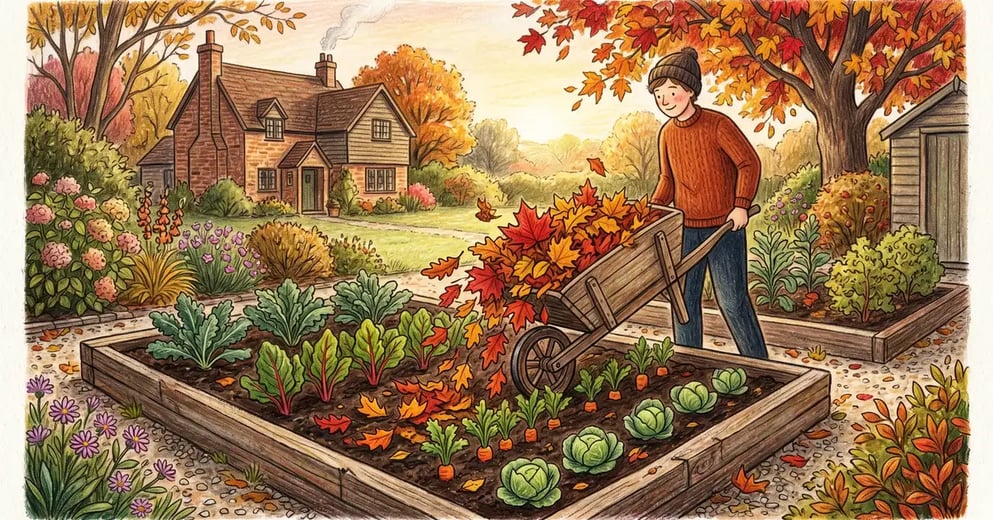

Every fall your trees drop hundreds of pounds of perfectly good garden amendment on your lawn, and most of it ends up in the curbside trash bag. Stop. Those leaves are worth real money and your soil wants them. Two to four inches (5 to 10 cm) of shredded leaf mulch on a vegetable bed will suppress weeds, feed earthworms, hold moisture, and add organic matter for years. Same leaves mowed back into your lawn nearly eliminate dandelions and crabgrass after three seasons. The science is solid. The technique fits in an afternoon. turn yard waste into a new bed leave the leaves covering raised beds for winter how deep to mulch in fall mixing leaves with grass clippings what size to shred them to
This is the cheapest, most-effective garden amendment you can get, and you can collect a year's supply in two weekends. Here is the how, the why, the species nuances, and the mistakes to avoid.
What "leaf mulch" actually means (and why it's not leaf mold)
Two terms get used interchangeably, and they aren't the same. Leaf mulch is shredded fall leaves applied directly to the soil surface as a protective layer. Leaf mold is what those leaves slowly become after one or two years of fungal decomposition in a pile or bag. This guide is about leaf mulch, the fast, surface-applied amendment that solves problems this season. We have a separate guide on composting leaves into finished leaf mold if that's where you want to take it.
The University of Minnesota Extension's guidance on mulching for soil and garden health recommends 2 to 4 inches (5 to 10 cm) of shredded leaves on garden beds, applied in autumn after harvest or in spring before planting. Iowa State's guide to using mulch in the garden hits the same range and explains why: thicker than 4 inches and the layer mats down and blocks water; thinner than 2 inches and weeds punch through.
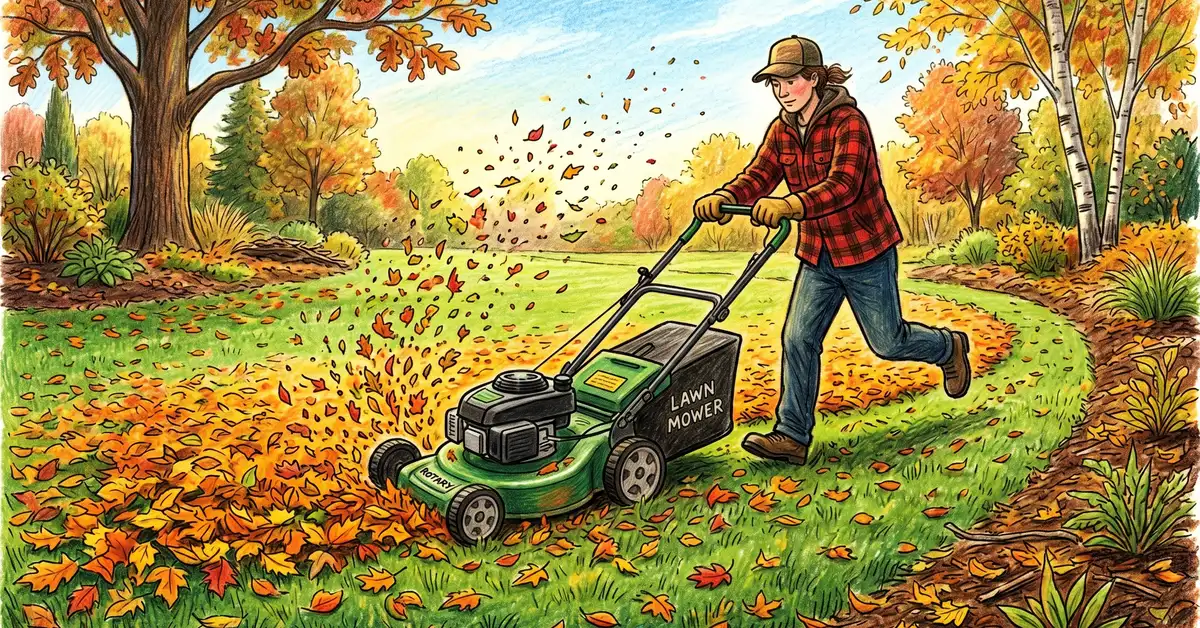
The lawn approach: just mow them in
If you have a lawn under deciduous trees, the easiest leaf strategy is the most-studied one. Michigan State University's turf research, summarized in the Extension article "Mulch Leaves Into Turf for a Smart Lawn", tracked a Kentucky bluegrass lawn over three years of fall leaf mulching. The result: dandelion populations dropped by more than 80 percent and crabgrass by roughly 50 percent, with no change in turf density. The shredded leaf fragments fed soil microbes, which mineralized nutrients back to the grass roots through the winter.
The technique:
Wait until leaves are dry
Wet leaves clog mowers and mat instead of shredding. Mow on a sunny afternoon two days after the last rain.
Set the deck high (3 in / 7.5 cm)
You are shredding leaves, not scalping turf. Higher decks chop better and leave grass tall enough to photosynthesize through the fragments.
Make 2 or 3 passes
One pass leaves whole leaves on the lawn (bad). Three passes turns them into confetti that disappears within a week (good). A side-discharge or mulching mower works fine. Don't bag.
Repeat through the fall
Don't wait for one giant leaf drop. Mow weekly or biweekly through October and November as leaves come down in waves.
Why this works (Holmgren's "produce no waste" principle)
David Holmgren's 6th permaculture principle is "produce no waste." Every fall, deciduous trees deliver tonnes of high-carbon material to the soil exactly where they grew that summer. Bagging it and trucking it to a municipal facility breaks the loop. Mowing it in returns carbon, builds soil, feeds microbes, and saves you the bag fee. It also matches Mollison's observation that the most-productive systems are those that "stack functions": one job (lawn maintenance) now does four (mowing, weed suppression, fertilization, soil-building).
The vegetable bed approach: 2 to 4 inches after harvest
For raised beds and in-ground vegetable gardens, leaf mulch goes on top of bare soil after fall harvest or around established plants in summer. Grow a Good Life's working guide to leaf mulch lays out the standard practice: shred leaves first (mower, leaf shredder, or weed-eater in a trash can), then apply 2 to 4 inches over the bed, leaving a 2 inch (5 cm) gap around any plant stems.
One bushel of dry, shredded leaves covers roughly 10 sq ft (1 m²) at 3 inches depth. A 4 by 8 ft (1.2 by 2.4 m) raised bed needs about 3 bushels. That is the contents of two large yard-waste bags. For most home gardens, the math is: collect 8 to 12 bagged yards of leaves in October, you have your entire next season's mulch.
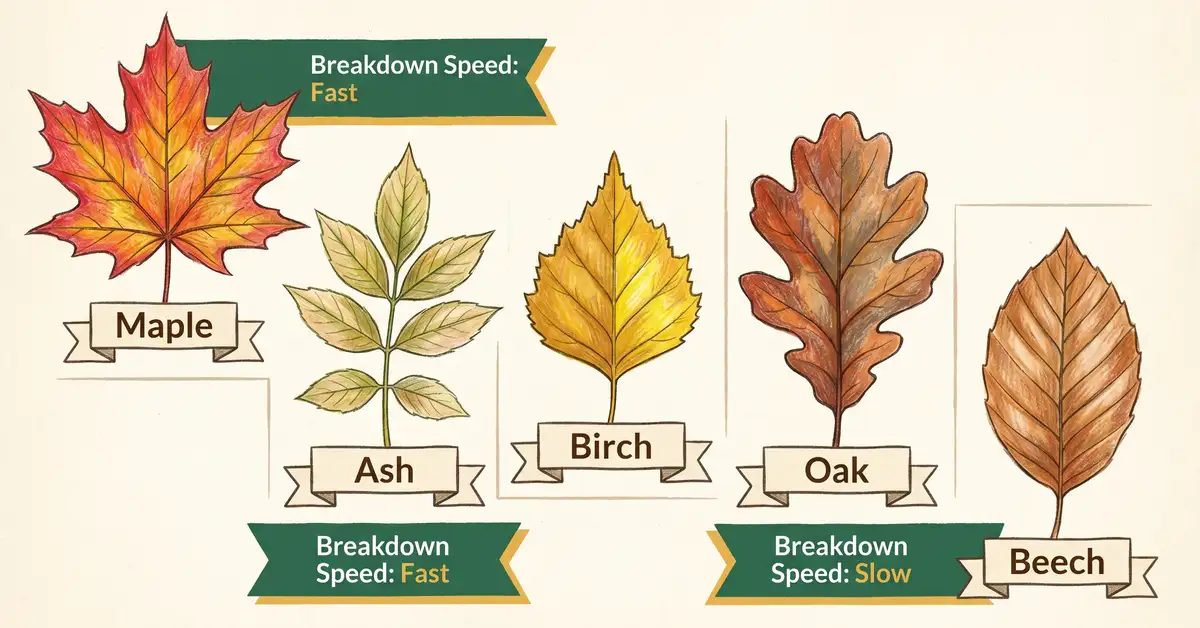
Species matters (and the oak-acidifies-soil myth)
Not all leaves break down at the same rate. A peer-reviewed comparative decomposition study published in the Journal of the Arkansas Academy of Science (PDF) measured first-year mass loss across species: sugar maple lost 60 to 70 percent of its mass in one year, ash 55 to 65 percent, while red oak and white oak lost only 30 to 40 percent. Beech, magnolia, and holly are slower still. The takeaway is not "avoid oak"; it's "shred oak finer and don't pile it thick on lawns."
The persistent myth that oak leaves acidify garden soil does not survive testing. Fresh oak leaves measure around pH 4.5 to 4.7, but as Joe Gardener's deep-dive on using leaves as mulch documents, finished oak-leaf compost lands between pH 6.0 and 7.5, well within the safe range for vegetables. Soil buffers small acid inputs. Shred your oak leaves to prevent matting and apply them freely.
Black walnut is the one species to handle carefully
Black walnut (Juglans nigra) leaves, twigs, and roots contain juglone, an allelochemical that inhibits or kills tomatoes, potatoes, peppers, eggplant, asparagus, and several other vegetables. Penn State Extension's authoritative "Landscaping and Gardening Around Walnuts" guide and the Pacific Northwest Plant Disease Handbook entry on black walnut toxicity list affected crops in detail.
Oregon State Extension's specific guidance on composting walnut leaves confirms that juglone breaks down in a hot compost pile over 6 to 12 months. The safe protocol: never use fresh walnut leaves as mulch around sensitive vegetables; hot-compost them for a full year first; or use them as mulch only around juglone-tolerant species (lawns, daffodils, daylilies, snowdrops, most ferns and hostas). If you have a single black walnut tree, identify it and route those leaves to a separate composting pile.
Earthworms and soil biology: what's actually happening under the mulch
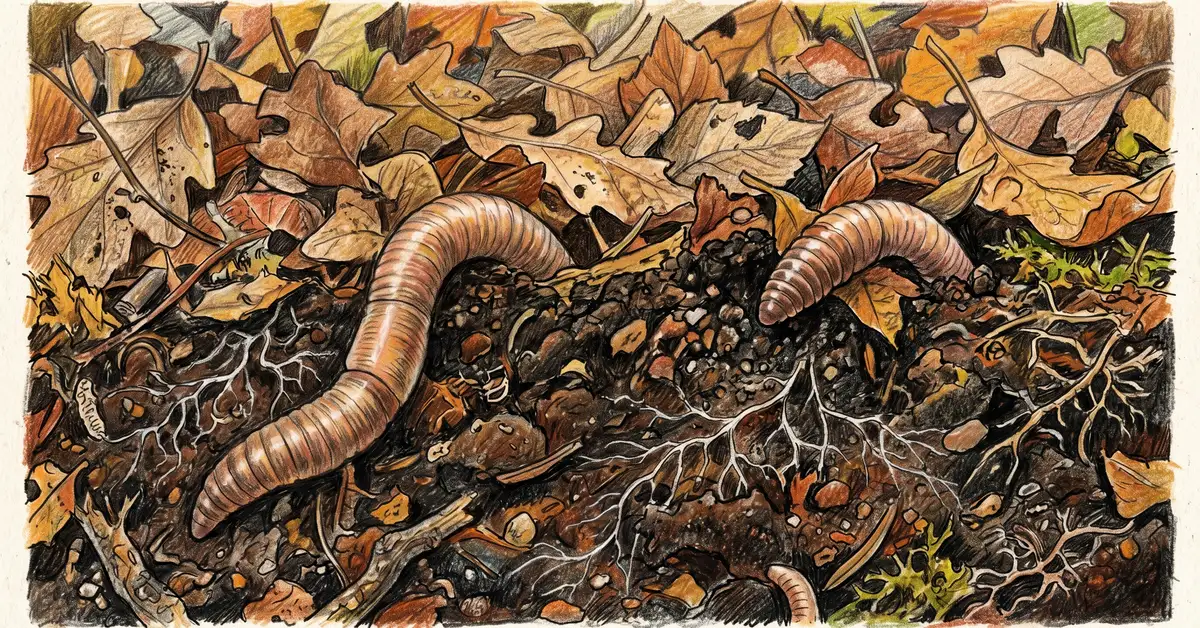
The most-dramatic visible change from a leaf-mulch year is what you find when you peel the mulch back the following spring. Earthworms. Lots of them. Studies cited in Nature's Way Resources' synthesis on earthworms document 2 to 5 times higher earthworm densities under mulched beds versus bare soil, with corresponding increases in soil aggregate stability and infiltration.
The mechanism is straightforward. Leaves are roughly 50:1 to 80:1 carbon-to-nitrogen depending on species, according to Cornell Composting's FAQ. That carbon feeds fungi, which feed bacteria, which feed protozoa, which feed nematodes and arthropods, which feed earthworms. After a season under leaf mulch, a square foot of bed in good condition might hold 5 to 15 earthworms compared with 0 to 3 in bare adjacent soil. Those earthworms move the leaf material down, deposit nutrient-rich castings, and tunnel paths for root growth. You bought that for free with leaves your neighbors put on the curb.
The tree-well mistake everyone makes
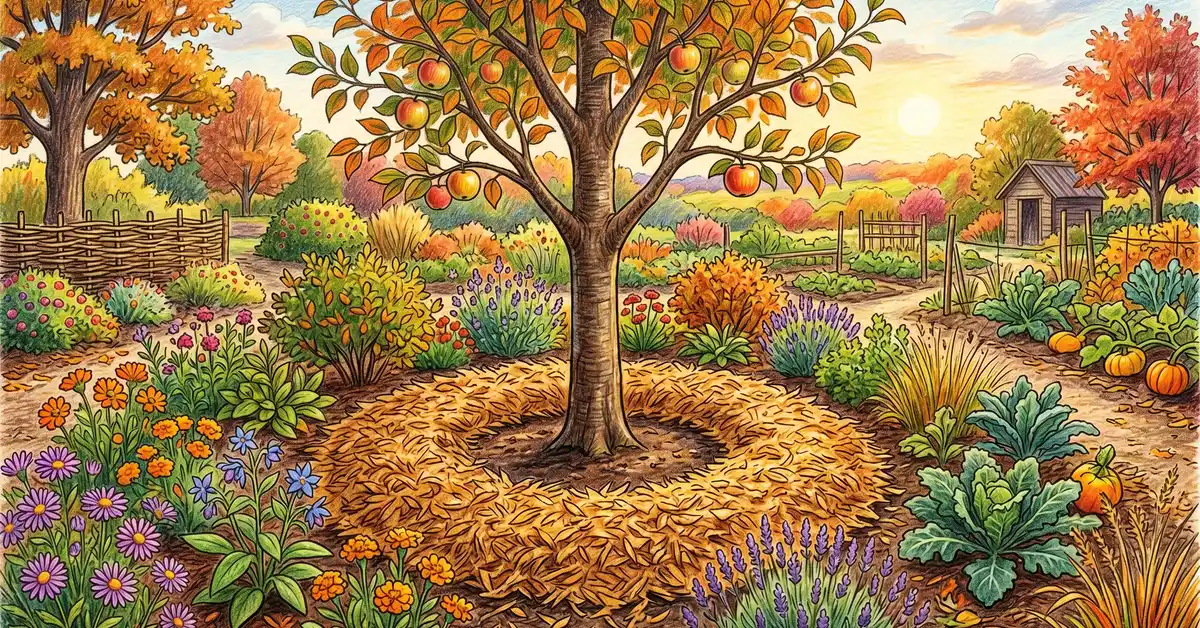
Leaf mulch is excellent around trees. Volcano mulching is not. The pattern you see at every shopping mall and most suburban front yards (a tall cone of mulch piled directly against the trunk) causes bark rot, encourages root girdling, hides vole damage, and slowly kills trees over 5 to 10 years.
The right shape is a donut, not a volcano. Spread 2 to 3 inches (5 to 7 cm) of shredded leaf mulch in a wide ring out to the drip line, but keep the inner 4 to 6 inches (10 to 15 cm) at the trunk completely clear of mulch. Bare soil should be visible right at the bark. Penn State Extension and Iowa State's Yard and Garden mulch guide both spell this out: trunks need airflow, not insulation. A vole-damage post from Forest Garden Blog documents how mulch piled against trunks creates winter tunnel cover for voles, which then girdle young fruit trees from the inside out.
Common mulching mistakes
Don't apply whole, unshredded leaves more than 1 inch (2.5 cm) deep. They mat together and form a water-shedding crust. Don't mulch with leaves from diseased trees (anthracnose on maples, tar spot, apple scab on apples). Don't pile mulch against any tree trunk. Don't apply walnut leaves around tomatoes. Don't mulch over wet, soggy beds in late fall; wait until the soil has drained.
Whole leaves vs shredded: the matting problem
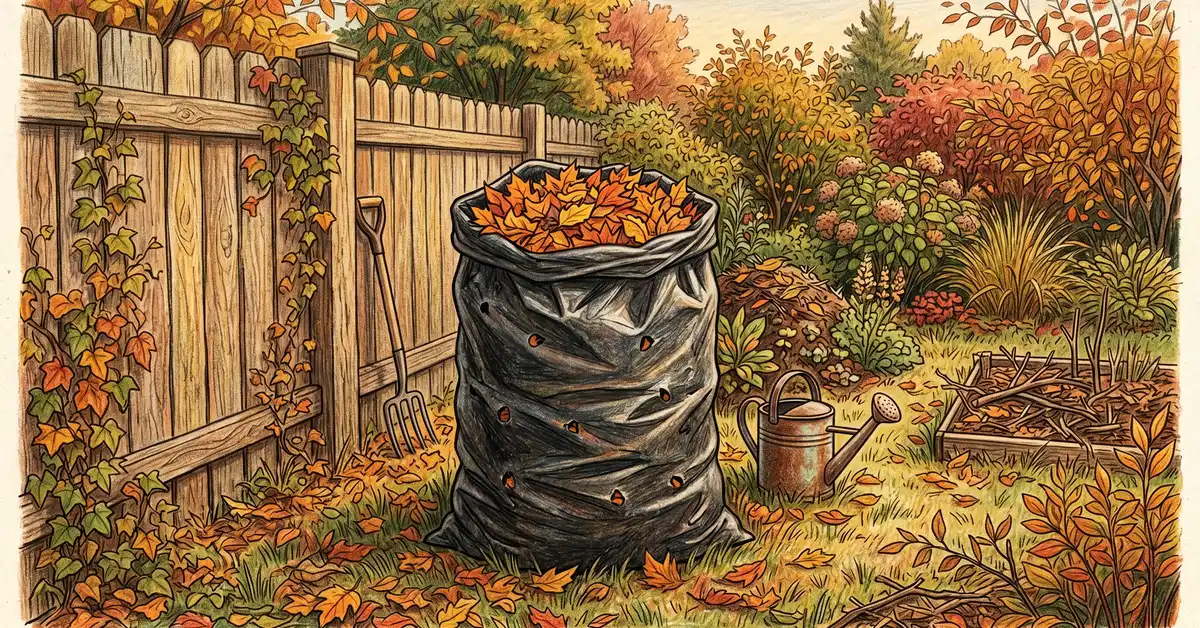
Whole leaves work fine in light layers (1 inch / 2.5 cm) around mature perennials and shrubs, but most species (especially maple, sycamore, and oak) will mat into a water-shedding layer when piled thicker. Shredded leaves break down 3 to 4 times faster, never mat, and are easier to spread evenly.
Three ways to shred without buying equipment: (1) Pile leaves on a tarp, mow over them with the deck high, 2 to 3 passes. (2) Pile leaves loosely in a clean 30-gallon trash can and run a string trimmer up and down inside the can for 60 seconds. (3) Stuff bags loosely, leave them open at the top, and let them sit for one winter; wet whole leaves break down anyway, just slower.
When to mulch (and when not to)
The two best application windows are late fall after the first hard frost (vegetable beds going to bed for winter) and late spring after soil has warmed (around established summer crops). Avoid mulching cold, wet spring soil; the mulch insulates the cold in and delays warm-season planting. If you must mulch in early spring, pull the mulch back to bare soil for 7 to 10 days before planting heat-loving crops like tomatoes and peppers.
Need the gear for this?
Bins and tumblers picked by yard size, with the honest trade-offs for each.
See the compost bin picksCost: free vs $30 to $80 per cubic yard
| Mulch type | Cost per cubic yard | Coverage @ 3 in |
| Shredded leaf mulch (yours) | $0 | ~108 sq ft |
| Shredded leaf mulch (neighbor's bags) | $0 | ~108 sq ft |
| Bagged hardwood mulch (home center) | $30 to $45 | ~108 sq ft |
| Bulk arborist wood chips (delivered) | Free to $25 | ~108 sq ft |
| Cocoa hull mulch | $80 to $120 | ~108 sq ft |
Sources:, regional 2026 retail bagged-mulch pricing.
A 5-year case study on GrowItBuildIt's leaf-mulch garden transformation documented organic matter going from 2.1 percent to 5.8 percent in a clay-loam vegetable garden, after five consecutive autumns of 3-inch leaf mulch applied directly to bare beds. The only inputs were leaves and time.
The bottom line
Shredded fall leaves are the most-undervalued garden amendment in your zip code. Mow them into your lawn, pile them 2 to 4 inches deep on your vegetable beds, ring them around your trees in donuts (never volcanoes). Skip walnut leaves on tomatoes. Skip whole leaves more than an inch deep. Everything else is essentially free soil-building.
FAQ
How do I make leaf mulch?
Pile dry fall leaves on a tarp or driveway, then shred them with a rotary lawn mower (deck on highest setting, 2 to 3 passes), a dedicated leaf shredder, or a string trimmer inside a 30-gallon trash can. Once shredded to roughly half-inch fragments, spread 2 to 4 inches (5 to 10 cm) on garden beds or 1 to 2 inches (2.5 to 5 cm) on lawns. No nitrogen amendment is needed for surface mulching.
Can mulching leaves kill grass?
Only if you apply too thick a layer of unshredded whole leaves and they mat down. Properly mowed and shredded leaves at 1 to 2 inches will not kill grass; Michigan State University Extension's three-year turf trial actually documented improved lawn quality and 80 percent reduction in dandelions with this practice.
Are dead leaves good for soil?
Yes. Fall leaves are a major free source of carbon and trace nutrients for the soil food web. They feed fungi, which feed bacteria, which feed protozoa and earthworms, raising organic matter, water retention, and aggregate stability. Five years of leaf mulching can raise garden organic matter from 2 percent to 5 to 6 percent.
Can I use whole leaves as mulch?
Yes, in light layers around mature plants. Most species mat down if piled deeper than about 1 inch (2.5 cm) when whole. Shredding solves the matting problem and triples decomposition speed. For deep bed mulching, always shred first.
What are the disadvantages of leaf mulch?
Four real downsides: (1) whole leaves mat and shed water if applied too thick, (2) black walnut leaves contain juglone toxic to tomatoes and several other crops, (3) leaves can harbor disease spores if collected from infected trees, (4) leaves slow spring soil warming, so pull back mulch 7 to 10 days before planting warm-season crops.
Will leaves kill my grass over winter?
Whole leaves left in unbroken layers thicker than 1 inch can suffocate turf over winter. The solution is to shred them with a mower in late fall so the fragments work down into the turf rather than sit on top. Shredded leaves at 1 to 2 inches are protective, not smothering.
Is leaf mulch good for vegetable gardens?
Yes, leaf mulch is one of the best amendments for vegetable beds. Apply 2 to 4 inches (5 to 10 cm) in fall after harvest or in late spring around established plants. It suppresses weeds by over 50 percent in the first season, retains soil moisture, and decomposes into organic matter that feeds next year's crops. Iowa State Extension recommends it as a top organic mulch.
Can I use oak leaves in the garden?
Yes, oak leaves are excellent mulch despite the persistent myth that they acidify soil. Fresh oak leaves are slightly acidic (pH 4.5 to 4.7) but finished oak-leaf compost settles between pH 6.0 and 7.5, well within the vegetable garden range. Shred oak leaves to prevent matting and use them freely.
What about walnut leaves?
Black walnut (Juglans nigra) leaves contain juglone, an allelochemical that inhibits or kills tomatoes, potatoes, peppers, eggplant, and asparagus. Either hot-compost walnut leaves for 6 to 12 months before using (Oregon State Extension confirms juglone breaks down) or use them as mulch only around juglone-tolerant species like lawns, daylilies, daffodils, and hostas.
Get the Weekly Dig
One practical permaculture guide a week, written for gardeners who do this on weekends: building living soil without buying it in bags. Free, no spam, unsubscribe any time.
Join the Weekly DigResources
- Michigan State University Extension: Mulch Leaves Into Turf for a Smart Lawn
- University of Minnesota Extension: Mulching for soil and garden health
- Iowa State University Extension: Using Mulch in the Garden
- Penn State Extension: Landscaping and Gardening Around Walnuts and Juglone-Producing Plants
- Oregon State Extension: Walnut leaves safe for composting?
- Cornell Composting: Frequently Asked Questions (C:N ratios)
- Pacific Northwest Plant Disease Handbook: Black Walnut Toxicity
- Comparative Leaf Decomposition Rates (Journal of the Arkansas Academy of Science, PDF)
- GrowItBuildIt: 5-Year Leaf Mulch Garden Soil Transformation Case Study