
Most people plant a cutting garden the way they plant a flower border: generous spacing, a few of everything, no plan for what happens after the first bloom. Then they cut six stems in July and the bed looks stripped.
A cutting garden is a production bed. Plants go in tighter than you think, get pinched when it feels wrong, and get harvested constantly because harvesting is what makes them produce more. Get those three things right and a 4x8 ft bed will supply a vase all summer.
What you will find below:
- Which flowers earn their space, with real spacing and vase-life numbers
- Why pinching a healthy plant triples your harvest
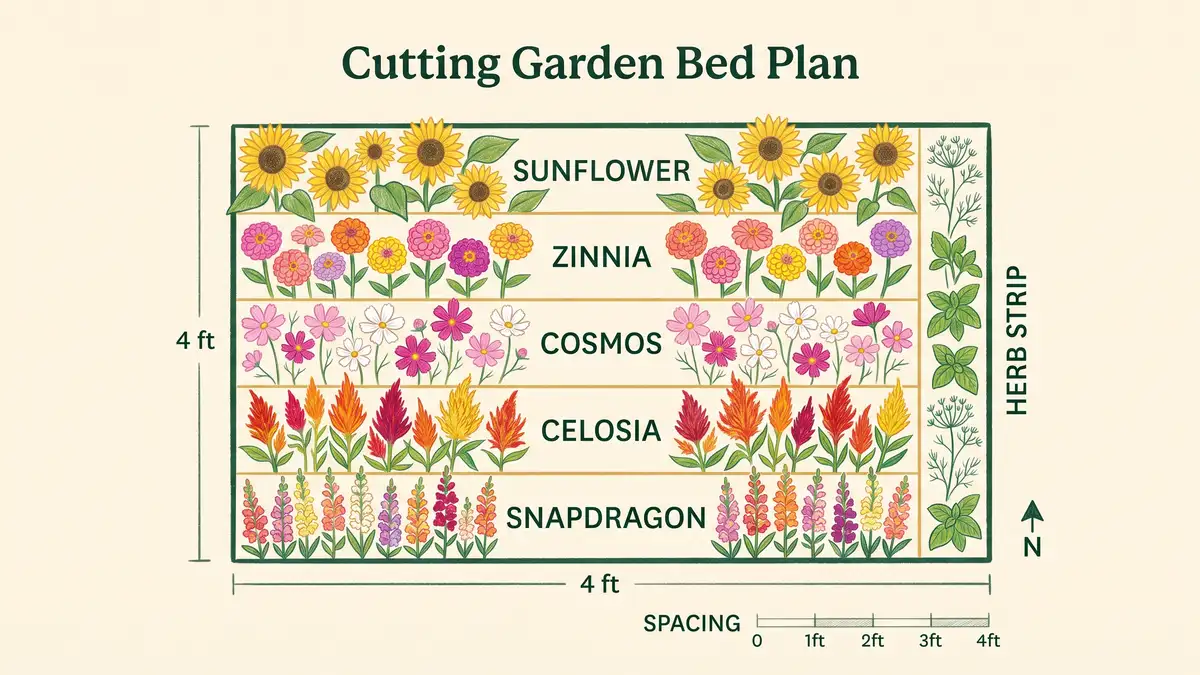
- A 4x8 ft bed plan with herbs doing double duty
- What flower strips actually do for beneficial insects
- The Japanese beetle mistake almost everyone makes
Key Takeaway
Plant cut-and-come-again annuals at production spacing, pinch them young, and cut hard and often. Zinnia, cosmos, celosia and dahlia reward harvest with more stems. Snapdragon, stock and single-stem sunflowers give you one cut each, so plant those in succession instead.
Which Flowers Are Worth Growing for Cutting?
The single most useful distinction is between plants that branch when you cut them and plants that give you one stem and stop. Fill most of the bed with the first group.
| Flower | Spacing | Days to First Cut | Vase Life | Type |
| Zinnia | 9-12 in | 60-70 | 7-10 days | Cut-and-come-again |
| Cosmos | 12-18 in | 70-85 | 5-7 days | Cut-and-come-again |
| Celosia | 9-12 in | Summer onward | 7-10 days, dries well | Cut-and-come-again |
| Dahlia | 12-18 in | 80-90 from tubers | 5-7 days | Cut-and-come-again |
| Snapdragon | 6-9 in | 80-100 | 10-14 days | One cut per spike |
| Stock | 6-9 in | 9-14 weeks | 10-14 days | One cut |
| Sunflower (single-stem) | 6-9 in | 60-80 | 5-10 days | One cut |
Sources: Utah State Extension, Zinnia Cut Flower Production, USU, Cosmos Cut Flower Production, USU, Celosia Cut Flower Production, UMass Extension, Field Grown Annuals for Cut Flowers
Note the spacing. Utah State's zinnia trials put plants at 9 to 12 inches, and snapdragons go in at 6 to 9. That is production density, not display density. The plants shade out weeds, hold each other up, and push stems upward chasing light rather than sprawling sideways.
Why Should You Pinch Healthy Seedlings?
Because one strong stem is worth less to you than six decent ones, and pinching is how you trade the first for the second.
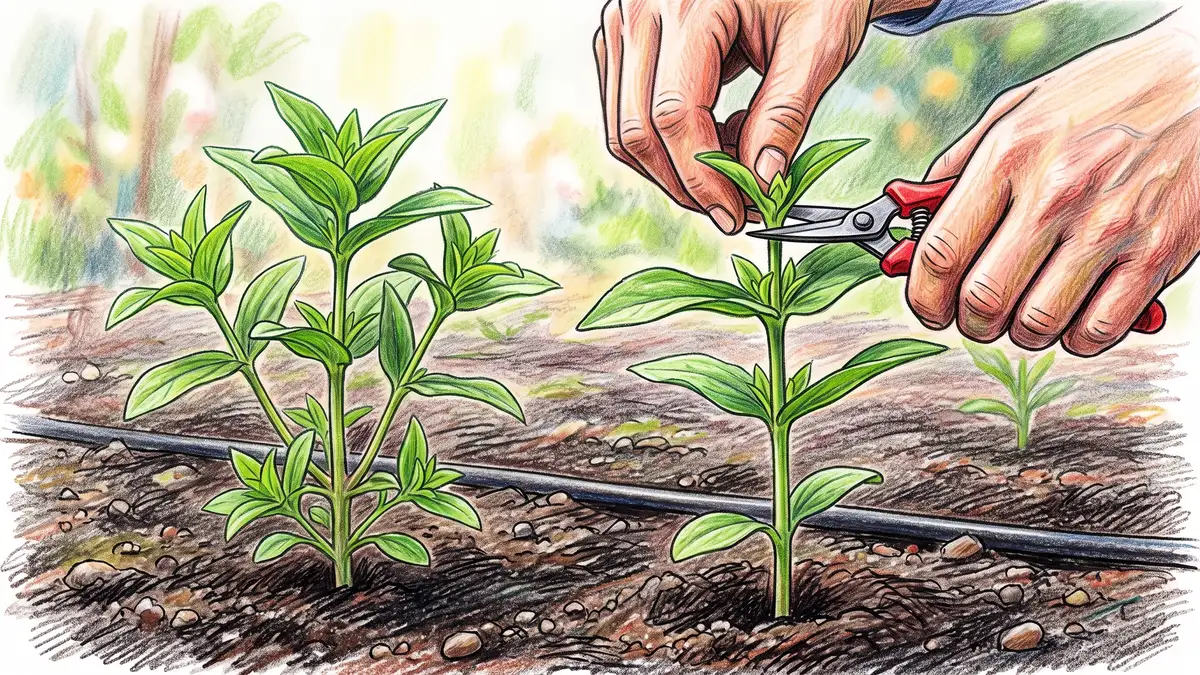
Cutting out the main growing tip forces the plant to activate the side buds it was suppressing. Utah State Extension recommends pinching cosmos when plants reach 8 to 10 inches tall, leaving two or three true leaves, and reports that pinched plants branch more and produce more stems that meet the 14-inch minimum length. The same logic applies to zinnia, celosia, snapdragon and dahlia.
Being straight about the evidence: extension sources give the recommendation and the rationale, but published stem-count comparisons between pinched and unpinched plants are surprisingly thin. This is a case where trial observation and near-universal commercial practice carry the argument rather than a controlled dataset.
Why This Works: Apical Dominance, Working For You
A growing tip produces auxin that travels down the stem and suppresses the lateral buds below it. Remove the tip and the signal stops, so those buds break. Gardeners meet this the first time they prune a shrub and wonder why it got bushier. In permaculture terms it is a form of coppicing at seedling scale: you are using the plant's own regrowth response as the yield strategy, the same principle behind managing branching sunflowers for multiple heads instead of one.
How Do You Lay Out a Cutting Garden Bed?
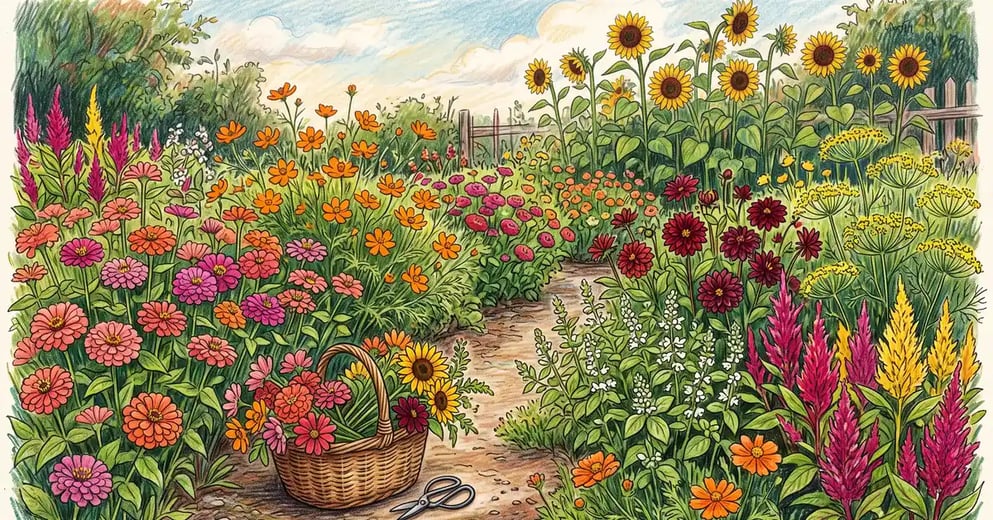
Keep beds 3 to 4 ft (0.9-1.2 m) wide so you can reach the center from both sides without stepping in and compacting the soil. Run bands across the bed rather than long rows down it, with the tallest at the north end.
Tallest at the north, shortest at the south
Sunflowers and tall amaranth at the back, snapdragons and gomphrena at the front. Everything gets light and nothing shades its neighbor out of the harvest.
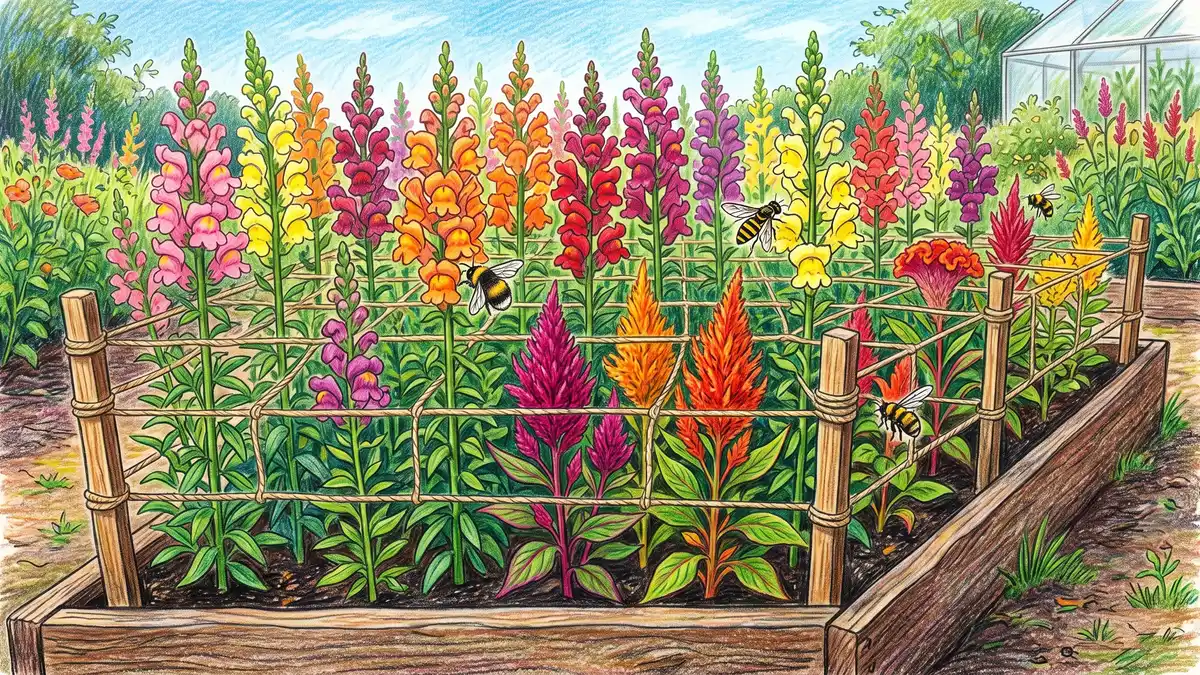
Put support netting up before you need it
Horizontal mesh stretched over short stakes, with stems growing up through the squares, is how commercial growers get straight stems. Install it when plants are a few inches tall. Trying to add it later means damaged plants.
Sow successions every 2-3 weeks
Essential for one-cut crops like sunflower and stock. A single sowing gives you one glorious week and then nothing. Three sowings give you two months.
Give one edge to flowering herbs
Dill, cilantro, fennel and basil left to flower along a bed edge feed hoverflies and parasitoid wasps. Cost you almost nothing in space and they earn their keep.
Soil expectations are not exotic. Cut flowers want the same well-structured, moisture-retentive ground everything else wants. If you are starting from compacted lawn, that is a soil building project before it is a flower project.
Does Companion Planting Help in a Flower Bed?
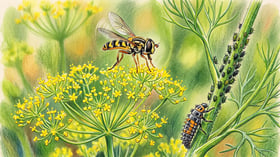
For beneficial insects, yes, with real data behind it. For the folk claim that certain plants repel pests by scent, mostly no.
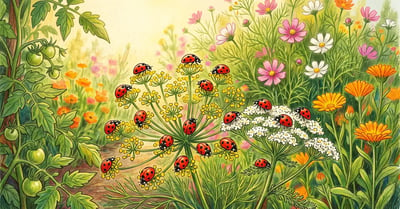
A SARE-funded study of wildflower plantings beside crop fields found significantly more natural enemies, mostly parasitoid wasps, near flower strips than in control fields. Trap catches averaged 4.7 versus 3.8 in the first year and 4.0 versus 2.8 in the second. More usefully for a home gardener, the effect reached 40 meters into the crop, which is further than most backyards are deep. The whole garden sits inside the influence zone.
That is the case for letting a strip of dill and cilantro bolt on purpose. The umbels are exactly the shallow, accessible flowers that hoverflies and small parasitoid wasps can feed from, and their larvae are what eat your aphids.
What does not hold up as well is the idea that marigolds or alliums repel pests from neighboring flowers by smell alone. Treat those pairings as neutral-to-mildly-helpful, and rely on habitat for predators instead. Our companion planting chart flags which pairings have evidence behind them.
Do Not Buy a Japanese Beetle Trap
University of New Hampshire Extension is blunt: Japanese beetle traps are useless as control because they attract more beetles to your yard than they catch. The beetles feed on more than 400 plant species, zinnia and cosmos among them, skeletonizing leaves and chewing buds. What works is hand-picking into soapy water in the morning or early evening, when they are sluggish, and doing it regularly rather than once.
How Do You Cut and Condition Flowers So They Last?

Cut in the early morning while stems are full of water and the day has not started pulling moisture out of them. Carry a bucket of clean water into the garden and put stems straight in, rather than laying them in a basket to wilt.
Strip every leaf that would sit below the waterline. Submerged foliage rots, the bacteria multiply, and blocked stems are the usual reason flowers flop after two days.
On flower food, the research is more species-specific than the packets suggest. UMass Extension's work on preservative solutions reports that most flowers benefit from roughly 2 percent sugar with a biocide, that Physostegia vase life doubled at 2 percent, and that gladiolus does well at 4 to 6 percent. But zinnias are damaged by sugar above 1 percent, and chrysanthemums and China asters do fine with none at all. The generic advice to add a spoonful of sugar to any vase is actively wrong for some of what you just cut.
Why This Works: Harvest Pressure Is the Whole System
A cut-and-come-again annual reads a harvested stem the same way it reads a browsing deer: lose the tip, break the side buds, try again. You are not extracting from the plant so much as running it in a loop where your take is the trigger for its next flush. That is the same disturbance-and-response relationship behind grazing rotations and coppice, applied to a flower bed. Stop cutting and zinnias set seed and quit, which is why flowers grown for the vegetable bed behave differently from the same species grown for the vase.
Frequently Asked Questions
Are zinnias perennials?
No. The common garden zinnia, Zinnia elegans, is a warm-season annual that completes its life cycle in one growing season and dies at first frost. It will not come back the following year from the same roots. It does self-seed readily in mild climates, so you may find volunteers appearing where last year's plants dropped seed, but those are new plants rather than regrowth. For a reliable cutting garden, sow fresh each spring after the soil has warmed.
How tall do zinnias get?
It depends entirely on the variety, and this matters more than most seed packets admit. Cutting-garden varieties in the Benary's Giant class produce 12 to 24 inch stems in Utah State's trials, which is what you need for a vase. Dwarf bedding varieties top out around 8 to 12 inches and are effectively useless for cutting. Read for stem length rather than plant height, and pinch young plants to push branching, which lengthens the stems that follow.
What should you not plant with zinnias?
Nothing chemically harms zinnias, so the real constraints are practical. Avoid planting them where anything will shade them, since they need full sun to produce well. Avoid crowding them below their recommended 9 to 12 inch spacing, because dense, still air among the foliage encourages powdery mildew, which zinnias are prone to. And avoid siting them next to a permanent structure that blocks airflow. Most "never plant these together" lists for flowers are folklore rather than measured effects.
How often should you cut flowers from a cutting garden?
More often than feels comfortable. Cut-and-come-again species like zinnia, cosmos, celosia and dahlia respond to harvest by producing more stems, and stop producing once they are allowed to set seed. Cut every two or three days through the peak of the season, taking stems deep into the plant rather than snipping just below the flower. Deep cuts trigger longer replacement stems. If you have more flowers than you need, cut anyway and give them away; leaving them on ends the harvest early.
What are the easiest cut flowers for beginners?
Zinnia first, by a distance. It germinates fast, tolerates heat, produces from around 60 to 70 days after sowing, and branches harder the more you cut it. Cosmos and celosia are nearly as forgiving, and celosia has the bonus of drying well for winter arrangements. Sunflowers are easy but mostly one cut per plant, so sow them in succession. Save dahlias and snapdragons for a second season, since both need more attention to timing and support.
Should you add sugar to the vase water?
Only if you know what you cut. UMass Extension's research shows most flowers benefit from about 2 percent sugar alongside a biocide, and some species gain a great deal. But zinnias are damaged by sugar concentrations above 1 percent, and chrysanthemums and China asters perform fine without any. A commercial flower-food packet used at the labeled rate is the safer default for a mixed bunch. Whatever you use, clean water, a clean vase and stripped lower leaves matter more than the additive.
Get the Weekly Dig
One practical permaculture guide a week, written for gardeners who do this on weekends: companion pairings that hold up under scrutiny, and the ones that do not. Free, no spam, unsubscribe any time.
Join the Weekly DigResources
- Utah State Extension — Zinnia Cut Flower Production in Utah (spacing, timing, stem length)
- Utah State Extension — Cosmos Cut Flower Production in Utah (pinching guidance)
- Utah State Extension — Celosia Cut Flower Production in Utah
- UMass Extension — Field Grown Annuals for Cut Flowers
- UMass Extension — Sugar and Acidity in Preservative Solutions for Field-Grown Cut Flowers
- Iowa State Extension — Getting Started With Cut Flowers
- NC Cooperative Extension — Creating a New Cut Flower Garden
- UNH Extension — Beetles on Ornamental Plants (Japanese beetle management)
- SARE — Wildflower Plantings and Natural Enemy Abundance (final report GNC07-086)