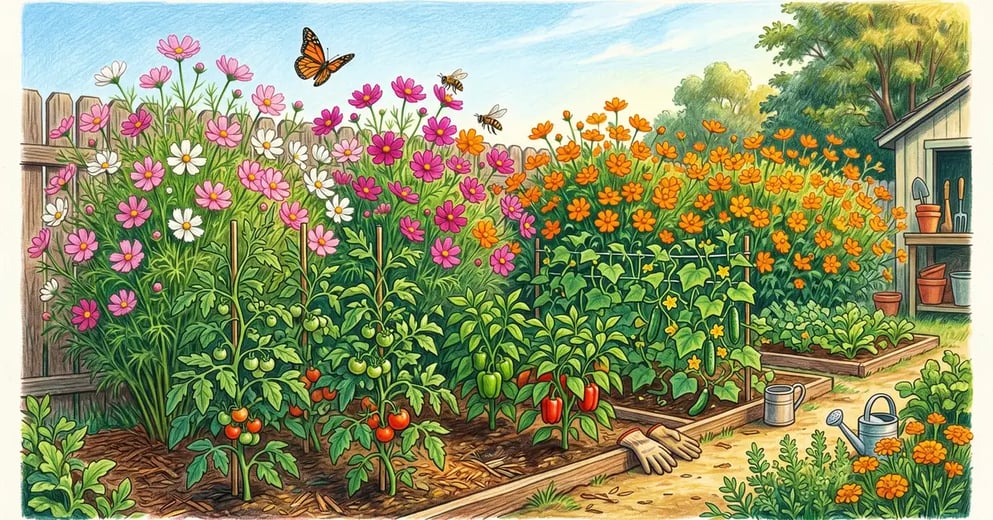

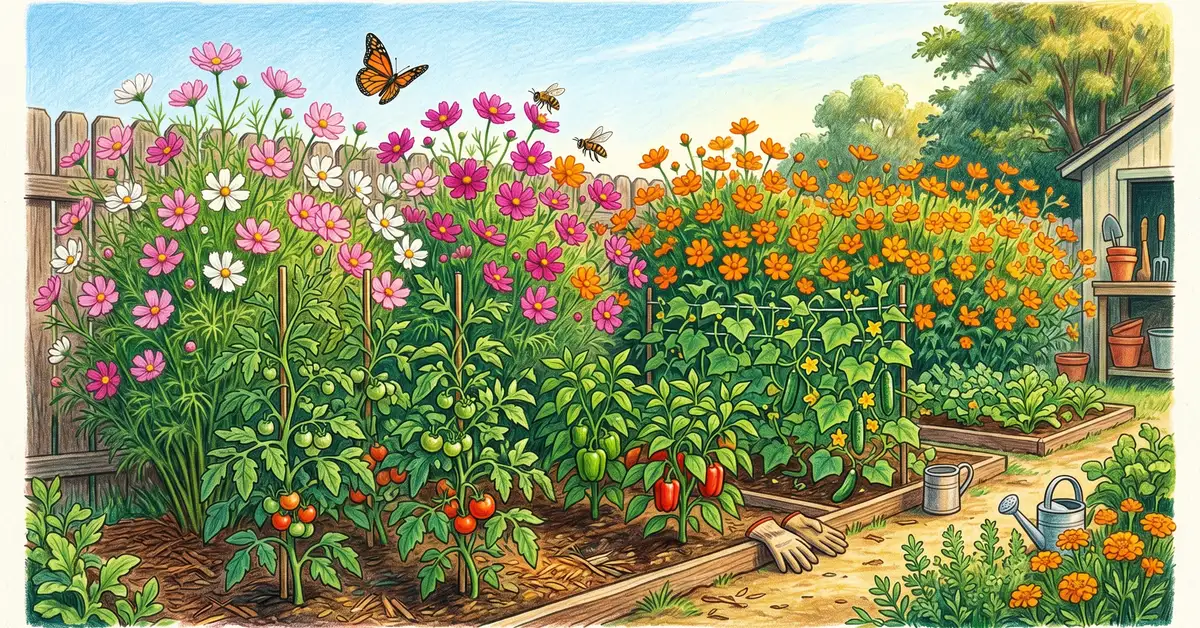
If you only have time to grow one flower in your vegetable garden this year, make it cosmos. A single packet of seed costs less than a coffee, the plants tolerate the worst soil you have, they bloom from July to frost, and they pull more beneficial insects into your beds than almost any other annual. This is not garden mysticism. It is open, accessible pollen on simple flowers and a clear track record in Penn State and UC IPM trials.
Two species, one job
Two cosmos species dominate US gardens, both native to Mexico and Central America. Cosmos bipinnatus (garden cosmos) grows 3 to 6 ft (0.9 to 1.8 m) tall with pink, white, or magenta single-form blooms. Cosmos sulphureus (sulphur cosmos) is shorter (2 to 4 ft / 0.6 to 1.2 m), faster to bloom, and produces intense orange and yellow flowers. Both are warm-season frost-tender annuals across USDA zones 2 to 11. Cite the Missouri Botanical Garden profiles for each species.
Why this works
Cosmos flowers are wide, open, and shallow. The pollen and nectar sit on a flat yellow disk at the center of eight simple petals. This shape gives short-tongued beneficial insects (hoverflies, lacewings, parasitic wasps, native sweat bees) easy access. Compare a tube-shaped flower like salvia: only long-tongued bumblebees and hummingbirds can reach inside. Penn State Extension's Center for Pollinator Research consistently ranks cosmos among the top home garden annuals for beneficial insect diversity.
The six beneficials that come for cosmos
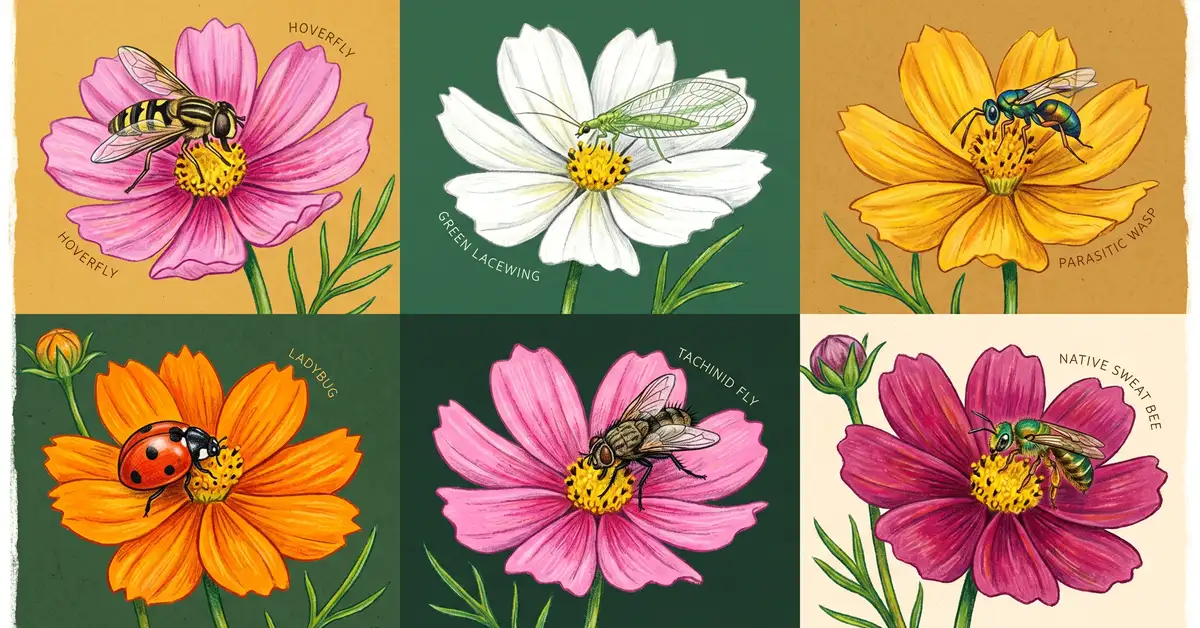
Plant a stand of cosmos and these six show up within a few weeks of bloom. Each one earns its place in your vegetable garden.
| Beneficial insect | What its larvae eat | Why it matters in your garden |
| Hoverflies (Syrphidae) | 50 to 400 aphids per larva | Top aphid predator; mimics bees but does not sting |
| Green lacewings (Chrysopidae) | Aphids, thrips, whitefly, mites | "Aphid lions" larvae eat 200+ aphids each |
| Parasitic wasps (Braconidae, Ichneumonidae) | Caterpillar interiors (cabbage worm, hornworm) | Tiny, harmless to humans, devastating to pest caterpillars |
| Tachinid flies | Caterpillars, beetle grubs | Lay eggs on tomato hornworm; classic biocontrol |
| Ladybugs (Coccinellidae) | Aphids, scale, mealybugs | 5,000+ aphids per ladybug lifetime |
| Native bees (Halictidae, Apidae) | N/A (adults pollinate) | 15-25% yield boost on cucumber, squash, peppers (Penn State) |
Sources:; Penn State Extension Pollinator Research.
The single-form principle
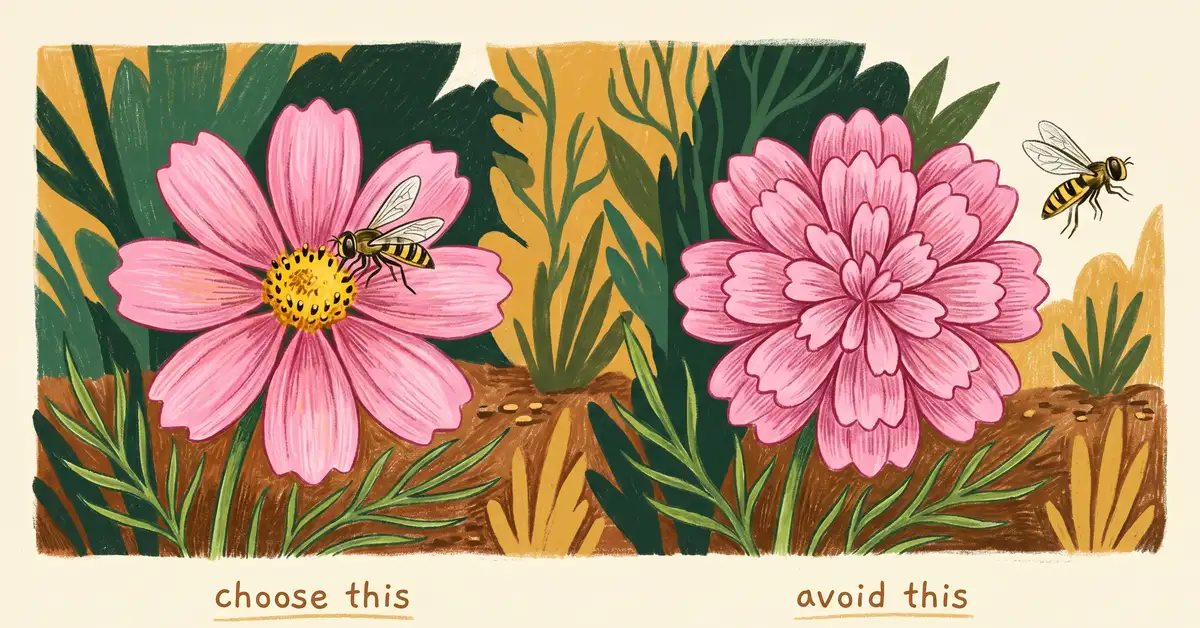
The single biggest mistake first-time cosmos companion planters make is buying double-form varieties. The "Double Click" and "Sea Shells" lines look gorgeous in a catalog but the extra petals fill the center disk and block insect access to pollen. Picking the right cultivar is the difference between a pollinator magnet and an expensive lawn ornament.
| Cultivar | Form | Pollinator value | Notes |
| 'Sensation' (C. bipinnatus) | Single | Excellent | Tall (5-6 ft), classic pink and white mix |
| 'Sonata' (C. bipinnatus) | Single | Excellent | Shorter (24 in), bushier, good for borders |
| 'Picotee' (C. bipinnatus) | Single | Excellent | White with red edges |
| 'Bright Lights' (C. sulphureus) | Single | Excellent | Orange/yellow mix, 3-4 ft |
| 'Cosmic Orange' (C. sulphureus) | Single | Excellent | Intense orange, dwarf (12-18 in) |
| 'Double Click' | Double | Poor | Pretty but blocks pollen access; avoid for companion use |
| 'Sea Shells' | Tubular | Poor | Curved petals reduce access; avoid for companion use |
Cultivar references:.
Best vegetable pairings
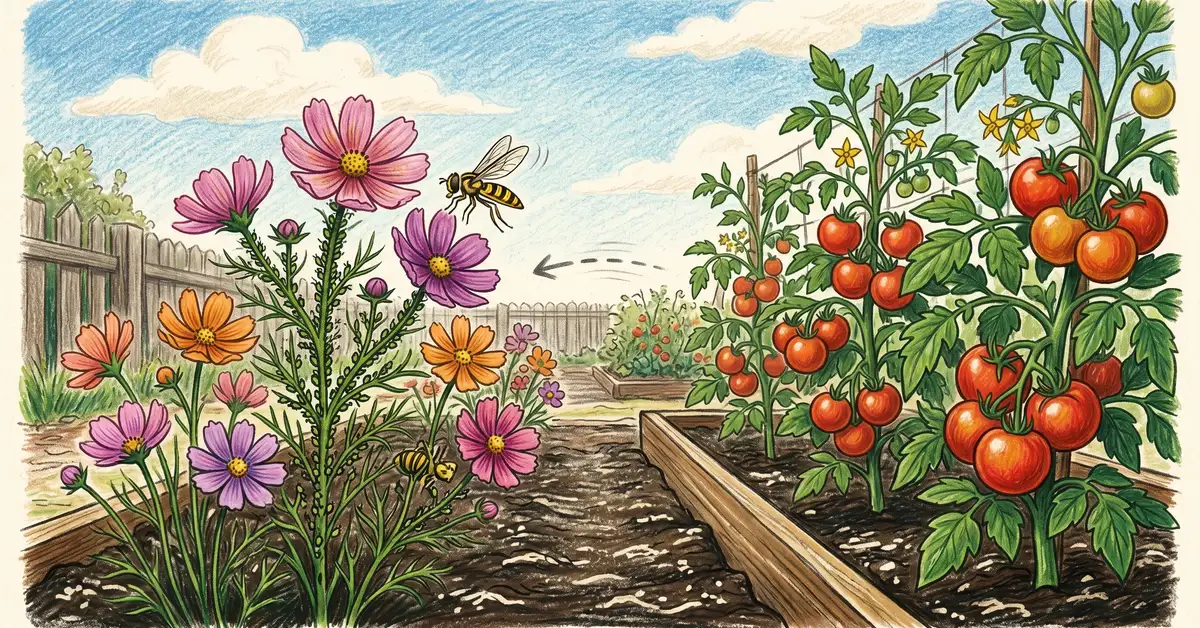
| Vegetable | How cosmos helps |
| Tomatoes | Trap crop for aphids; attracts tomato hornworm parasitoids |
| Cucumbers | Pollinator attraction = 15-25% yield boost (Penn State) |
| Squash & zucchini | Pollinator attraction critical for fruit set |
| Brassicas (cabbage, kale, broccoli) | Parasitic wasps reduce cabbage worm damage |
| Beans & peas | Cosmos pollinators improve bean set |
| Sweet peppers | Hoverflies attracted to cosmos eat aphids on peppers |
| Corn | Tall cosmos partners well aesthetically; bonus insectary |
The insectary border concept
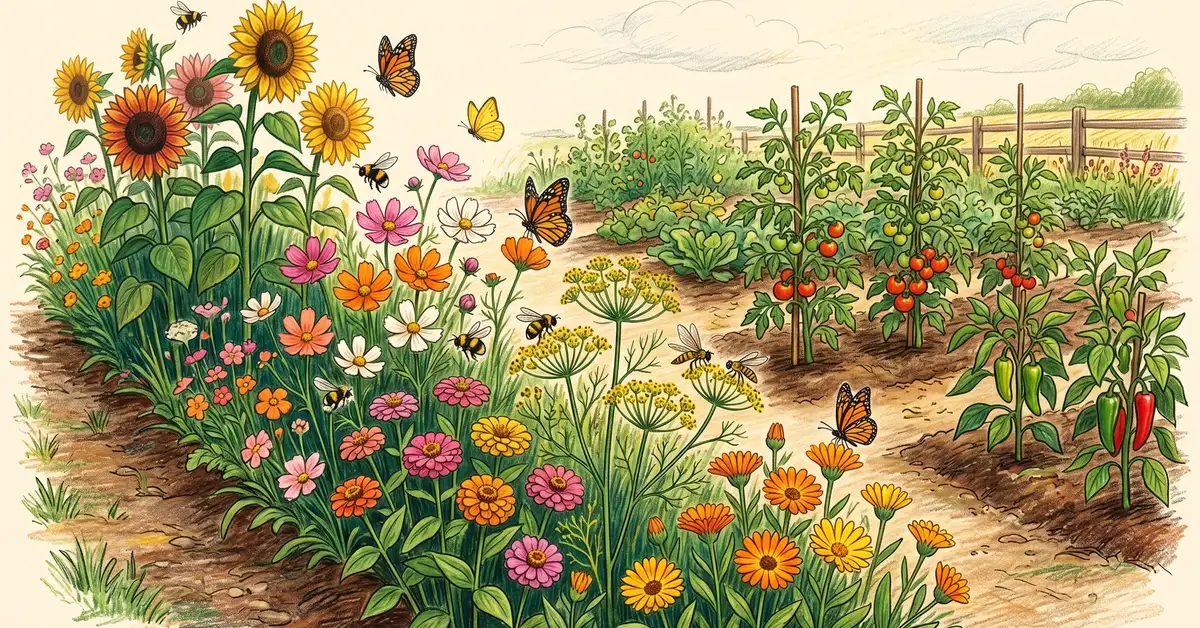
Cosmos works well as a standalone but works better as part of an insectary border, a 3 to 5 ft (0.9 to 1.5 m) wide strip of beneficial-insect flowers running along the edge of your vegetable beds. Mix cosmos with three other flower-form categories to provide a continuous bloom calendar from late spring through frost.
- Umbel forms (umbrella-shaped): dill, fennel, cilantro left to flower, anise hyssop. Best for parasitic wasps.
- Aster forms (open daisy shape): cosmos, zinnia, sunflower, calendula, marigold. Best for hoverflies, ladybugs, native bees.
- Spike forms: mountain mint, salvia, agastache. Best for bumblebees.
- Tubular forms: nasturtium, scarlet runner bean. Best for hummingbirds.
A single 4 ft (1.2 m) wide insectary border running 20 ft (6 m) along the long edge of a 20 ft by 30 ft (6 m by 9 m) vegetable garden gives you about 80 sq ft (7.4 sq m) of dedicated pollinator habitat. That is enough to fundamentally change the insect ecology of the whole garden.
Sowing, growing, and the lazy gardener's calendar
Order seed in late winter
One packet of Cosmos bipinnatus 'Sensation' and one packet of Cosmos sulphureus 'Bright Lights' covers a 4 ft by 20 ft (1.2 m by 6 m) border. Total cost: $6 to $12 in 2026.
Direct sow after last frost
Wait until soil reaches 60°F (15°C). Most US zones: mid-April to late May. Scatter seeds, rake lightly into soil, water in. Germination in 7 to 10 days.
Thin to spacing
Once seedlings reach 4 in (10 cm), thin to 12 to 18 in (30 to 45 cm) apart. Crowded cosmos gets powdery mildew; spaced cosmos blooms longer.
Do not fertilize
Cosmos blooms best in poor to average soil. Rich soil produces 6 ft tall leafy plants with few flowers. Resist the temptation to feed.
Pinch first buds (optional)
When plants reach 12 in (30 cm), pinch the top growing tip. This delays first bloom by a week but creates bushier plants with 2-3x more flowers over the season.
Stake the tall ones
'Sensation' and other 5-6 ft cultivars will flop in wind without support. Stake at 24 in (60 cm) or grow against a fence.
Save seed in August or September
Each spent flower head produces 8 to 20 seeds. Collect into a paper envelope, label, store dry. Seed remains viable 3 to 5 years. You will not need to buy cosmos seed again.
Seed saving and self-sowing
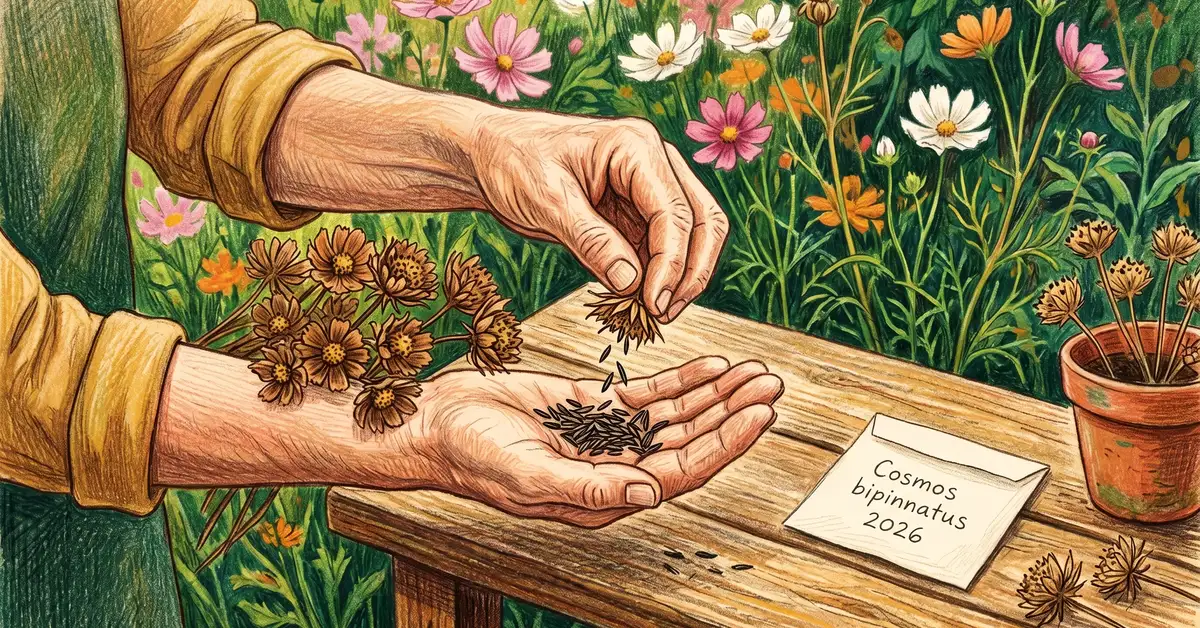
Cosmos is one of the easiest annuals in North America to save seed from. The flower heads dry on the plant; each one produces 8 to 20 long, dark, slender seeds; pinch the dried head and the seeds fall into your palm. Store dry in paper envelopes labeled with species and year. Properly stored cosmos seed remains viable for 3 to 5 years. If you leave some flowers to drop seed in place, cosmos volunteers reliably in the same spot the following spring. By year three you typically have so much volunteer cosmos that you are pulling it as weed.
The economics for the weekend gardener
The cost-benefit math on cosmos is unusually one-sided. Total year-one investment for a 4 ft by 20 ft (1.2 m by 6 m) insectary border anchored by cosmos:
| Item | Cost (US 2026) |
| Cosmos seed (2 packets) | $6 to $12 |
| Companion flower seed (zinnia, dill, calendula, marigold) | $10 to $20 |
| Stakes for tall varieties | $5 to $15 |
| Labor (planting + occasional weeding) | 3 to 5 hours over the season |
| Total year-one outlay | $21 to $47 |
| Year-two cost (you saved seed) | $0 to $10 |
Get the Weekly Dig
One practical permaculture guide a week, written for gardeners who do this on weekends: companion pairings that hold up under scrutiny, and the ones that do not. Free, no spam, unsubscribe any time.
Join the Weekly DigFrequently Asked Questions
What is companion planting cosmos?
Companion planting cosmos means growing cosmos flowers (Cosmos bipinnatus or Cosmos sulphureus) intentionally alongside vegetables to attract beneficial insects. The simple, open flowers give easy pollen and nectar access to hoverflies, lacewings, parasitic wasps, ladybugs, tachinid flies, and native bees, which then prey on garden pests and pollinate vegetable crops.
What does cosmos attract to the garden?
Six categories of beneficial insects: hoverflies (50 to 400 aphids per larva), green lacewings (aphid lions, 200+ aphids each), parasitic wasps (lay eggs in cabbage worms and hornworms), tachinid flies (parasitize hornworms and beetle grubs), ladybugs (5,000+ aphids per lifetime), and native bees (15-25% yield boost on cucumber, squash, and peppers per Penn State research).
What grows well with cosmos?
Cosmos pairs excellently with tomatoes (trap crop for aphids), cucumbers and squash (pollinator boost), brassicas (parasitic wasp attraction reduces cabbage worm damage), beans, peas, sweet peppers, and corn. Cosmos has no significant allelopathic conflicts so it is safe alongside almost any vegetable.
Do double-form cosmos attract pollinators?
Much less than single-form. Double-form cultivars ('Double Click', 'Sea Shells') fill the center disk with extra petals, blocking insect access to pollen and nectar. For pollinator and beneficial insect attraction, always choose single-form (8 simple petals with an open yellow center) cultivars like 'Sensation', 'Sonata', 'Picotee', 'Bright Lights', or 'Cosmic Orange'.
When should I plant cosmos seeds?
Direct sow outdoors after last frost when soil temperature reaches 60°F (15°C). In most US zones this is mid-April to late May. Germination takes 7 to 10 days. First bloom comes 50 to 65 days after sowing. For continuous bloom, sow successive batches every 3 to 4 weeks until 90 days before your fall frost date.
How do I plant cosmos to attract beneficial insects?
Sow in a 3 to 5 ft (0.9 to 1.5 m) wide border at the edge of your vegetable beds. Mix Cosmos bipinnatus (tall, pink/white) with Cosmos sulphureus (shorter, orange/yellow) for season-long bloom. Space plants 12 to 18 in (30 to 45 cm) apart in full sun (6+ hours). Do not fertilize; rich soil produces leafy plants with few flowers.
Does cosmos repel garden pests?
Not directly. Cosmos does not chemically repel squash bugs, cucumber beetles, Japanese beetles, or other common pests. The pest reduction benefit is indirect, through beneficial insect attraction. Hoverflies, lacewings, parasitic wasps, and ladybugs drawn to cosmos prey on aphids, caterpillars, and soft-bodied pests on adjacent vegetables. Plan a 1 to 2 season ramp-up period for predator populations to build.
Can I save cosmos seed from my garden?
Yes, easily. Cosmos is one of the simplest annuals for seed saving. Let some flowers go to seed in late summer. Each spent flower head produces 8 to 20 dark, slender seeds. Pinch dried heads to release seeds into your palm. Store dry in paper envelopes labeled with species and year. Properly stored cosmos seed remains viable 3 to 5 years. Cosmos also self-sows reliably; volunteers appear in the same spot the following spring.
Resources
- Missouri Botanical Garden Plant Finder
- Penn State Center for Pollinator Research
- UC Integrated Pest Management (Natural Enemies)
- Xerces Society for Invertebrate Conservation
- Johnny's Selected Seeds (cosmos cultivar guide)
- Seed Savers Exchange
- Botanical Interests
- Monarch Joint Venture (monarch corridor planting)