
What Is a Worm Tower and Does It Actually Work?
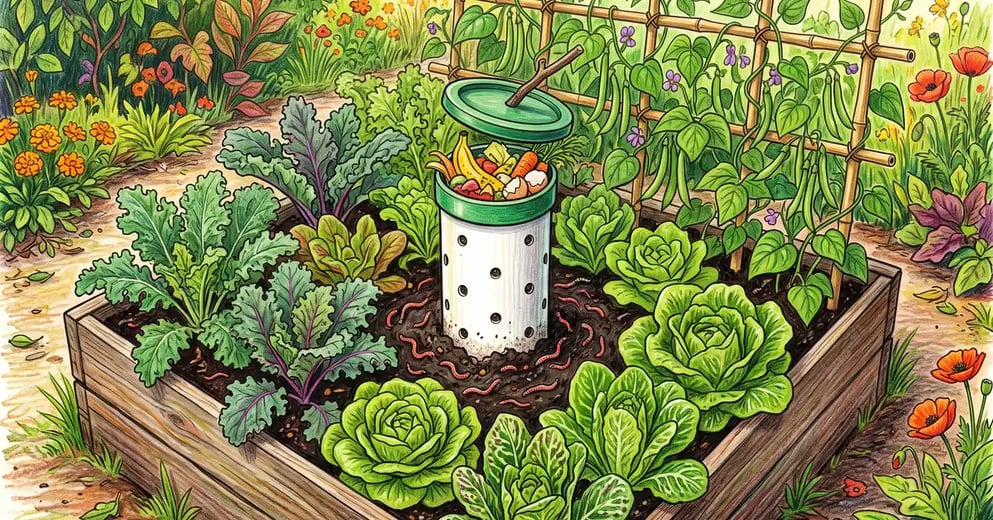
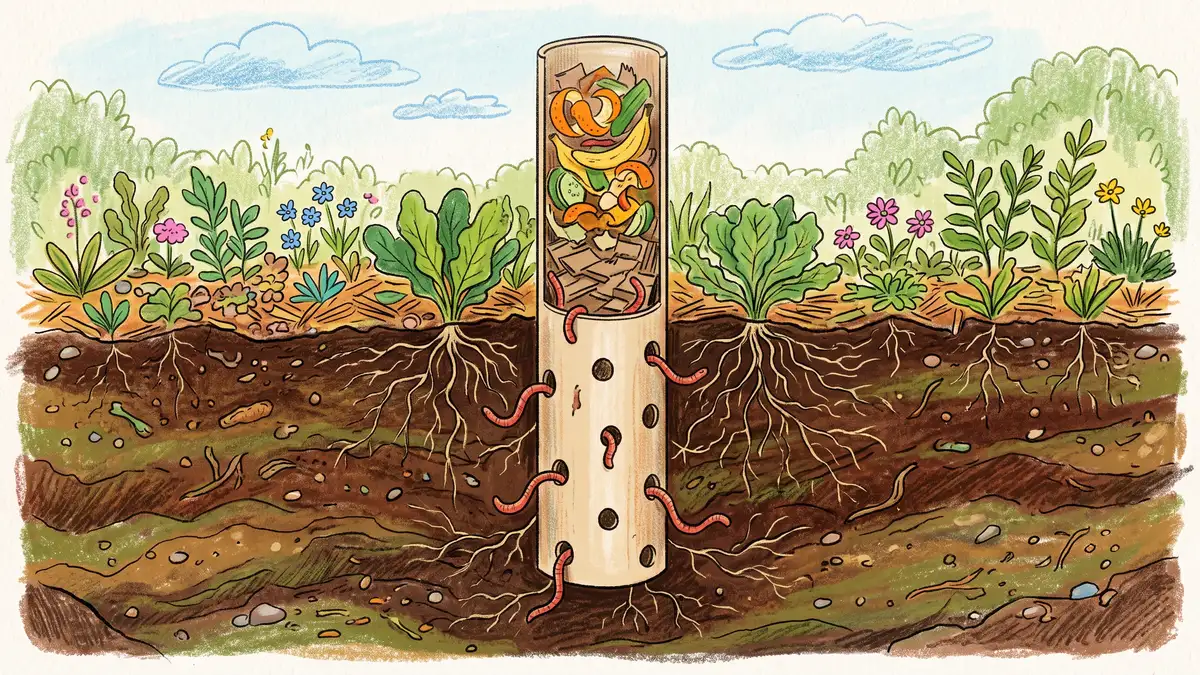
It works. It just does not work at the scale most people assume. A worm tower is a perforated pipe or bucket sunk vertically into a bed, filled with kitchen scraps, with composting worms free to move between the tower and the soil around it. Castings end up in the root zone without you ever harvesting or spreading anything.
That is the appeal, and it is real. The problem is throughput, and nobody sells you the arithmetic up front. So here it is before anything else, because if you are running a homestead you need to know what one tower actually processes before you build six.
The EPA's home composting guidance recommends starting a worm system with about one pound of worms, roughly 1,000 individuals, and notes that only around seven of the roughly 9,000 described earthworm species are actually suited to vermicomposting. A pound of red wigglers processes roughly a quarter of its body weight per day under ordinary conditions. A 4-inch tower does not hold anything close to a pound of worms.
What we will cover:
- The capacity math, so you size the system correctly the first time
- Build dimensions: diameter, depth, hole placement
- What the vermicompost yield research actually shows
- Where towers beat a bin and where a bin wins outright
Key Takeaway
A worm tower is a delivery mechanism, not a waste-processing system. It puts a small amount of very high-quality castings exactly where roots are, with zero handling. If your goal is to process a household's kitchen waste, you need a bin or a pile. Run both.
How Much Can One Worm Tower Really Process?
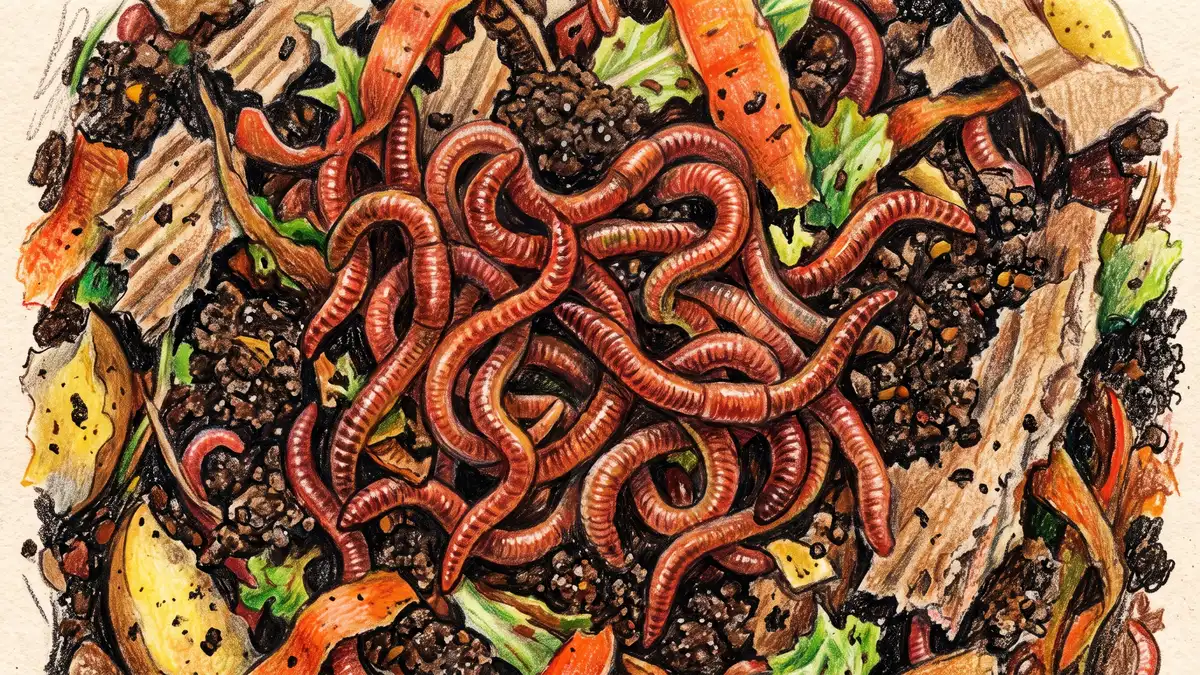
Roughly an ounce a day. Work it through and the number is unavoidable. A 4-inch pipe gives you about a twelfth of a square foot of working surface. At a typical vermicomposting stocking density of about 2 pounds of worms per square foot, that tower supports somewhere near 2.6 ounces of worms.
Apply the EPA's 25 percent of body weight per day and you get about 0.7 ounces of material processed daily. Use the optimistic half-body-weight figure that circulates in worm-farming marketing and you still only reach about 1.3 ounces.
A two-person household generates several pounds of compostable kitchen waste a week. Five towers would handle around a third of a pound a day between them. That is not a criticism of the method, it is a sizing constraint, and knowing it stops you from being disappointed in October.
| System | Worm Mass | Daily Intake (25% rule) | Castings Recovery |
| Single 4-in. worm tower | ~2.6 oz. | ~0.7 oz. | Stays in the bed |
| Six 4-in. towers | ~1 lb. total | ~4 oz. | Stays in the bed |
| Standard worm bin (1 lb. worms) | 1 lb. | ~4 oz. | Harvestable in bulk |
| Bin scaled to 4 sq. ft. | ~8 lb. | ~2 lb. | Harvestable in bulk |
Sources: US EPA, Composting At Home (feeding rate), NC State Extension, Raising Earthworms (Eisenia fetida) (stocking density and worm biology)
There is a second constraint worth knowing. NC State Extension classifies earthworms as epigeic, endogeic or anecic by habitat, and notes that epigeic species such as Eisenia fetida do not construct permanent burrows and live in organic-rich surface layers, under leaf litter or in manure heaps. They are not deep diggers. Deep burrowing is what anecic species like Lumbricus terrestris do, and those are not the worms in your tower.
So the picture of red wigglers ranging widely through your bed distributing castings is optimistic. They will move into rich, moist soil near the tower. They will not colonise the far corner of a dry bed. Our comparison of red wigglers and garden earthworms covers why that distinction matters.
Is the Castings Payoff Worth It?
On a per-ounce basis, yes, and the trial data is not subtle. Zergaw and colleagues ran a two-season field experiment on hot peppers using coffee pulp vermicompost produced by Eisenia fetida and Dendrobaena veneta. At the highest application rate the plots produced 222.3 fruits per plant against 24.3 in the residual control, with peak yields of 26.2 tonnes per hectare.
A separate seedling study from the University of South Florida's tropical ecology program found lettuce grown in food-waste vermicompost reached 6.4 cm height versus 5.6 cm in ordinary food-waste compost, with cilantro at 3.4 cm against 2.5 cm. Vermicompost beat plain compost, and both beat the soil control.
Read the Application Rates Before You Get Excited
Those pepper trials applied vermicompost at tens of tonnes per hectare. A worm tower produces a few pounds of castings a season, spread over a few square feet. The biology is real, the effect size is real, and the dose is nothing like what you will achieve from a tower. Treat towers as a supplement to your soil program, not as the program.
Need the gear for this?
The bins that work, the ones that leak, and a DIY build that costs under $30.
Compare worm bin setupsHow Do You Build One?
About 20 minutes and $10 to $15 per tower if you buy pipe, or free if you have a spare 5-gallon bucket.
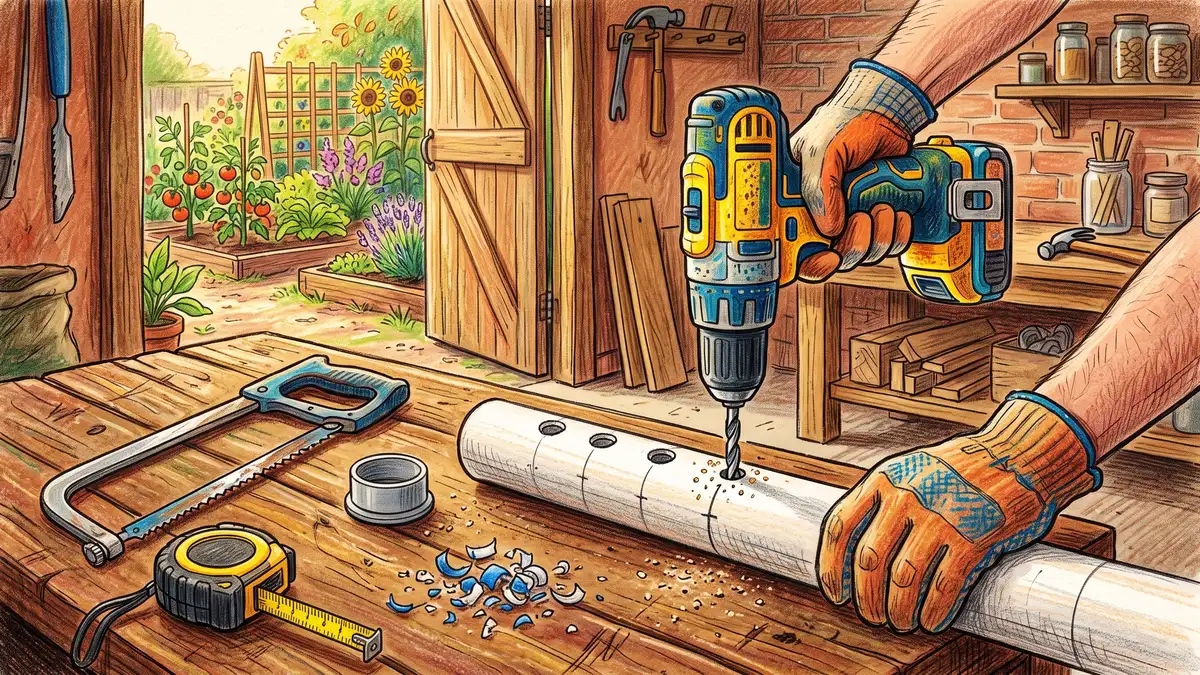
Cut pipe to 18-24 inches
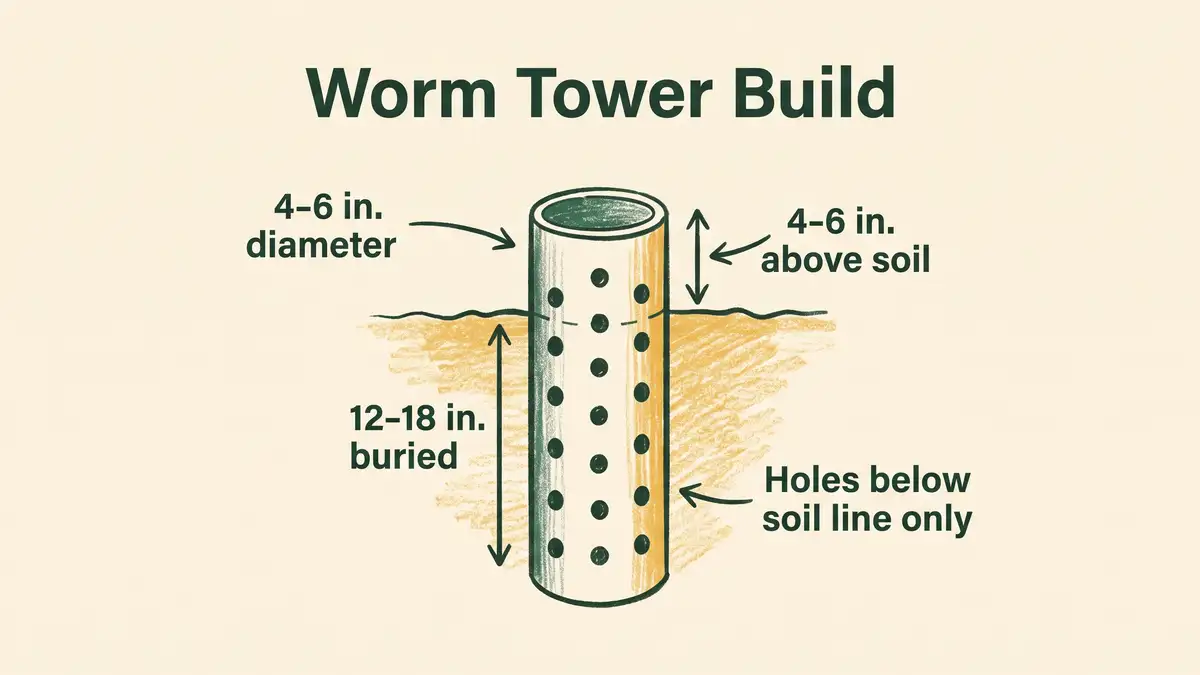
Use 4 to 6 inch diameter PVC or a bucket with the bottom cut out. Larger diameter holds more worms and more food, which given the throughput math is worth the extra dollar. Anything under 4 inches is decorative.
Drill holes on the buried portion only
Half-inch holes, roughly 2 inches apart, over the bottom 12 to 18 inches. Nothing above the soil line, or you get flies and escapees. Worms and moisture move through those holes in both directions.
Sink it, leaving 4-6 inches proud
Bury 12 to 18 inches, keeping the rim above grade so you can lift the lid without shovelling soil out of it. Firm the soil around the outside so there is no air gap. Position it centrally: worms will not travel far.
Charge with bedding, then worms, then food
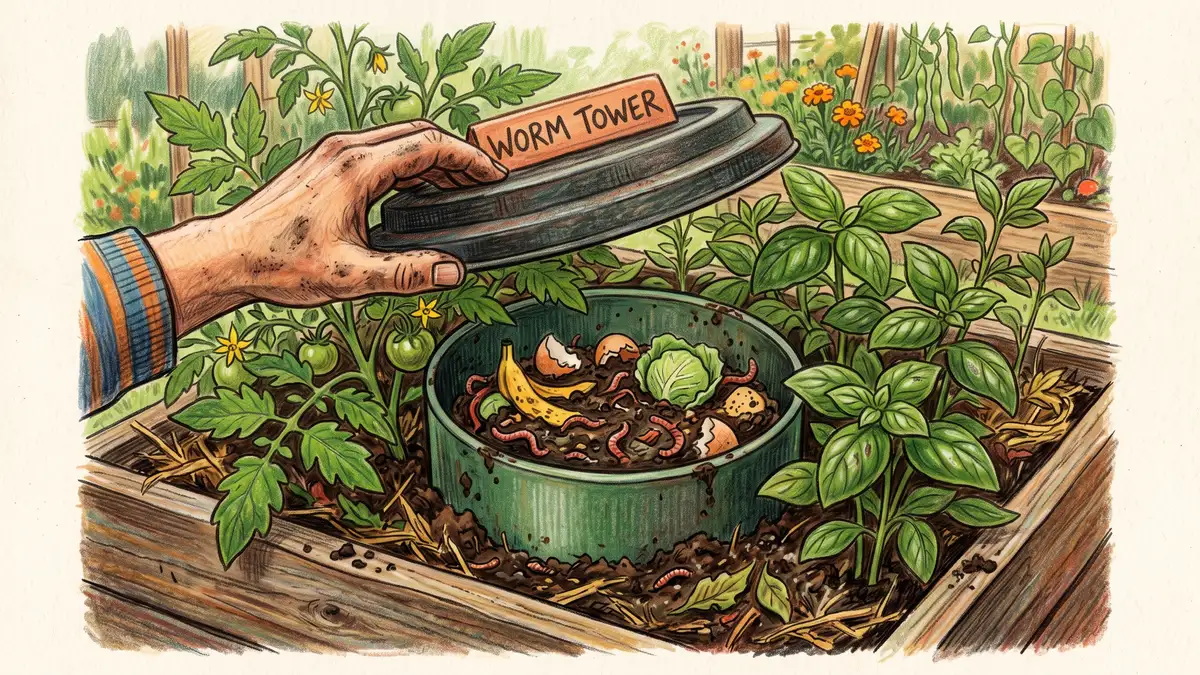
Start with several inches of damp shredded cardboard or leaf mould, add your worms, then bury scraps under a couple of inches of bedding as EPA recommends. Cap it. Feed weekly, in small amounts, and stop if food is accumulating.
Why This Works: Relative Location
Permaculture design puts elements where their outputs land directly on another element's inputs, cutting out transport and handling. It is the same logic that governs zoning in a food forest. A worm bin in the shed means carrying scraps out and castings back. A tower in the bed collapses both trips to zero. That is the actual advantage here, and it is a design advantage rather than a biological one. Same worms, better placement.
What About Temperature and Winter?
The soil buffers you, but only so far. NC State reports that Eisenia fetida live and breed between 55 and 85 °F, with 60 to 80 °F recommended for intensive cocoon production. Red wigglers survive up to about 100 °F and down to around 30 °F, but feeding and reproduction fall away sharply as they approach either end. Practitioner temperature guidance narrows the productive band further, to roughly 65 to 77 °F ideal with 39 to 90 °F tolerable.
In-ground placement helps at both extremes. Soil at 12 to 18 inches swings far less than air, so a buried tower runs cooler in August and warmer in November than an exposed bin. In cold zones the tower will still go dormant, and worms will either move deeper into the surrounding soil or die back. Assume you are restocking in spring north of about zone 6, or plan for overwintering worms indoors.
Skip the things that kill worm systems regardless of format: meat, dairy, oils, salty food, and large volumes of citrus or onion. Our complete worm food list has the full inventory, and the troubleshooting guide covers what to do when a system goes sour.
Frequently Asked Questions
Do worm towers actually work?
Yes, within a narrow definition of working. They reliably convert small volumes of kitchen scraps into castings and deposit them in the root zone with no handling. They do not process meaningful household waste volumes, and they do not produce harvestable bulk vermicompost. If you measure them as a waste system, they fail. If you measure them as a slow-release fertility point inside a bed, they succeed.
How many worm towers do I need per raised bed?
One per 4 by 4 foot bed is the practical minimum, and two is better in a 4 by 8. This is driven by dispersal rather than throughput. Red wigglers are epigeic surface feeders that do not build permanent burrows, so casting distribution concentrates near the tower rather than spreading evenly. More towers, closer together, beats one large one.
What worms go in a worm tower?
Eisenia fetida, red wigglers, are the standard choice and the species EPA singles out for home vermicomposting. European nightcrawlers (Eisenia hortensis) also work and tolerate slightly cooler conditions. Do not use common garden earthworms or nightcrawlers from bait shops: Lumbricus terrestris is a deep-burrowing anecic species that feeds on surface detritus, not concentrated scraps in a tube, and will simply leave.
How long before a worm tower produces results?
Six to twelve weeks before you see castings accumulating in the tower, and a full season before soil changes near it are obvious. Populations build slowly, roughly doubling over three to six months under good conditions, so a tower started in spring is at its most productive in late summer. Plant the heaviest feeders nearest to it in year two, not year one.
Is a worm tower better than a compost bin?
Different jobs. A bin holding a pound of worms processes roughly the same daily volume as six towers and gives you castings you can move wherever you want. A tower gives you zero handling and direct root-zone delivery. Most homesteads should run a bin or pile for volume and towers for placement. Our worm bin setup guide covers the volume side.
Get the Weekly Dig
One practical permaculture guide a week, written for gardeners who do this on weekends: composting that actually finishes and soil that feeds itself. Free, no spam, unsubscribe any time.
Join the Weekly DigBuild two, size your expectations to the arithmetic, and they will earn their $20 several times over. For the wider system, see our complete vermicomposting guide and what the castings do once they are in the ground in the soil health guide.
Resources
- NC State Extension — Raising Earthworms (Eisenia fetida) for a Commercial Enterprise
- US EPA — Composting At Home: Vermicomposting Basics
- Cornell Waste Management Institute — Composting and Vermicomposting Resources
- Cornell eCommons — Vermicompost: A Living Soil Amendment
- UF/IFAS Extension — Vermicomposting
- WSU Extension Whatcom County — Worm Composting
- Zergaw et al. (2023) — Coffee Pulp Vermicompost Field Trial on Hot Pepper Yield
- University of South Florida — Growth Variation of Lettuce and Cilantro Under Compost and Vermicompost Treatments