
What Is the Difference Between Soil Structure and Soil Texture?
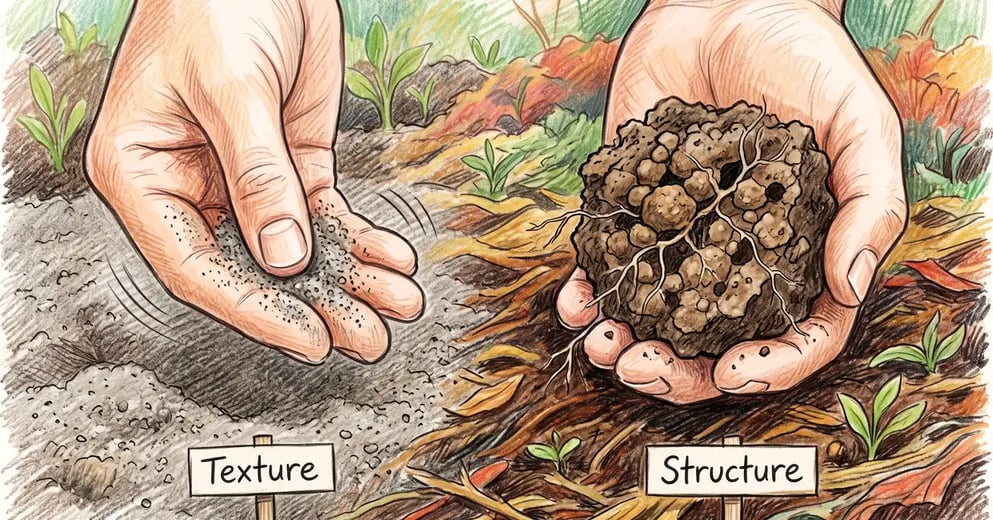
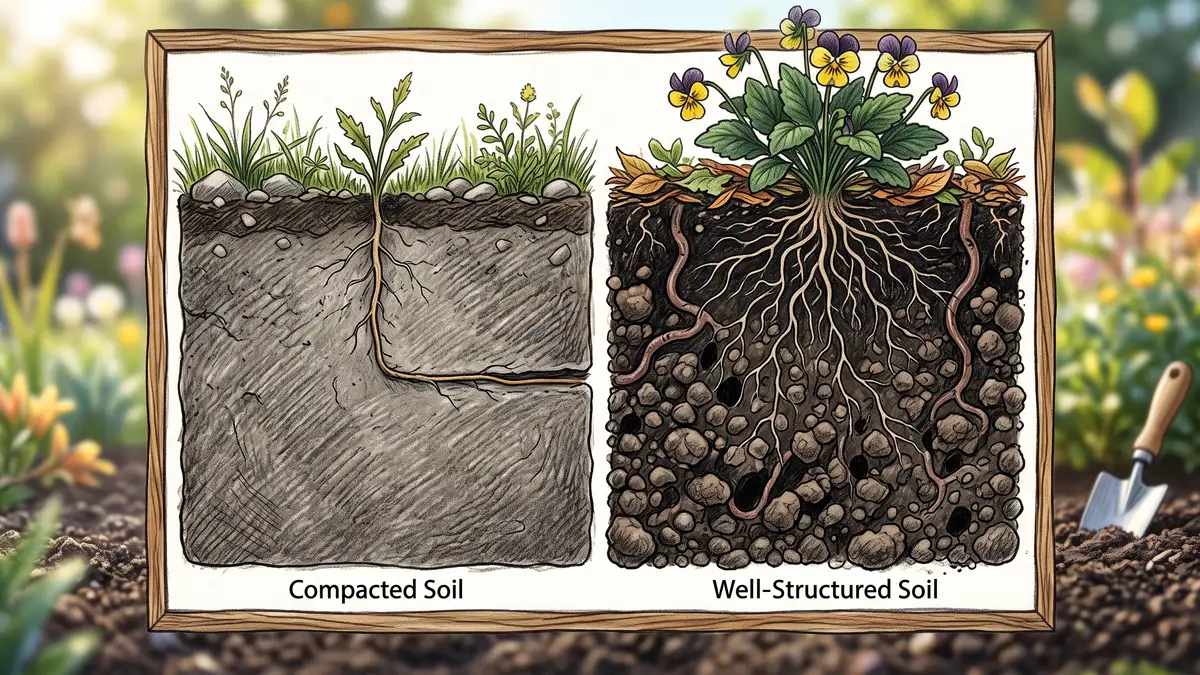
Texture is what your soil is made of. Structure is how those pieces are stuck together. Texture you inherited and cannot change. Structure you can wreck in an afternoon or build over years, and that difference is the whole reason this distinction matters. soil jar test compacted layers that stop roots
Texture is the weight proportion of sand, silt and clay in the fine-earth fraction of your soil. It came from the parent material your ground weathered out of, and short of importing enormous volumes of different soil, it is permanent. Structure is the arrangement of those particles into aggregates, and it is a living, changeable property driven by roots, fungi, worms, organic matter and how you treat the ground.
Gardeners spend a lot of energy trying to change the thing that is fixed and very little on the thing that responds. Below is how to identify both, and where to actually put the effort.
What we will cover:
- Two ten-minute home tests that tell you your texture without a lab
- The seven structure types, and which two mean you have a problem
- The bulk density numbers at which roots physically stop growing
- Why adding sand to clay soil almost never works, with the arithmetic
Key Takeaway
Texture sets your starting conditions. Structure determines whether your soil actually performs. A clay soil with good granular structure will outgrow a clay soil that has been compacted into a massive block, and the two can sit ten feet apart in the same garden with identical texture. Everything you do as a gardener acts on structure.
How Do You Find Out Your Soil Texture?
Two home tests get you close enough for any garden decision you will make. Neither needs equipment you do not already own.
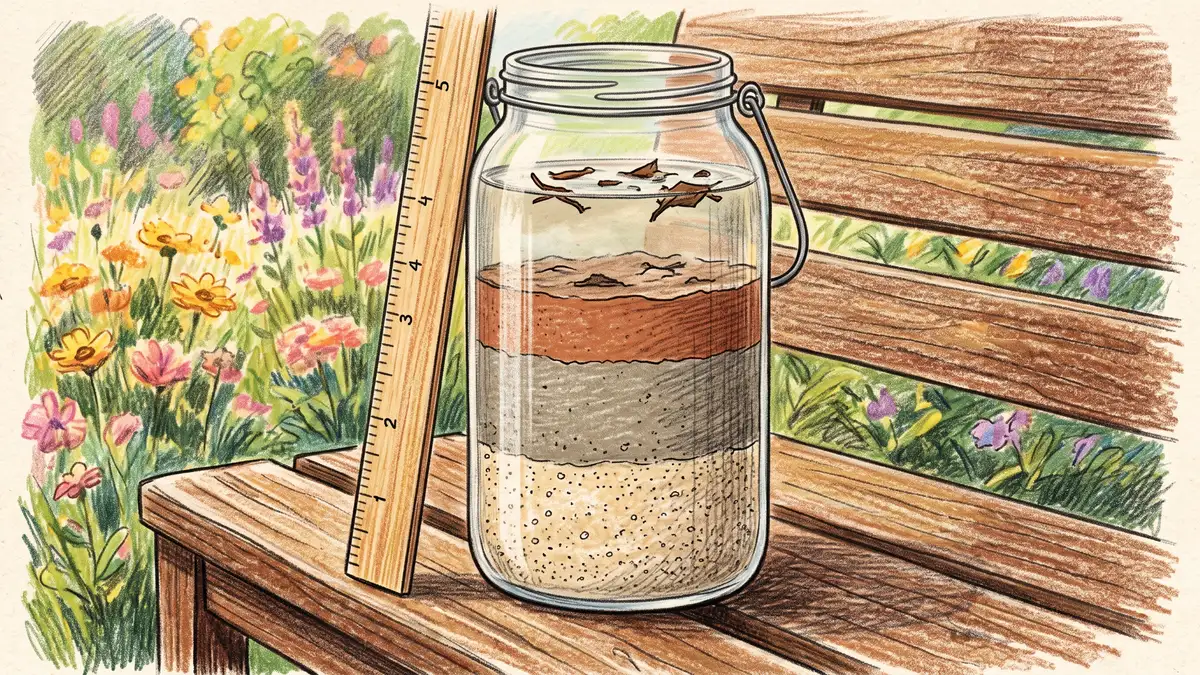
The jar test separates the particles by settling speed. Montana State University Extension's procedure is to fill a straight-sided jar one third with soil, top it up with water, add a teaspoon of dishwasher detergent as a dispersant, and shake hard. Then mark the layers as they settle: sand at 1 minute, silt at 6 hours, clay at 24 hours. Measure each band, work out the percentages, and read them off the triangle.
| Particle | Diameter (USDA) | Feels Like | Settles In |
| Sand | 2.0 to 0.05 mm | Gritty | 1 minute |
| Silt | 0.05 to 0.002 mm | Floury, smooth when dry | 6 hours |
| Clay | 0.002 mm and below | Sticky and plastic when wet | 24 hours |
Sources: USDA NRCS Soil Survey Manual, Chapter 3, Montana State University Extension
Fill a straight-sided jar one third with soil
Straight sides matter, because you will be measuring band depths against the glass. Pull soil from several spots in the bed and remove stones and roots first.
Add water and a teaspoon of dispersant
Top the jar up almost full, then add a teaspoon of dishwasher detergent or water softener. This stops the clay particles clumping together and settling early.
Shake hard, then mark at 1 minute, 6 hours, 24 hours
Sand drops out within a minute, silt over about 6 hours, clay by 24 hours. Mark the top of each band on the glass with tape as you go.
Convert the bands to percentages
Measure each band, divide by the total settled depth, and read the three percentages off the texture triangle or the USDA calculator.
Source: Montana State University Extension, Soil Texture Jar Test
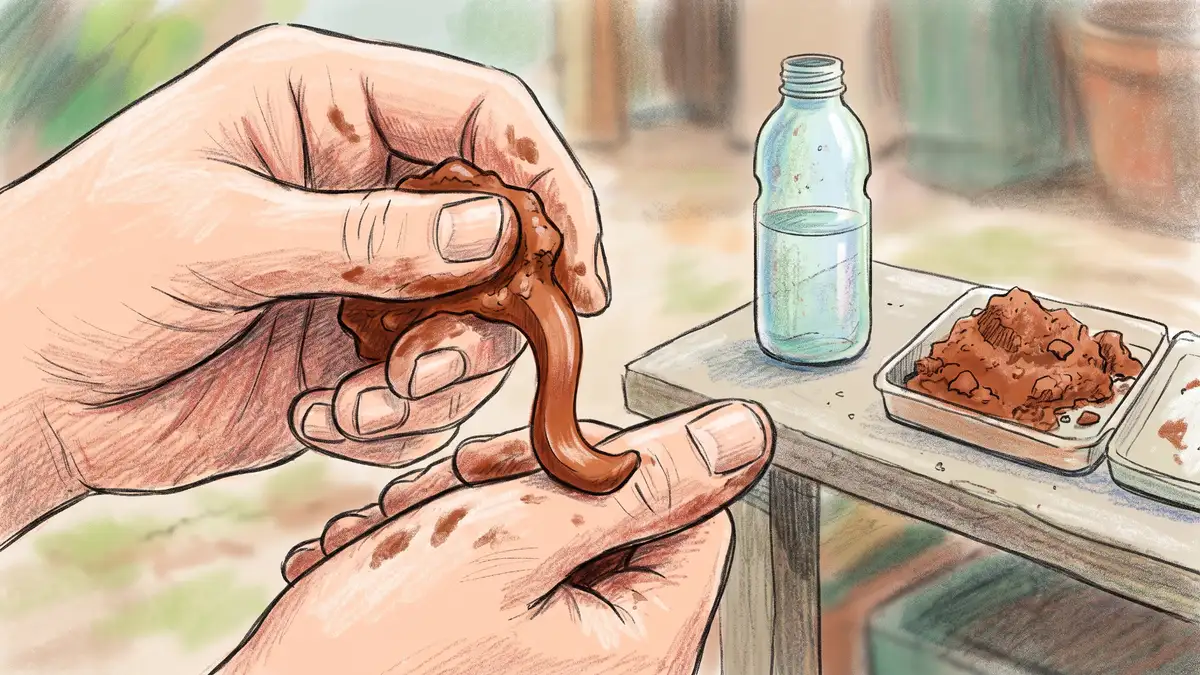
The ribbon test is faster and needs nothing but water. Take an egg-sized lump of soil, wet it until it just holds together, and squeeze it between thumb and forefinger to push a ribbon out over the edge of your thumb. NC State Extension's rule of thumb is that the longer the ribbon, the higher the clay content, and a ribbon of three quarters of an inch or more means a clayey soil. Anything shorter that cracks and breaks is in loam territory.
Once you have percentages, the USDA soil texture calculator will place you on the triangle without you having to squint at the diagonal axes. There are 12 classes, and the ones most gardens land in are sandy loam, loam, silt loam and clay loam.
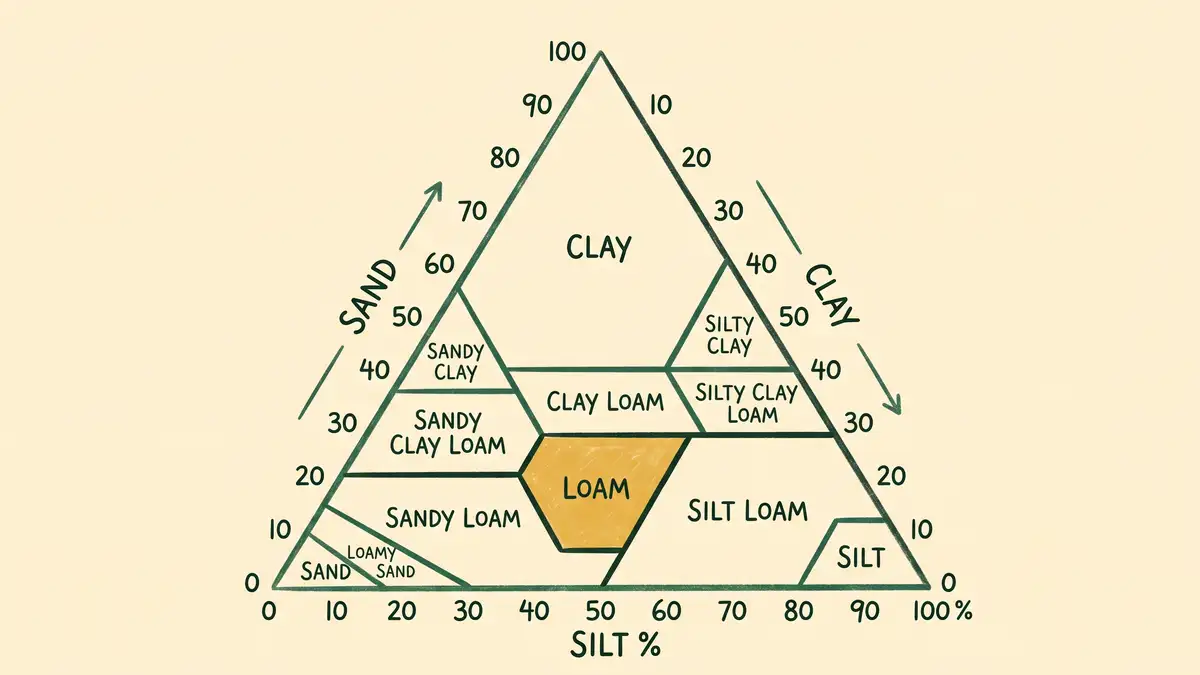
A few boundaries worth knowing, from the USDA definitions: a soil is clay at 40 percent clay or more, clay loam from 27 up to 40 percent clay, and loam from 7 up to 27 percent clay with 28 to 50 percent silt and no more than 52 percent sand. Note how little clay it takes to dominate the behaviour of a soil. At 27 percent clay you are already out of loam.
Texture Is Measured Without the Stones
Texture describes only the fine-earth fraction, meaning particles under 2 mm. Gravel and stones are screened out before the test. This is why a rocky garden can still classify as loam, and why your texture result may feel disconnected from what digging actually feels like.
What Are the Soil Structure Types?
Seven of them, and you can identify yours by breaking open a spadeful and looking at the shapes. Structure is described by grade (weak, moderate or strong), size, and type. Type is the shape of the aggregates, and it is the part that tells you most.
| Type | Looks Like | Verdict for a Garden |
| Granular | Small rounded crumbs, 1-10 mm | The target. Ideal topsoil |
| Subangular blocky | Rounded-edge cubes, 5-50 mm | Normal and fine in subsoil |
| Angular blocky | Sharp-edged cubes | Acceptable, denser than granular |
| Prismatic | Vertical columns, flat tops | Subsoil. Water moves down, not sideways |
| Columnar | Vertical columns, rounded tops | Subsoil, high-clay parent material |
| Platy | Thin horizontal plates | Problem. Blocks roots and water |
| Single grain | Loose particles, no aggregates | Structureless. Usually low-OM sand |
| Massive | One dense cohesive block | Problem. Compacted, few pores |
Sources: USDA NRCS Soil Survey Manual, Chapter 3, USDA NRCS Basic Soil Properties, Field Crop News
Granular is what you are aiming for in the top few inches. USDA's own summary is blunt about it: granular, loamy textured soils make the best farmland. Those small rounded crumbs give you macropores that drain and micropores that hold water, at the same time.
Platy is the one to watch for in a worked garden. Thin horizontal plates form where soil has been cultivated repeatedly to the same depth or walked on when wet, and they prevent or significantly impede downward root and water movement. If you dig and find a loose surface sitting on a thin dense layer that peels apart in sheets, that is what you have.
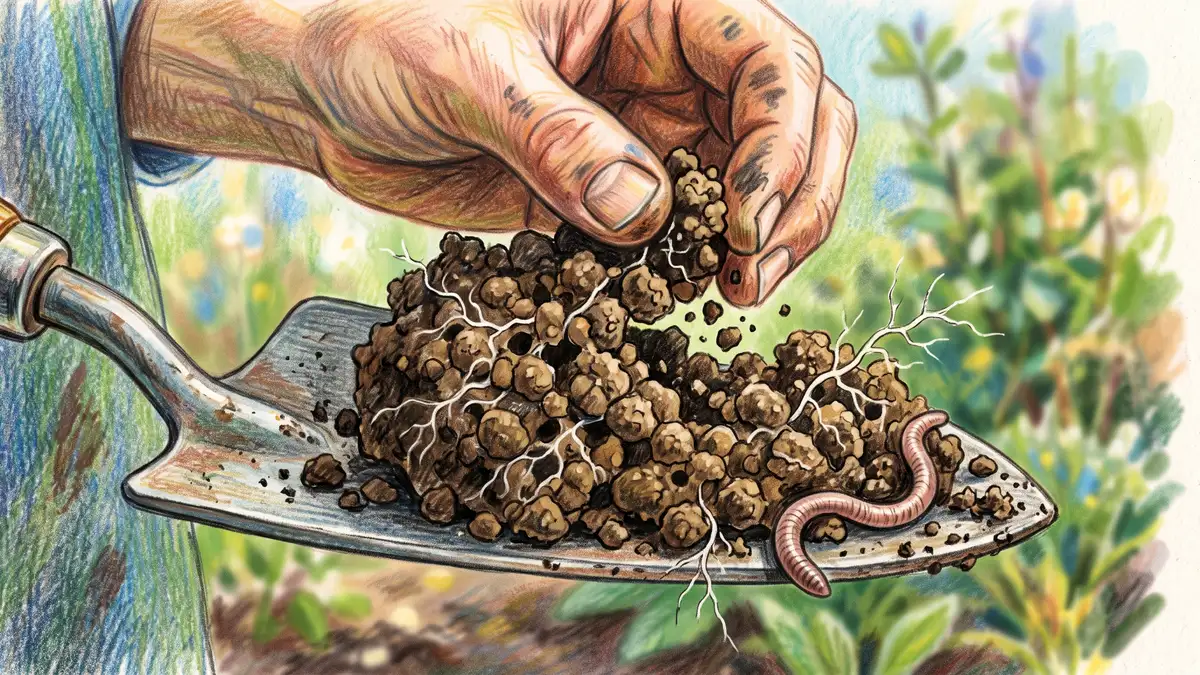
There is one more distinction worth carrying around, and it comes from the USDA soil survey glossary. A ped is a natural aggregate formed by soil processes, and its surfaces survive repeated wetting and drying. A clod is a lump produced by tillage. It looks like structure and behaves nothing like it, because it has none of the biological and chemical bonding that holds a ped together.
This is why a freshly rotavated bed can look beautifully crumbly in April and set like a brick after the first heavy rain. You made clods, not peds.
Why This Works: Aggregates Are Built, Not Made
Peds form because roots physically enmesh particles and exude sugars, fungal threads bridge across them, and earthworms pass soil through their guts and excrete it already aggregated. Every one of those is a biological process that takes time and needs living roots in the ground. That is the mechanism behind no-dig growing and permanent soil cover: you are not avoiding work for its own sake, you are leaving the organisms that build structure undisturbed long enough to do it.
Need the gear for this?
Which broadfork holds up in clay, which one suits a small bed, and what to skip.
See the broadfork picksWhen Does Compacted Soil Actually Stop Roots?
There are hard numbers for this, and they depend on your texture. Bulk density is the mass of dry soil per unit volume including its pore space, and USDA NRCS publishes thresholds for where root growth becomes restricted.
| Soil Texture | Ideal for Growth | Restricts Root Growth |
| Sandy | Below 1.60 g/cm³ | Above 1.80 g/cm³ |
| Silty | Below 1.40 g/cm³ | Above 1.65 g/cm³ |
| Clayey | Below 1.10 g/cm³ | Above 1.47 g/cm³ |
Source: USDA NRCS, Soil Quality Indicators: Bulk Density
Look at the clay row. Clay soils hit their restricting threshold at a much lower density than sand does, because what matters is not weight but the pore space between aggregates. This is texture and structure interacting: the same compaction event does more damage to clay than to sand.
You can also test structure directly without a lab. The slake test drops an air-dried aggregate into water and scores how well it holds together. The NRCS Soil Quality Test Kit Guide scores this from 0 to 6: an aggregate that loses half its structural integrity within 5 seconds scores a 1, while one that still has 75 to 100 percent of itself intact after five immersion cycles scores a 6. Run it on the same spot each autumn and you have a genuine measure of whether your practices are working.
Can You Change Your Soil Texture by Adding Sand?
Not at any volume you would realistically move. This comes up constantly with heavy clay, and the arithmetic settles it faster than the folklore does.
USDA classifies a soil as clay at 40 percent clay or more by weight. To move a clay soil down into the clay loam class you have to get its clay fraction below 40 percent of the total soil mass. That means adding sand in a proportion comparable to the mass of soil already in the bed, not a few bags across a border. For a bed 8 inches deep, you are talking about volumes that would be cheaper to solve by building a raised bed and importing topsoil outright.
The productive move is to stop trying. Texture is fixed, and a clay soil with strong granular structure and good organic matter grows excellent vegetables. Put the effort into structure instead, which responds to compost, mulch, roots and being left alone.
Key Takeaway
Test your texture once and write it down. It will not change, and knowing it tells you what to expect from drainage and watering. Then stop thinking about it. Structure is the variable under your control, and the practices that build it are the same ones you would do anyway: keep soil covered, keep living roots in the ground, add organic matter, and stay off the beds when they are wet.
Frequently Asked Questions
What is the difference between soil structure and soil texture?
Texture is the proportion of sand, silt and clay particles in your soil, measured by weight on the fraction under 2 mm. Structure is how those particles are bound together into aggregates, called peds. The practical difference is that texture is inherited from parent material and effectively permanent, while structure is created by biological activity and destroyed by compaction and tillage. Texture tells you what soil you have. Structure tells you how well it is currently working.
How do I test my soil texture at home?
Use the jar test or the ribbon test. For the jar test, fill a straight-sided jar a third full of soil, top with water and a teaspoon of dishwasher detergent, shake hard, then mark the settled layers at 1 minute for sand, 6 hours for silt and 24 hours for clay. For the ribbon test, wet an egg-sized lump and squeeze it out between thumb and forefinger; a ribbon three quarters of an inch or longer indicates a clayey soil, while a shorter one that cracks suggests loam.
What is the best soil structure for a garden?
Granular, meaning small rounded crumbs roughly 1 to 10 mm across with plenty of visible pore space between them. USDA describes granular, loamy textured soils as the best farmland, because the arrangement provides large pores that drain and admit air alongside small pores that hold water for plants. Blocky structure in the subsoil beneath is normal and fine. The two you do not want are platy, which blocks water and roots, and massive, which is compacted soil with almost no pores at all.
How do I know if my soil is compacted?
Dig a hole and look at the shape of what comes out. Compacted soil appears as massive structure, a dense cohesive block with no visible aggregates, or as platy structure, thin horizontal plates that peel apart. Roots turning sideways instead of growing down is a strong signal, as is water pooling on the surface long after rain. If you want a number, USDA gives bulk density thresholds where root growth is restricted: above 1.80 g/cm3 in sandy soils, 1.65 in silty soils and 1.47 in clayey soils.
Should I add sand to clay soil?
No, in almost every home garden situation. USDA classifies a soil as clay at 40 percent clay or more, so shifting it out of that class means diluting the clay fraction below 40 percent of the total soil mass, which requires adding sand at a volume comparable to the soil already there. That is not achievable with a few bags. Adding organic matter and improving structure gets you the drainage and workability you actually want, without trying to change something that is fixed.
How long does it take to improve soil structure?
Longer than a season and less than you might fear, though we would rather not quote a figure we cannot source. What is clear from the mechanism is that structure is built by roots, fungi and soil animals, so improvement tracks how continuously you keep living roots in the ground and organic matter on the surface. The honest answer is to measure it rather than guess: run a slake test on the same bed each autumn and score it 0 to 6. That gives you your own data instead of someone else's average. Our soil health guide covers the practices in more detail.
Does soil texture affect how often I water?
Yes, substantially. Sandy soils drain fast and need more frequent, lighter watering, while clay soils hold water far longer and are much easier to overwater. Silt sits between the two. This is one of the genuinely useful reasons to know your texture: it sets your baseline watering rhythm before you account for weather, mulch or crop. Combining a known texture with good structure and a mulch layer is what makes a bed forgiving, an idea explored further in our introduction to permaculture.
Get the Weekly Dig
One practical permaculture guide a week, written for gardeners who do this on weekends: building living soil without buying it in bags. Free, no spam, unsubscribe any time.
Join the Weekly DigResources
- USDA NRCS — Soil Survey Manual, Chapter 3: Examination and Description of Soil Profiles
- USDA NRCS — Soil Quality Indicators: Bulk Density
- USDA NRCS — Soil Quality Test Kit Guide (slake and aggregate stability tests)
- USDA NRCS — Glossary of Terms Used in Soil Survey and Soil Classification
- USDA NRCS — Basic Soil Properties
- USDA NRCS — Soil Texture Calculator
- Montana State University Extension — Soil Texture Jar Test
- NC State Extension — Soil Ribbons
- Soil Science Society of America — Soil Texture Triangle
- Field Crop News — Soil Structure