
What Happens When You Garden With Nothing?
Strip a garden down to almost nothing. No land you own. No hose. Rationed drinking water. Sand or rubble instead of soil. No money for seed, and no certainty you will be there next season. Then ask what people grow anyway, and how.
That is the situation in refugee camps and displacement settlements, and the answers coming out of them are among the most rigorous field tests of small-space food growing anywhere. UNHCR counted 117.3 million people forcibly displaced at the end of 2023. What those households worked out about water, vertical space and soil transfers directly to a rented yard, a balcony, or a drought-restricted suburb in Arizona. This is not a piece about charity. It is about design under constraint, which is what permaculture has always been for.
What you'll get:
- Measured yields from documented camp garden programmes
- The sack garden method, and how many plants one holds
- Water strategy when you have gallons, not a hose
- How to garden on land you have no right to dig
- Five techniques that transfer straight to a US backyard
Key Takeaway
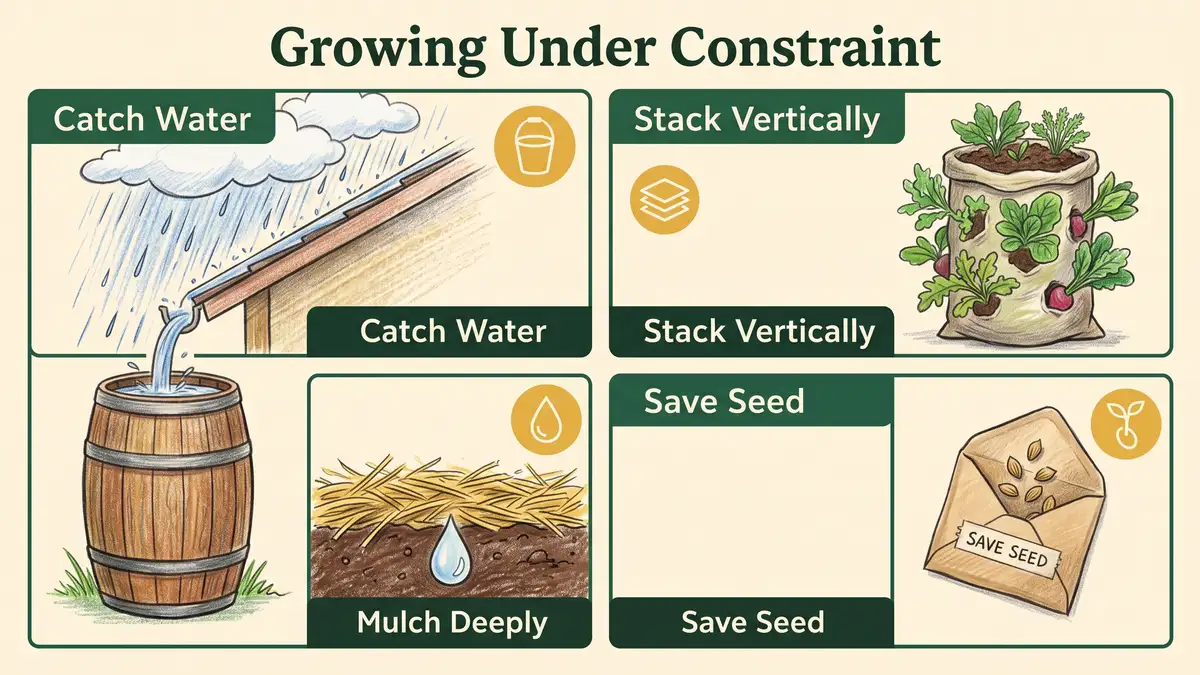
Constraint does not stop food production, it redirects it upward, into containers, and toward nutrient density rather than calories. The techniques that work in a camp are the same ones that work on a rented patio: stack vertically, catch every drop, build soil from waste, and choose crops you harvest again and again.
Why Would Anyone Plant a Garden They Might Have to Leave?
Because displacement lasts far longer than most people imagine. A US State Department policy analysis drawing on UNHCR data found the average length of major protracted refugee situations had reached about 26 years, with 23 of 32 such situations running past two decades. Once someone has been displaced six months, the odds strongly favour at least three more years.
Twenty-six years is not an emergency. It is a lifetime of growing seasons, which changes the maths completely: soil built this year pays back for two decades, and a fruit tree planted now fruits long before anyone goes home.
The second surprise is location. Roughly 78 percent of refugees live in cities, not camps, often in informal settlements or shared rooms. Displacement gardening is therefore a small-space, container-based, improvised urban practice, even when the gardeners come from farming backgrounds. Which is exactly the situation of most people reading this.
What Do These Gardens Actually Produce?
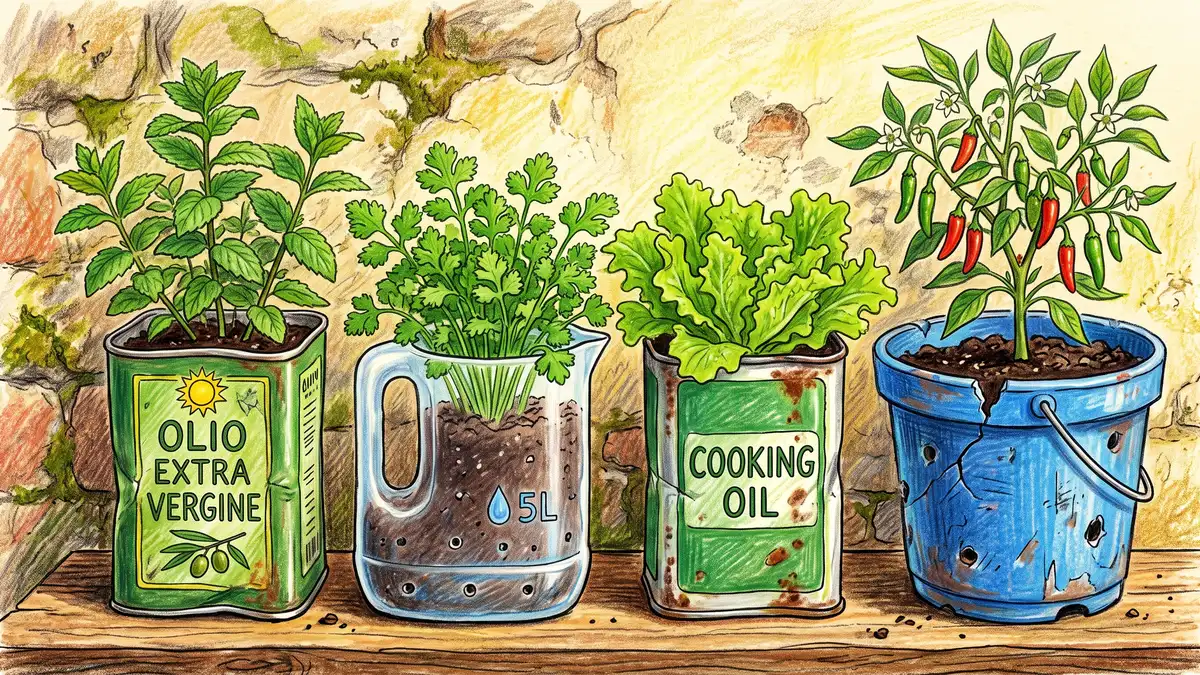
More than the phrase "camp garden" suggests, and at a cost that is genuinely startling. A multi-year study of home gardens in the Rohingya camps at Cox's Bazar, run by Re-Alliance with the Food Security Cluster and Rohingya student researchers between 2022 and 2025, found households harvesting between 7 and 195 kilograms (15 to 430 pounds) of produce a year, depending on which organisation supported them.
The same research found 93 percent of gardens still in use seven to eleven months on, and reported ActionAid spending 33.6 million taka (about US$276,000) to build 10,000 gardens: roughly $27.60 per garden, returning up to 430 pounds of vegetables a year.
| Location | Documented Figure | Source |
| Cox's Bazar, Bangladesh | 15 to 430 lb produce per household per year | Re-Alliance, 2022 to 2025 |
| Cox's Bazar, Bangladesh | 93% of gardens still active at 7 to 11 months | Re-Alliance, 2022 to 2025 |
| Bidi Bidi, Uganda | 800 acres allocated for block farming | Norwegian Refugee Council, 2024 |
| Bidi Bidi, Uganda | ~75% of refugees lack sufficient land to cultivate | Norwegian Refugee Council, 2024 |
| Za'atari, Jordan | 650+ residents trained in hydroponics | University of Sheffield |
Sources: Re-Alliance home gardens research, Norwegian Refugee Council (2024), University of Sheffield Institute for Sustainable Food
The land constraint at Bidi Bidi is worth sitting with. Each household gets a plot of about 30 by 30 metres (roughly 98 by 98 feet), which must hold the shelter plus water and sanitation. A suburban lot doing four jobs at once, which is why every remaining niche gets planted.
How Do You Grow Vertically in a Few Square Feet?
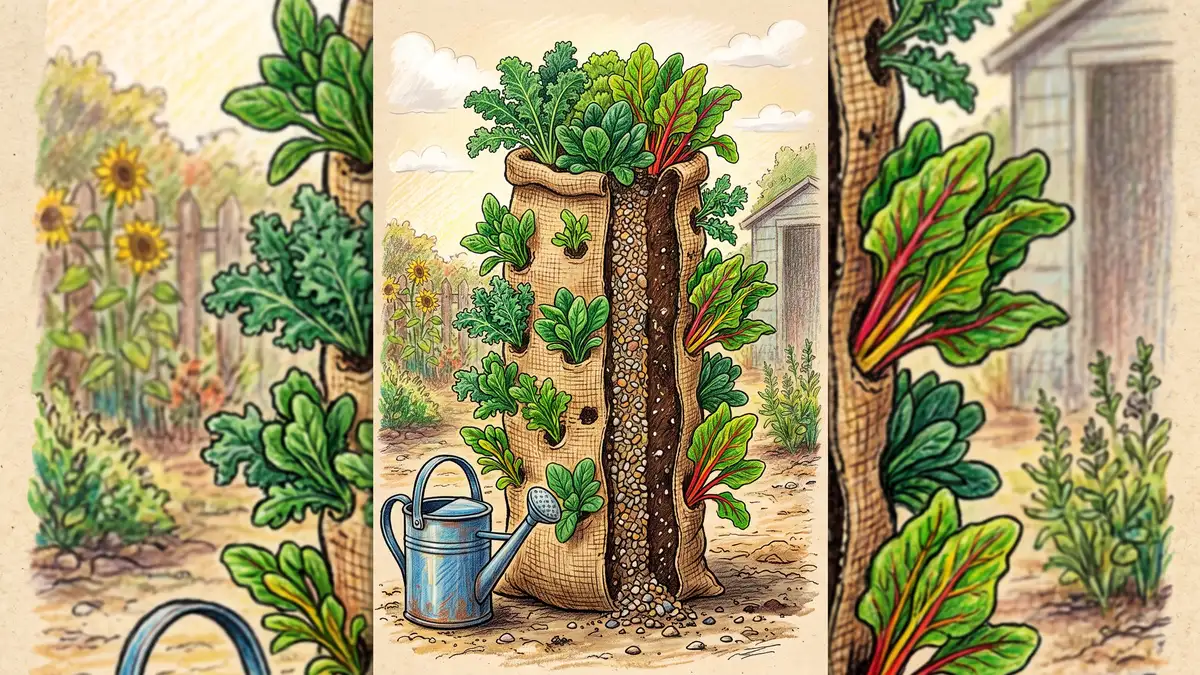
The sack garden is the most transferable technique in this field. Stand a heavy woven sack upright and fill it with soil and compost, building a central column of gravel for drainage. Cut planting holes in the sides every 6 to 8 inches (15 to 20 cm). Plant the top and every hole.
A sack about 2 feet (60 cm) across and 3 feet (90 cm) tall supports roughly 40 to 80 plants, typically cut-and-come-again greens like kale, chard, spinach and amaranth. Total ground footprint: about 3 square feet. Materials cost is usually a few dollars because the sacks are reused.
The multi-storey garden, documented by the Emergency Nutrition Network as a response to food insecurity where land is limited, applies the same principle to a conical mound. A 2022 study of sack gardens in a Nairobi settlement found a workable route to better vegetable availability and diet quality.
Why This Works: Obtain a Yield
Holmgren's third design principle sounds obvious until you apply it to space rather than time. A sack garden does not grow more per plant, it grows more per square foot of ground, treating the vertical dimension as real estate. The same logic runs through the twelve permaculture design principles: when one resource is scarce, look for the one that isn't. Ground is scarce. Air is free.
How Do You Water a Garden With Almost No Water?
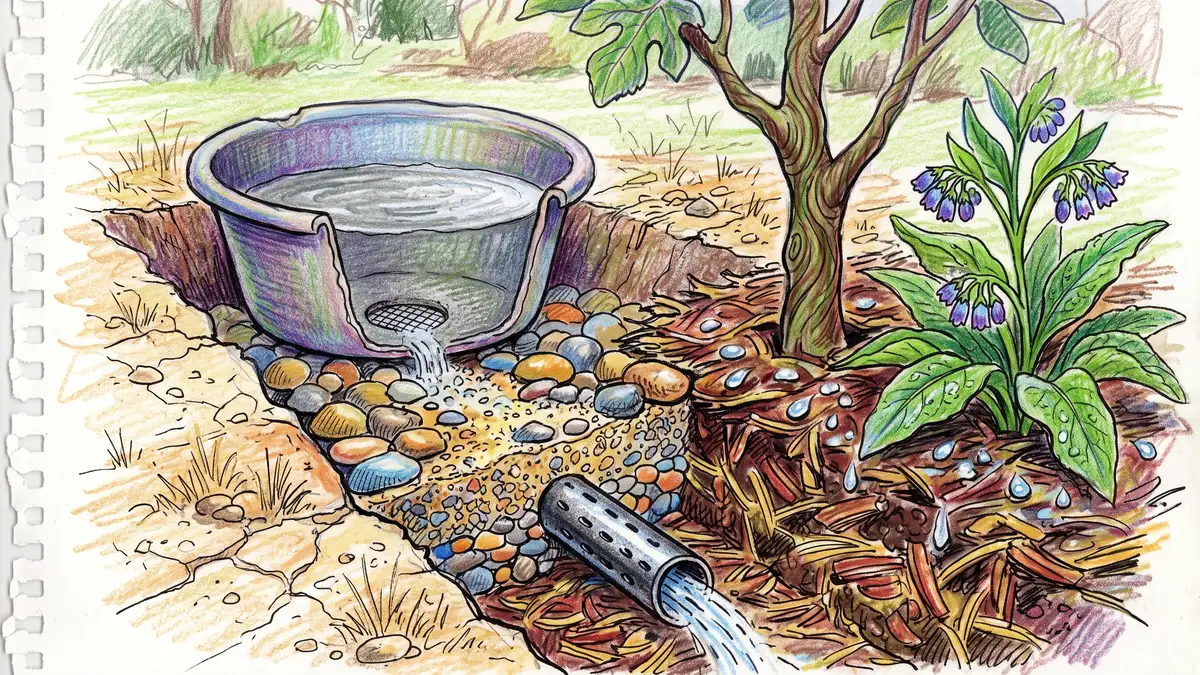
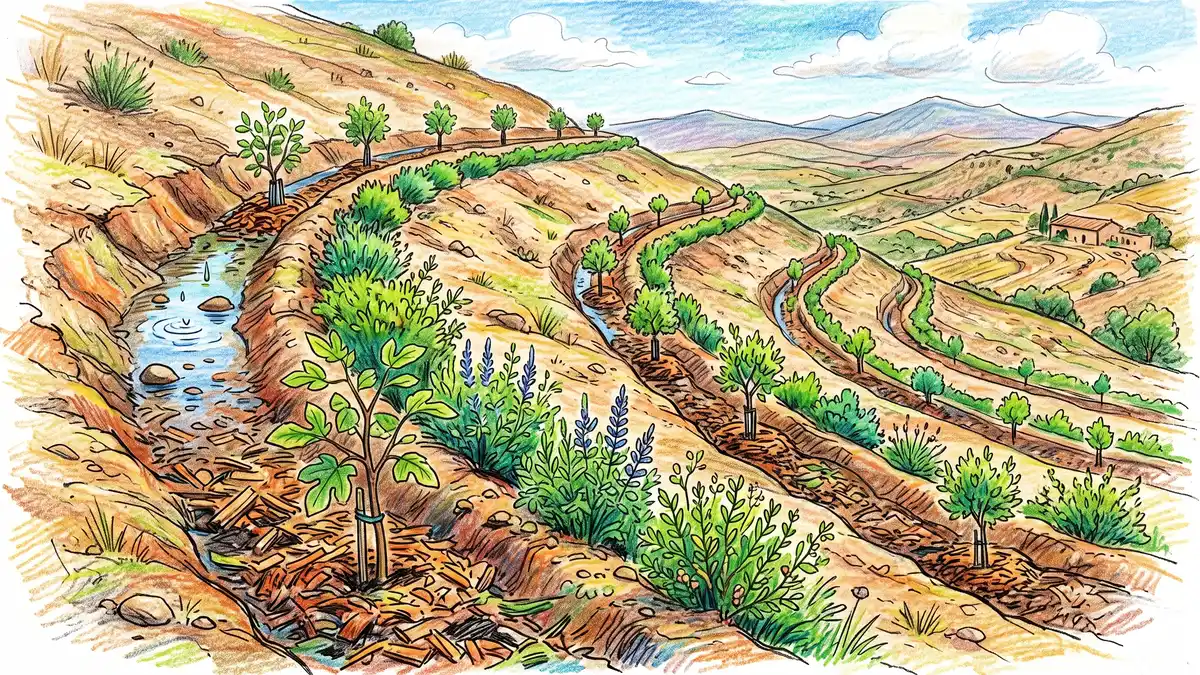
You stop thinking about irrigation and start thinking about capture, retention and reuse. Humanitarian standards target roughly 4 gallons (15 litres) per person per day for drinking, cooking and washing combined. Almost none can go on plants, so camp gardeners work three other angles.
Capture first. A 2025 study of shelter transformation at Za'atari camp in Jordan documented residents tilting roofs to one side and adding gutters to catch what rain falls. The arithmetic: one inch of rain on one square foot of roof yields about 0.62 gallons, so a 200 square foot roof in a half-inch shower produces around 62 gallons.
Then retention. Concern Worldwide's homestead gardening guidelines for the Rohingya camps lean on composting and mulching to improve sandy soils and hold moisture. Deep mulch of 3 to 6 inches (7.5 to 15 cm) is the cheapest water-saving move anywhere, and building soil organic matter compounds it.
Then reuse. Dishwater and laundry water go to trees and shrubs through mulch basins, filtered through gravel and sand, never onto leaves eaten raw. Same practice, same safety rules, in Tucson or Jordan.
What Transfers to a US Garden?
Five things, each grounded in a documented practice rather than a nice idea.
Build systems you can carry
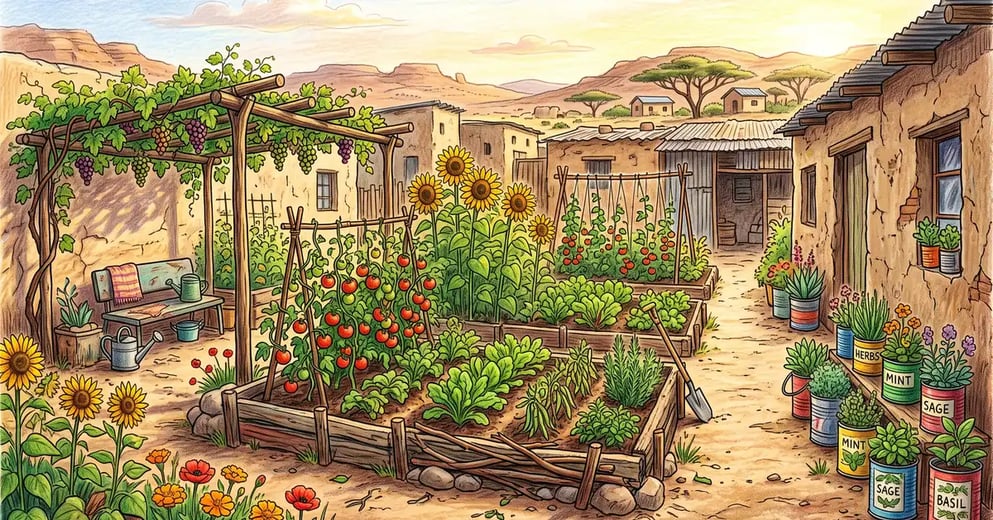
If you rent, use sacks, large containers and freestanding trellises rather than in-ground beds. Camp gardeners design for relocation as a default, and roughly a third of American households rent.
Treat every hard surface as catchment
Run the numbers on your roof. A 1,000 square foot roof in a 20-inch rainfall year sheds roughly 12,400 gallons. Even one barrel changes what a dry August looks like.
Grow nutrients, not staples
Camp gardens skew hard toward leafy greens and herbs because they harvest repeatedly and pack nutrition into small biomass. Do not try to grow your grain in 200 square feet.
Make fertility from your own waste stream
Kitchen scraps, leaves, coffee grounds and cardboard become the growing medium. Where compost is unavailable at any price, this is not optional, and it is why it works so well.
Treat community as infrastructure
Block farming at Bidi Bidi organised 28 farmer groups in one zone alone. Seed swaps, shared tools and surplus exchange do the same work on a suburban street.
An Honest Limit
Camp gardens do not replace food aid, and nobody involved claims they do. Yields of 15 to 430 pounds of vegetables a year matter enormously for micronutrients and dignity, but are a fraction of caloric need. Same realism for your yard: a small garden meaningfully improves diet and resilience. It will not feed you.
What Do These Gardens Give Beyond Food?
The non-caloric returns are the ones participants mention first. The Re-Alliance research found households reporting reduced stress, a sense of normalcy and improved wellbeing, with women and elderly residents describing gardens as spaces that structured their days and let them use skills from home.
The Lemon Tree Trust, working in Domiz camp in Iraqi Kurdistan since 2015, frames its work around dignity, hope and beauty rather than yield, and its Gawilan community garden is built as shared social space. A visiting academic writing in The Conversation estimated about a third of shelters at Za'atari had a garden of some kind, and compared the impulse to lockdown gardening.
There is an ecological return too. A 2025 study of reforested areas in the Rohingya camps documented measurable above and below-ground biomass and carbon stock, so even camp-scale replanting stabilises slopes and stores carbon.
Why This Works: People Care
Permaculture's second ethic, people care, is usually the vaguest of the three. These projects give it teeth. Permaculture for Refugees runs teacher training designed by Rosemary Morrow on Lesvos, on the premise that teaching people to meet their own needs is more durable than supplying those needs. Skills travel when people are moved. Infrastructure does not.
Key Takeaway
The design pattern is consistent across every documented project: go vertical, capture water at the surface it lands on, build soil from waste, and prioritise crops you cut repeatedly. None of it needs land ownership, money or a hose. It is worth learning before you need it.
Frequently Asked Questions
What is food security, and can a home garden improve it?
Food security means reliable access to enough safe, nutritious food. A small garden rarely moves the calorie side much, but it moves the nutrition side considerably. In the Cox's Bazar research, households with gardens reported better access to fresh vegetables and less dependence on buying produce, some earning 100 to 2,500 taka from surplus. The realistic US framing is identical: your garden improves diet quality and buffers price shocks rather than replacing the store.
How much food can you actually grow in a very small space?
Documented camp gardens produced 15 to 430 pounds of vegetables per household per year, from plots measured in square yards rather than acres. The range reflects design quality, inputs and water access more than land area. A sack garden holding 40 to 80 cut-and-come-again greens yields through most of a season from about 3 square feet, roughly a doormat's footprint.
What is a sack garden and how do you make one?
Stand a heavy woven sack upright and fill it with soil and compost, building a gravel column up the centre as you go for drainage. Cut planting holes every 6 to 8 inches around the sides, and plant seedlings into the holes plus the open top. Leafy greens work best because you harvest leaves repeatedly rather than pulling the plant. Water into the gravel column so moisture spreads evenly.
How do you garden when you cannot dig or plant permanently?
Design everything to be portable. Containers, sacks, straw bales and freestanding trellises need no ground disturbance and move with you. At Bidi Bidi, refugees get temporary land use rather than ownership, which discourages permanent earthworks, so households concentrate on fast-yielding annuals and portable structures. Renters can apply identical logic, adding slower perennials in large pots that travel.
What can American gardeners learn from refugee camp gardens?
Mainly that the constraints most of us treat as blockers were already solved by people facing worse versions of them. No soil becomes containers and compost. No water becomes mulch, roof catchment and greywater. No land becomes vertical growing. No money becomes reused materials and saved seed. These are the same answers permaculture reaches from first principles, arrived at independently under real pressure. Our overview of permaculture around the world covers more regional traditions.
Get the Weekly Dig
One practical permaculture guide a week, written for gardeners who do this on weekends: permaculture design for real backyards. Free, no spam, unsubscribe any time.
Join the Weekly DigResources
- UNHCR: Global Trends Report 2023
- USA for UNHCR: What Is a Refugee Camp? Definition and Statistics
- Re-Alliance: Home Gardens in Cox's Bazar Research
- Norwegian Refugee Council (2024): Block Farming Model for Refugees in Bidi Bidi
- Concern Worldwide: Homestead Gardening Guidelines for Rohingya Camps
- Emergency Nutrition Network: Multi-Storey Gardens to Support Food Security
- Zivkovic et al. (2022): Feasibility and Impact Assessment of a Sack Garden Intervention
- Alshawawreh (2025): Spatial Transformation of Shelters in Za'atari Refugee Camp
- Mahmood et al. (2025): Biomass and Carbon Stock Monitoring in the Rohingya Camps
- Permaculture Principles: The 12 Design Principles