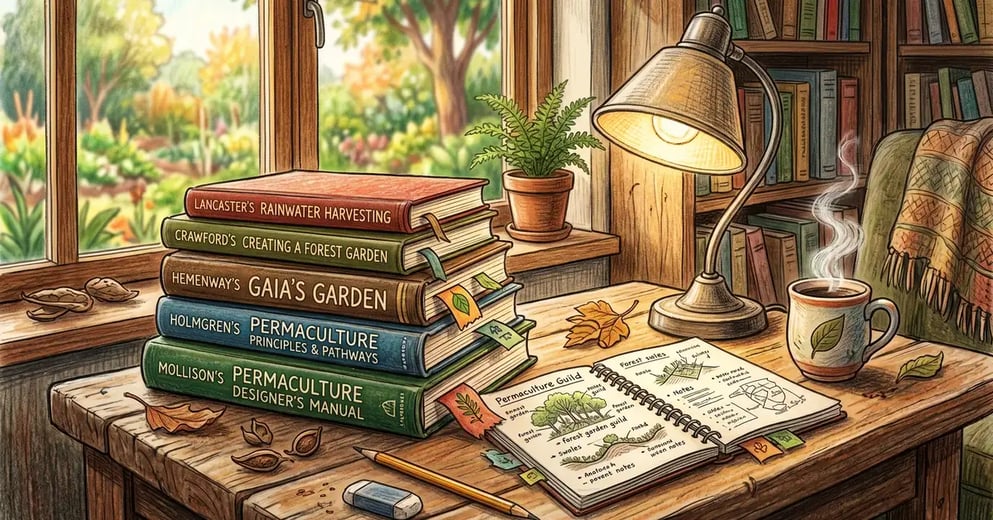

Permaculture's literature has been accumulating for almost five decades. Bill Mollison and David Holmgren published Permaculture One in 1978; Mollison's 576-page Designers' Manual followed in 1988 and remains the canonical reference text on every accredited 72-hour PDC reading list worldwide. The result for a curious reader in 2026 is a deep but disorganised stack: foundational classics, beginner-friendly entry points, food forest references, water harvesting specialist works, urban applications, and recent additions on climate adaptation.
This guide is the reading order we'd actually recommend, organised by reader level. Every book below is one you can actually get hold of today, with an honest assessment of who it suits and where it falls short. The 15 selections cover beginner through practitioner across temperate, dryland, urban, and global contexts.
Quick answer
Start with Toby Hemenway's Gaia's Garden if you have a backyard and want to apply permaculture this season, or Huw Richards' The Permaculture Garden if you want a current, photo-led book that gets food on the table in year one. Move to Holmgren's Principles and Pathways for the design framework. Add Crawford's Creating a Forest Garden for temperate food forests, Lancaster's Rainwater Harvesting for Drylands for water systems, and Hemenway's The Permaculture City if you garden without land. Mollison's Designers' Manual is the canonical reference, but it is almost never stocked on Amazon, so buy it direct.
How to use this list
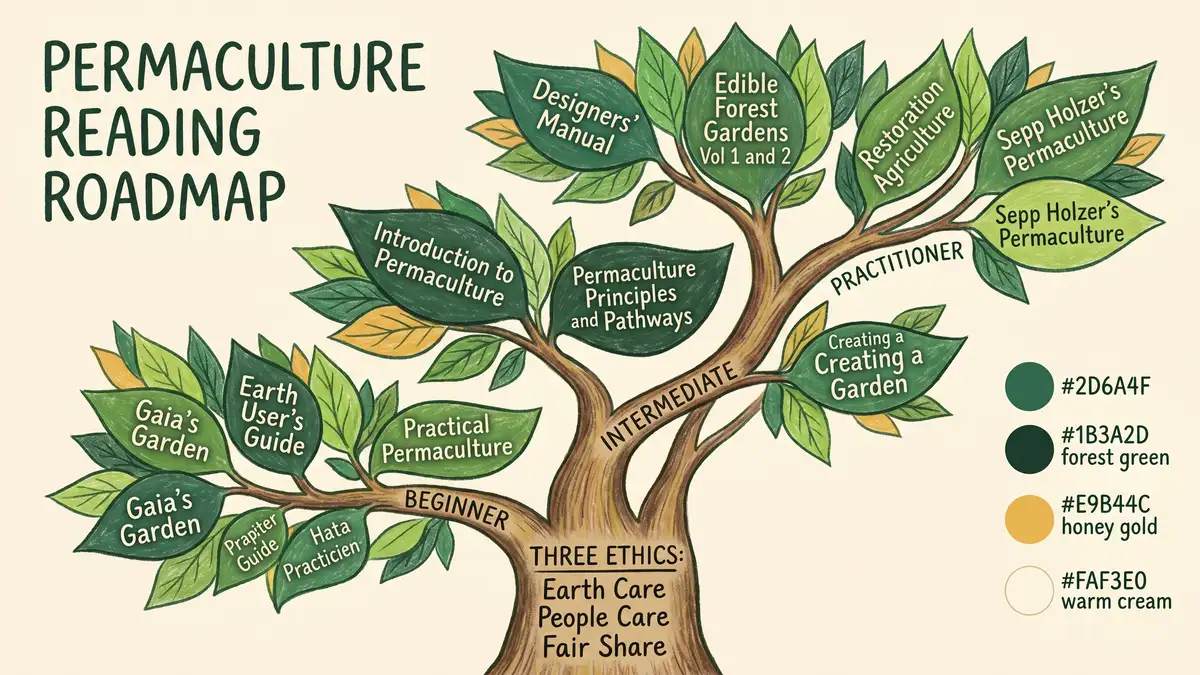
Three honest principles before you start ordering:
Pick by your level, not by reputation. Mollison's Designers' Manual is the most cited permaculture text in the world and one of the worst beginner books in existence. It is dense, encyclopedic, and tropical in heritage. Buying it as your first permaculture book is a fast way to bounce off the topic.
Pick by your climate and your space. The foundational corpus has documented tropical bias. If you garden in cool-temperate Britain, Patrick Whitefield's Earth Care Manual will serve you better than the originals. If you're in dryland Arizona or Spain, Brad Lancaster is the canonical reference. If you have no land at all, Hemenway's The Permaculture City is the one.
Used books are fine. AbeBooks and Powell's stock used copies of every classic on this list at 40 to 60 percent of retail. Library systems via WorldCat hold most of these too.
Why this works (the permaculture insight)
The permaculture canon mirrors permaculture itself: layered, succession-based, with foundational species (Mollison, Holmgren) supporting later specialist work (Crawford, Toensmeier, Lancaster) supporting beginner-friendly understory plants (Hemenway, Richards). Reading in tiers respects this structure. Trying to read the canopy texts before the understory is like planting a chestnut tree before you understand soil.
Tier 1: beginner reads (start here)
1. Gaia's Garden: A Guide to Home-Scale Permaculture (2nd ed., 2009) by Toby Hemenway, Chelsea Green Publishing, 328 pages. The most consistently recommended first book for permaculture beginners, and by a wide margin the most reviewed permaculture title in print. Hemenway's central thesis, that ecological gardening with diverse edible plants creates more abundant gardens by working with nature rather than against it, lands intuitively across gardening backgrounds. Explicitly addresses the misconception that permaculture requires multi-acre rural property. Best for: any urban, suburban, or small-rural beginner with no prior permaculture exposure.
My take: still the single best entry point, and the review volume behind it is not an accident. Hemenway writes like a gardener rather than a theorist, so the concepts arrive attached to things you can actually do this weekend. If you buy one book from this list, buy this one. Its only real weakness is age: the plant lists and urban chapters predate the last decade of small-space growing, which is where the newer books below earn their place alongside it.
Check price on Amazon View at publisher (paid link)
2. The Permaculture Garden: A Practical Approach to Year-Round Harvests by Huw Richards. A modern, photo-led guide built around getting food out of a permaculture garden in every season rather than only at peak summer. Strong on planning the year, succession, and low-input beds, from one of the most-followed young growers working today. Best for: beginners who want a current, visual, immediately actionable book rather than a foundational text.
My take: this is the book I would hand a beginner today. It is the highest-rated permaculture title on Amazon right now, it costs less than most of the classics, and it is written for people who want to eat from the garden this year rather than study design theory first. Purists will note it is lighter on philosophy than Mollison or Holmgren, and that is exactly why it works as a first book. Pair it with Gaia's Garden and you have both the how and the why.
Check price on Amazon (paid link)
3. Practical Permaculture: for Home Landscapes, Your Community, and the Whole Earth (2015) by Jessi Bloom and Dave Boehnlein, Timber Press, 336 pages. Contemporary permaculture communication that integrates visual design sophistication with substantive content. Reflects a real evolution in pedagogy for readers who expect good design alongside technical depth. North American focus, with strong illustration. Best for: visual learners and those wanting current pedagogy rather than older foundational classics.
My take: the best-designed book in the canon, and that matters more than design snobbery suggests. Concepts that read as abstract in Mollison become obvious when Bloom and Boehnlein draw them. It sits in a useful middle ground: more rigorous than a beginner's picture book, far more approachable than the manuals. If diagrams help you think, start here rather than with a wall of text.
Check price on Amazon (paid link)
4. The Complete Guide to Home Permaculture: How to Transform Your Home and Garden by Brandy Hall. A recent, heavily illustrated guide aimed squarely at applying permaculture to an ordinary house and yard, covering site assessment, water, soil, and planting in a modern visual format. Best for: homeowners who want a current, practical, design-led starting point.
My take: we left this off the list when it was new because it had almost no community feedback to judge it by. It has since earned a near-perfect rating, and it has earned its place here. It is the most approachable of the modern design books, and it is unusually strong on assessing what you actually have before you plant anything, which is the step most beginners skip. It is not a reference you will still be consulting in a decade, but it will get a real design out of you in a single season.
Check price on Amazon (paid link)
5. Permaculture Design: A Step-by-Step Guide (2012) by Aranya, Permanent Publications. Methodical pedagogical resource structured around the actual design process sequence, not abstract principle. Derived from course worksheets refined and tested on PDC students over time. Integrates ethics, principles, philosophy, tools, and techniques directly into the process narrative. Best for: anyone preparing for a Permaculture Design Certificate course or wanting structured methodology rather than philosophical exposition.
My take: the most underrated book on this list, and the one with the widest gap between how well known it is and how useful it is. It does the thing almost no other permaculture book does: walks you through a design from blank page to finished plan, in order, with the worksheets. If you have read the theory and still cannot produce an actual design, this is the missing step.
Check price on Amazon (paid link)
Tier 2: intermediate reads (the design framework)

6. Permaculture: Principles and Pathways Beyond Sustainability (2002, rev.) by David Holmgren. The most systematic articulation of the twelve permaculture design principles available in published form. Holmgren positions permaculture as a positive response to environmental crisis, focused on what we build rather than what we oppose, synthesising 25 years of theoretical development. More accessible than Mollison's writing while maintaining depth. Best for: designers transitioning from other disciplines who require robust philosophical grounding, and educators explaining permaculture to others. Pairs naturally with our walkthrough of the 12 permaculture principles.
My take: this is the book that reorganises how you see every other gardening book on your shelf. The twelve principles get quoted everywhere in fragments; reading them in Holmgren's own framing is a different experience entirely. It is dry in places and it is the most expensive book here per page of practical instruction, so treat it as the framework you read once properly and then apply for years, not a weekend read.
Check price on Amazon (paid link)
7. The Earth Care Manual: A Permaculture Handbook for Britain and Other Temperate Climates (2004, rev.) by Patrick Whitefield, Permanent Publications, 480 pages. The definitive permaculture guidance for cool-temperate regions. Treats permaculture as an interconnecting framework across building design, community structure, food, energy, water, microclimate, and shelter, with 249 diagrams, photographs, and tables. Best for: UK, Northern European, and cool-temperate North American readers who find Australian foundational texts climatically distant.
My take: if you garden anywhere cold and wet, this quietly replaces half the canon. Whitefield did the work of translating tropical-origin permaculture into a climate where the growing season is short and the soil is heavy, and nobody has done it better since. It is expensive and it is a brick, which is the honest reason it is not higher on the list. For its intended reader it is worth every penny.
Check price on Amazon (paid link)
8. The Permaculture City: Regenerative Design for Urban, Suburban, and Town Resilience (2015) by Toby Hemenway, Chelsea Green Publishing. Hemenway's follow-up to Gaia's Garden, shifting the lens from the garden to the whole urban system: food, water, energy, livelihood, and community in town. Best for: renters, apartment dwellers, and anyone applying permaculture where land is scarce.
My take: if Gaia's Garden is about your yard, this is about your street. It is the strongest answer to the objection we hear most often, that permaculture needs acreage, and Hemenway is the clearest writer in the canon. He is at his best here connecting design thinking to how cities actually function. Be aware it is more conceptual than practical, so buy it as the companion to a hands-on book rather than as a how-to on its own.
Check price on Amazon (paid link)
9. Introduction to Permaculture (1991, rev. 1997) by Bill Mollison and Reny Mia Slay, 224 pages. Originally derived from a 15-pamphlet series accompanying Mollison's 1981 PDC. Functions as a more pedagogically structured presentation of core concepts than the Designers' Manual, intended to prepare readers for that more technical text. Best for: anyone curious about Mollison's original framework who isn't ready for the 576-page Manual yet.
My take: the sane way to read Mollison. You get the founder's actual thinking without the encyclopedic sprawl, and it is the natural on-ramp if you intend to reach the Designers' Manual eventually. It is priced oddly high for its size, which is the one thing that gives me pause about recommending it over Holmgren for the same money.
Check price on Amazon (paid link)
Tier 3: practitioner reads (depth and specialisation)
10. Permaculture: A Designers' Manual (1988) by Bill Mollison, Tagari Publications, 576 pages. The definitive technical reference and required text on every accredited PDC. Encyclopedic in scope: humid tropics, dryland strategies, humid cool-to-cold climates, urban applications. Mollison's "invisible structures" chapter on community organising and local economies remains influential. Best for: anyone planning to teach, consult professionally, or design at scale. Treat it as a reference, not a cover-to-cover read.
My take: the most important book here and the hardest to buy. It is almost never in stock on Amazon, and when a copy does appear it is usually a marked-up third-party listing, so go direct to the publisher instead. That inconvenience is worth accepting if you are going professional. If you are not, buy Holmgren or Whitefield and consult this one at a library, because reading it cover to cover as a beginner will put you off permaculture entirely.
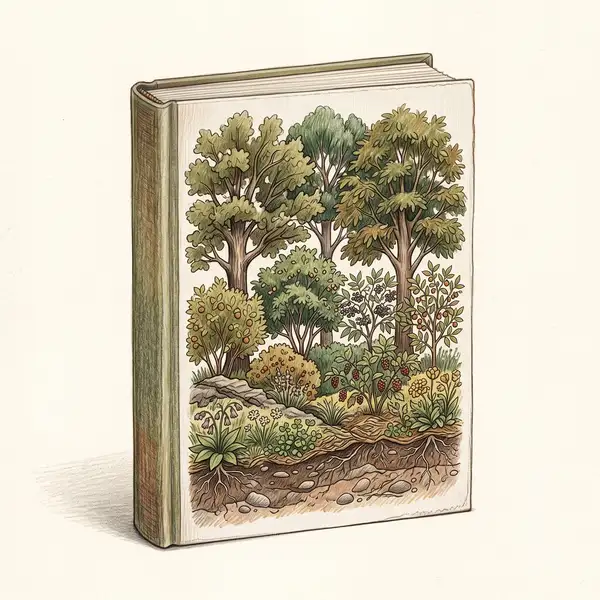
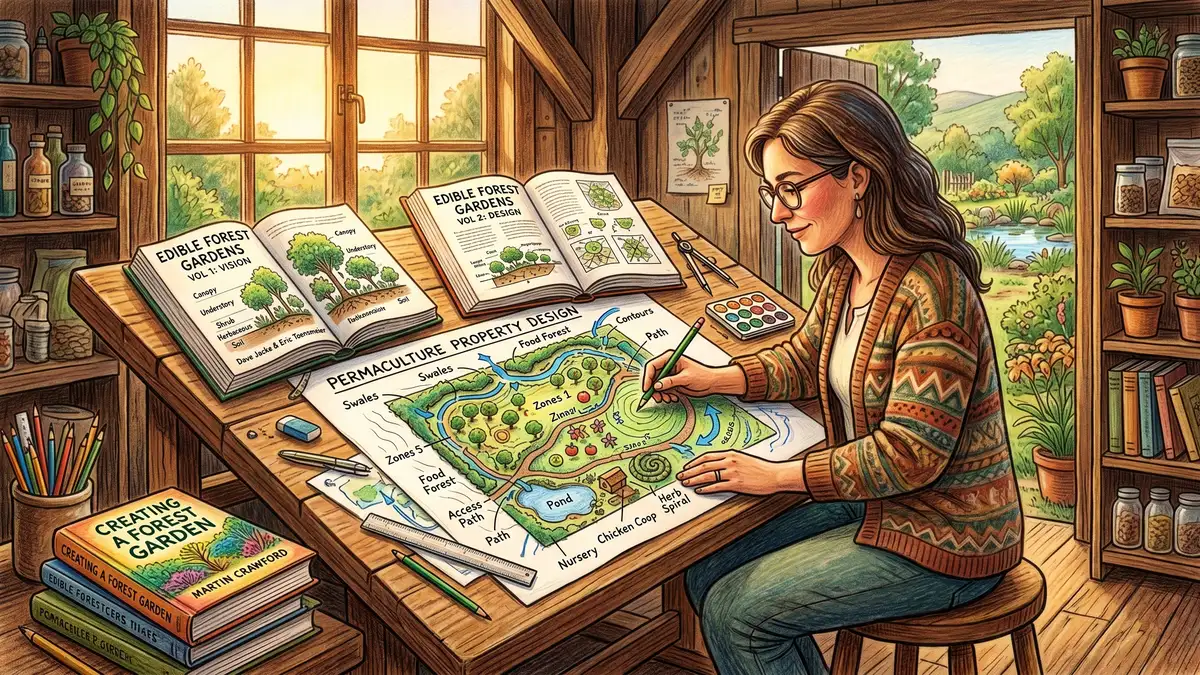
11. Creating a Forest Garden: Working with Nature to Grow Edible Crops (2010, rev. 2022) by Martin Crawford, Green Books, 384 pages. The definitive book on temperate food forest design. The 2022 update added a substantive chapter on coping with extreme weather under climate change, and the plant-selection guidance covers many uncommon edibles suited to temperate climates. Best for: anyone designing or implementing a temperate food forest; pairs well with our guide to berry bushes for food forests.
My take: Crawford has actually grown the system he is describing for decades, and it shows on every page. The species tables alone justify the price, and the 2022 climate chapter is the most useful update any book on this list has received. If you are planting perennials in a temperate climate, this is not optional.
Check price on Amazon (paid link)
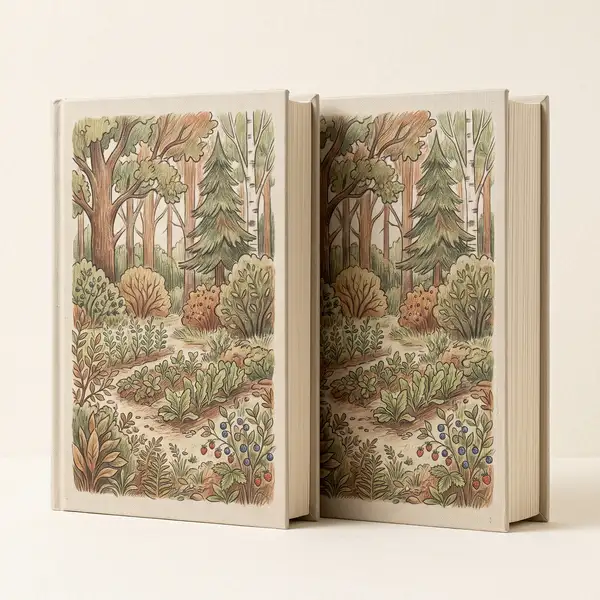
12. Edible Forest Gardens, Volumes I and II (2005) by Dave Jacke and Eric Toensmeier, Chelsea Green Publishing, two-volume set. The most comprehensive North American treatment of temperate forest gardens. Volume I covers ecological vision and theory; Volume II covers practical design for home-scale systems. Plant species lists are thorough and North America specific. Best for: serious North American food forest designers and educators.
My take: the deepest work on this list and priced accordingly. Nothing else comes close on the ecology behind why a forest garden works, and the appendices are a career's worth of reference. Buy it only after you have read Crawford and are certain you want this level of depth, because for a home-scale grower it is far more book than the job requires.
Check price on Amazon View at publisher (paid link)
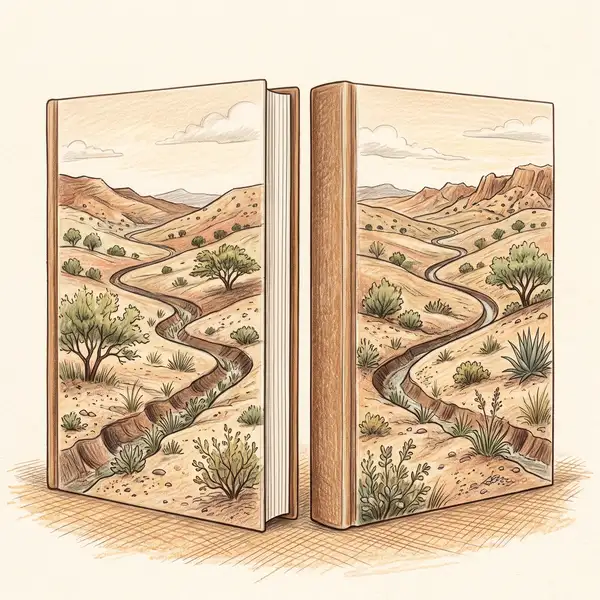
13. Rainwater Harvesting for Drylands and Beyond, Volume 1 (3rd ed., 2019) by Brad Lancaster, Rainsource Press, 288 pages. The standard reference for water harvesting design across dryland regions globally. Volume 1 covers principles; Volume 2 covers practical earthworks. Particularly valuable for Arizona, the US Southwest, Mediterranean Europe, and the Middle East and North Africa. Best for: anyone in a water-scarce or dryland region; the principles transfer with adaptation to wetter climates.
My take: water is the constraint that decides whether a dryland design survives, and Lancaster is the person who worked out how to teach it. Volume 1 alone will change how you look at every slope on your property. Start there rather than buying the set, because the principles volume does most of the work and the earthworks volume only matters once you are ready to dig.
Check price on Amazon View at publisher (paid link)
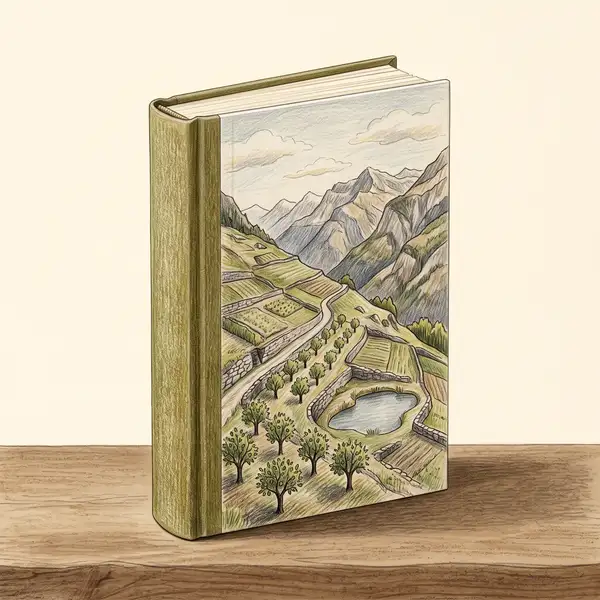
14. Sepp Holzer's Permaculture: A Practical Guide to Small-Scale, Integrative Farming and Gardening (2011) by Sepp Holzer, Chelsea Green Publishing, 256 pages. The "rebel farmer" of the Austrian Alps shares lifetime farming methods with rare honesty about both techniques and economic viability. Covers holistic system setup, fruit variety selection, terrace and pond construction, animal shelter and livestock integration, and edible mushroom cultivation. Best for: small-farm operators wanting an integrated practical and economic perspective.
My take: the most enjoyable read on this list and the most quietly radical. Holzer grows citrus at altitude in Austria by manipulating microclimate, and the book is full of things the textbooks say should not work. Take the specifics as inspiration rather than instruction, since his site and climate are unusual, but the mindset it gives you about working with terrain is worth the cover price on its own.
Check price on Amazon (paid link)
15. The Carbon Farming Solution (2016) by Eric Toensmeier, Chelsea Green Publishing. Positions carbon farming as central to global climate change mitigation, covering tropical, temperate, Mediterranean, and dryland contexts with substantial scientific rigor. Best for: practitioners working at farm or landscape scale who need to quantify climate benefits, and policy-makers addressing regenerative agriculture.
My take: this is a reference work, not a gardening book, and it should be bought as one. If your interest is the climate argument for perennial agriculture, with the numbers to back it, nothing else is close. If you want to know what to plant this spring, it will be the least useful book on this list. Know which of those you are before you buy.
Check price on Amazon (paid link)
The 15 books at a glance
| # | Title | Author | Reading level |
| 1 | Gaia's Garden | Toby Hemenway | Beginner |
| 2 | The Permaculture Garden | Huw Richards | Beginner |
| 3 | Practical Permaculture | Bloom & Boehnlein | Beginner |
| 4 | The Complete Guide to Home Permaculture | Brandy Hall | Beginner |
| 5 | Permaculture Design: A Step-by-Step Guide | Aranya | Beginner-Intermediate |
| 6 | Principles and Pathways | David Holmgren | Intermediate |
| 7 | The Earth Care Manual | Patrick Whitefield | Intermediate |
| 8 | The Permaculture City | Toby Hemenway | Intermediate |
| 9 | Introduction to Permaculture | Mollison & Slay | Intermediate |
| 10 | Permaculture: A Designers' Manual | Bill Mollison | Practitioner |
| 11 | Creating a Forest Garden | Martin Crawford | Practitioner |
| 12 | Edible Forest Gardens, Vols I-II | Jacke & Toensmeier | Practitioner |
| 13 | Rainwater Harvesting for Drylands | Brad Lancaster | Practitioner |
| 14 | Sepp Holzer's Permaculture | Sepp Holzer | Practitioner |
| 15 | The Carbon Farming Solution | Eric Toensmeier | Practitioner |
A reading order that actually works
Month 1 to 3: Gaia's Garden or The Permaculture Garden
Read one cover to cover and apply small experiments as you go. Sketch your property zones. By the end you will know whether permaculture is for you.
Month 4 to 6: Holmgren's Principles and Pathways
Read each of the 12 principle chapters with your own property in mind. The framework will reorganise how you see every other book on your shelf.
Month 7 to 12: One specialist text
Pick the book aligned with your project. Crawford for temperate food forests. Lancaster for dryland water. Whitefield for cool-temperate Britain. Hemenway's City book if you have no land. This is where reading turns into actual designs.
Year 2: Aranya to design, Mollison as reference
Work through Aranya's step-by-step process to produce a real design, and consult Mollison's Manual as the encyclopedia it is when specific questions arise.
Choose a book by use case
| Your situation | Best book to start with | Why |
| Backyard gardener, no permaculture exposure | Hemenway, Gaia's Garden | Most accessible entry point; addresses small-space directly |
| Want harvests in year one | Richards, The Permaculture Garden | Season-by-season practical planning, modern and visual |
| Apartment, balcony, or no land | Hemenway, The Permaculture City | Applies the design lens to urban systems, not acreage |
| Cool-temperate UK / Northern Europe | Whitefield, Earth Care Manual | Climate-specific depth; 480 pages of regional examples |
| Designing a temperate food forest | Crawford, Creating a Forest Garden | 2022 update with extreme-weather chapter |
| Dryland / Mediterranean / semi-arid | Lancaster, Rainwater Harvesting | Standard reference for water-scarce regions |
| Preparing for a PDC course | Aranya, Permaculture Design | Walks through the actual design sequence; PDC-tested worksheets |
| Climate / carbon focus | Toensmeier, Carbon Farming Solution | Carbon sequestration metrics across global contexts |
| Teaching or consulting professionally | Mollison, Designers' Manual | Encyclopedic; required on every accredited PDC |
If you remember six things
(1) Start with Hemenway's Gaia's Garden or Richards' The Permaculture Garden, not Mollison's Manual. (2) Holmgren's Principles and Pathways comes second; it gives you the design framework. (3) Pick one specialist text aligned with your project: Crawford for temperate food forests, Lancaster for dryland water, Hemenway's City book for no land. (4) Mollison's Designers' Manual is a reference, not a cover-to-cover read, and you will need to buy it direct from the publisher. (5) Used copies at AbeBooks and Powell's run 40 to 60 percent of new pricing; libraries cover the rest. (6) Climate and space matter more than reputation when choosing.
What's missing from this list (and why)
Caveats and gaps
This list deliberately excludes several books recommended elsewhere. Geoff Lawton has not published a major standalone book despite running the Permaculture Research Institute. Permaculture One (1978) is historically significant but largely superseded; skip it unless you're studying the movement's history. Looby Macnamara's People & Permaculture is excellent on social systems but expects a foundation in land-based practice first. We have also dropped several titles that readers simply cannot buy at a fair price: Mark Shepard's Restoration Agriculture and David Holmgren's RetroSuburbia are both worthwhile books, but neither is reliably available at a sane price, so we would rather point you at something you can actually get.
For broader permaculture context across global traditions, our guide to permaculture around the world covers regional adaptations that complement the largely Anglophone canon represented here. For the soil-building foundations every permaculture designer eventually encounters, the soil health guide covers the science underpinning the textbooks.
Buying advice
Direct from publishers. Chelsea Green, Permanent Publications, Tagari Publications, and Rainsource Press all sell direct. This supports authors and small publishers more than Amazon does, and for Mollison's Designers' Manual it is effectively the only reliable option.
On Amazon. Fast, familiar, and where many readers already buy. The book links throughout this guide are Amazon affiliate links (paid link): if you buy through them GrowPerma earns a small commission at no extra cost to you, which helps keep this site free. If you would rather support authors and small publishers directly, use the publisher links instead.
Used through AbeBooks or Powell's. Used copies of most titles run 40 to 60 percent of new pricing. Permaculture readers tend to be careful with their books.
Library systems via WorldCat. Most foundational titles are widely held, and interlibrary loan covers the rest. Free if you have time, and the sensible way to sample the expensive practitioner references before committing.
Get our free permaculture starter guide
Whether you're picking your first permaculture book or planning a homestead-scale design, our 12-page starter guide covers the foundations every serious project depends on.
Read the free guideFrequently asked questions
What is the best permaculture book for beginners?
Toby Hemenway's Gaia's Garden: A Guide to Home-Scale Permaculture (2nd edition, Chelsea Green Publishing) remains the most consistently recommended first book, and it has more reader reviews than any other permaculture title. It is accessible whether or not you have gardening experience and directly addresses the misconception that permaculture requires acreage. If you would rather have something current, visual, and focused on getting harvests in your first year, Huw Richards' The Permaculture Garden is the strongest modern alternative and is currently the highest-rated permaculture book available.
What is the most important permaculture book?
Bill Mollison's Permaculture: A Designers' Manual (1988, Tagari Publications, 576 pages) is the definitive technical reference and required reading on every accredited 72-hour Permaculture Design Course. However, it is not a beginner book, and it is rarely stocked by major online retailers, so you will usually need to order it directly from Tagari Publications. Most practitioners use it as a reference alongside more accessible introductions.
Are there free permaculture books?
Some permaculture authors have released material openly. David Holmgren has free essays at holmgren.com.au, and Looby Macnamara's People & Permaculture has authorised free PDF circulation. Most foundational permaculture texts are widely held in public library systems and accessible via interlibrary loan through WorldCat. Used copies of most books on this list run 40 to 60 percent of retail through AbeBooks and Powell's. Avoid pirated PDFs, which harm small publishers and the authors who sustain the field.
What is the best book on food forests?
For temperate climates, Martin Crawford's Creating a Forest Garden (revised 2022, Green Books) is the definitive reference, and the 2022 update added a chapter on coping with extreme weather under climate change. For North American temperate contexts specifically, Dave Jacke and Eric Toensmeier's two-volume Edible Forest Gardens offers more comprehensive plant species data, though at a substantially higher price. Start with Crawford unless you need the deeper ecological theory.
Which permaculture book is best if I have no garden?
Toby Hemenway's The Permaculture City is the clearest answer for renters, apartment dwellers, and anyone in a town or city. It applies permaculture design thinking to food, water, energy, and community at the scale of a street or neighbourhood rather than a plot, and it directly tackles the assumption that you need land to practise permaculture. Pair it with a hands-on growing book, since it is more conceptual than instructional.
What books should I read before taking a Permaculture Design Course?
Aranya's Permaculture Design: A Step-by-Step Guide is the best preparation because it walks through the actual design sequence used in PDCs, with the worksheets. Hemenway's Gaia's Garden and Holmgren's Principles and Pathways together provide the conceptual foundation. Many accredited programs also assume familiarity with the first half of Mollison's Designers' Manual. Plan for 20 to 30 hours of pre-course reading minimum.