
Eggshells are about 95 percent calcium carbonate, the same compound found in agricultural lime. Whether they deliver that calcium to your tomatoes depends almost entirely on particle size. A whole shell tossed in the compost will sit there for years releasing nothing. A finely powdered shell can match agricultural lime as a calcium and pH amendment in the same growing season. This guide separates the science from the folklore so you know what your eggshells will and will not do. how calcium works in the garden
Sources: USDA Agricultural Research Service; Iowa State University Extension; University of Illinois Extension home gardening publications.
The short answer to the title question is yes, eggshells add calcium to soil and compost, but the speed and amount depend on how finely you grind them. The popular practice of dropping whole shells in the planting hole or scattering halves around the tomato bed delivers almost no calcium in the season when you need it. The shell sits there as a slow weathering particle that releases its calcium over 5 to 10 years. By the time it finishes, the tomato that you planted has been long gone.
The same eggshell, ground into fine powder with a coffee grinder or a spice grinder, behaves chemically like ground agricultural limestone. It raises soil pH in acidic soils, releases calcium ions into the soil solution within weeks to months, and feeds the calcium pool that your plants can actually use. This article walks through the science, the practical preparation methods, the realistic application rates, and the common myths around eggshells in the US backyard.
The chemistry: why eggshells equal lime when ground fine
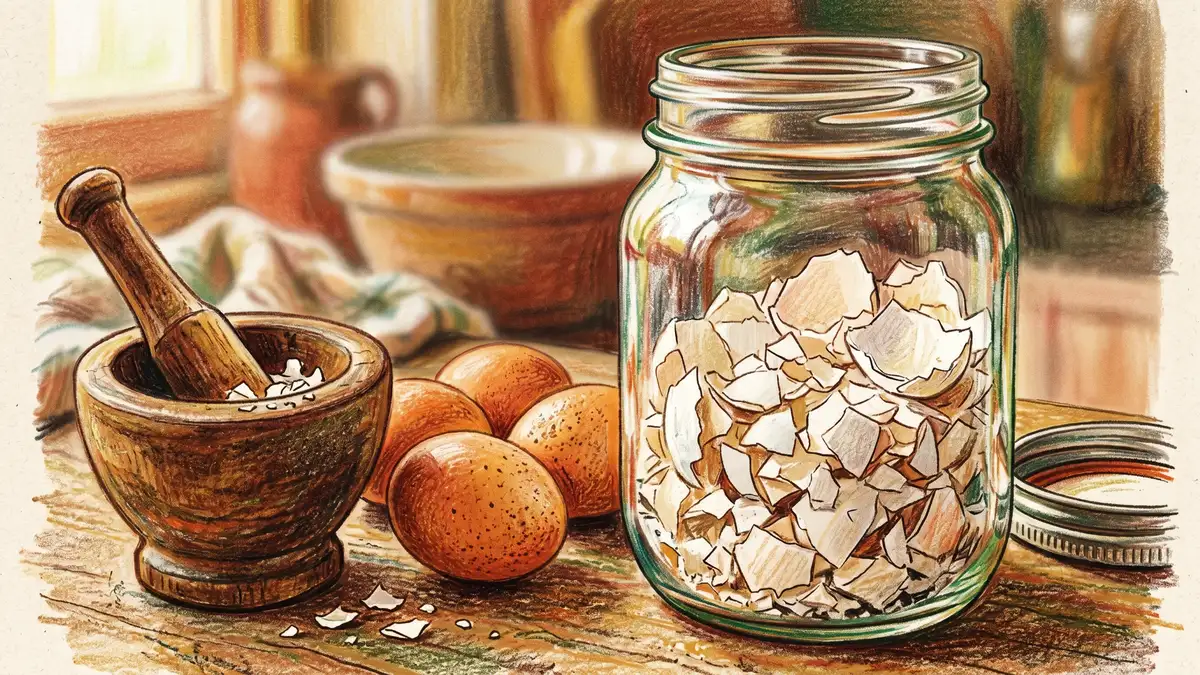
A chicken eggshell consists of three components. The bulk (94 to 97 percent by mass) is calcium carbonate (CaCO3), the same chemical compound that makes up limestone, marble, and chalk. The remaining 3 to 6 percent is an organic matrix of structural proteins, glycoproteins, and small amounts of nitrogen, phosphorus, and sulfur. Trace amounts of magnesium and potassium round out the composition.
This is the same calcium carbonate found in agricultural lime sold at every US garden center. The neutralizing value of pure agricultural lime is typically rated 95 to 100 percent calcium carbonate equivalent. Dried, ground eggshell measures 90 to 95 percent on the same scale. As a liming and calcium source, eggshell is functionally identical to lime, assuming you prepare it the same way: finely ground.
Why does grinding matter so much? Calcium carbonate is sparingly soluble in pure water but dissolves measurably in slightly acidic soil solution. The reaction releases calcium ions and consumes hydrogen ions, raising soil pH. The reaction rate depends on the surface area exposed to soil moisture. A whole eggshell has very low surface area for its mass. A finely ground powder has 100 to 1,000 times more surface area, so it dissolves 100 to 1,000 times faster.
| Particle form | Time to substantial breakdown | Calcium release in current season | Practical use |
| Whole or half shells | 5 to 10+ years | Negligible | Compost bulk only; visual reminder |
| Coarsely crushed (5 to 10 mm pieces) | 1 to 3 years | Very low | Long-term background amendment |
| Finely crushed (1 to 3 mm) | 6 to 18 months | Low to moderate | Slow-release calcium and grit for worm bins |
| Finely powdered (under 75 microns) | Weeks to months | Moderate to high (matches lime) | Active soil amendment and pH adjustment |
Source: composted by USDA-ARS, Iowa State Extension, University of Illinois Extension comparative reports.
Step-by-step: preparing eggshells for the garden
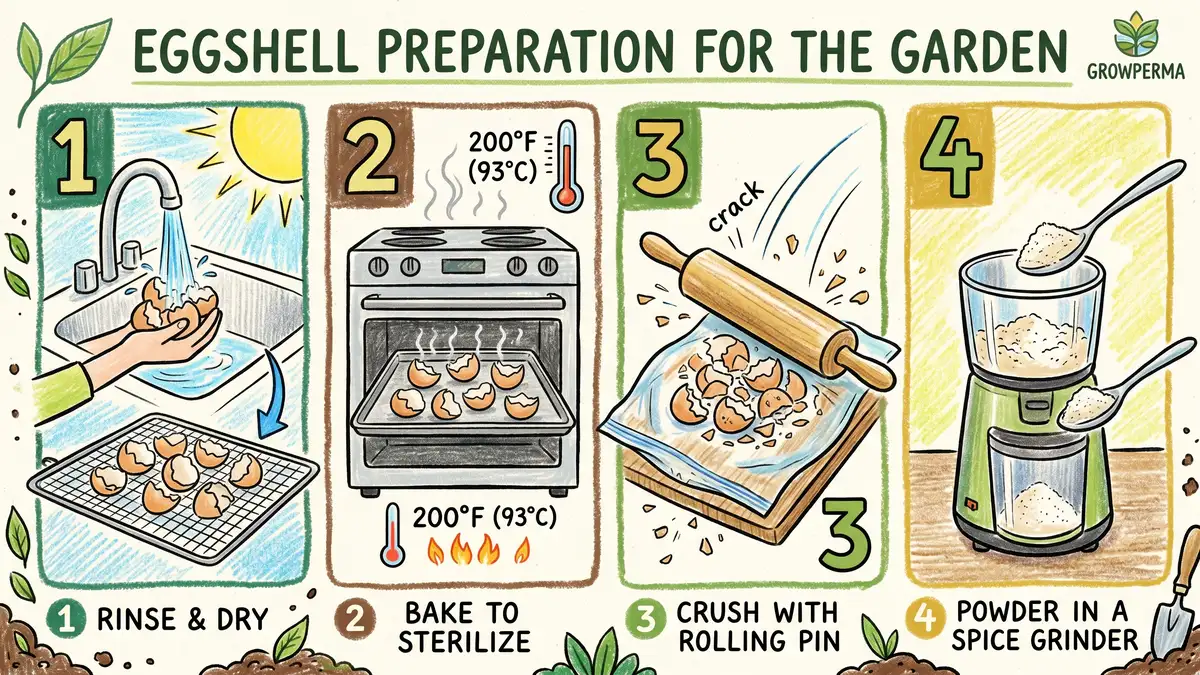
Rinse and air-dry
Rinse used shells in cool water as soon as you crack each egg. Air-dry on a paper towel for a few hours, or on a baking sheet overnight, until they feel completely dry. This step prevents mold and bacterial growth during storage and reduces any residual egg smell that might attract pests.
Bake at 200 to 250 degrees F for 10 to 15 min
Spread the dried shells on a baking sheet and bake for 10 to 15 min. This sterilizes any residual Salmonella, removes any final moisture, and makes the shells brittle enough to grind easily. Baked shells turn slightly off-white and snap cleanly under pressure.
Crush with a rolling pin
Place baked shells in a heavy plastic bag and crush with a rolling pin or the bottom of a glass jar. This gets you to coarse crumb size (1 to 5 mm pieces) suitable for worm bins or coarse soil incorporation. Many gardeners stop here for compost-bound shells.
Grind to powder for active amendment
For tomato planting holes, container mix amendment, or active lime application, transfer the crushed shells to a spice grinder, coffee grinder, or Vitamix and pulse for 15 to 30 seconds. The result should be a fine off-white powder that flows like flour. This is the form that matches agricultural lime in reactivity.
Store in an airtight container
Eggshell powder keeps indefinitely in a sealed glass jar. Label with the date and contents. A typical household producing 4 to 6 dozen eggs per month can build a 1 lb stockpile of powder in 6 to 9 months of saving.
How much to apply and where
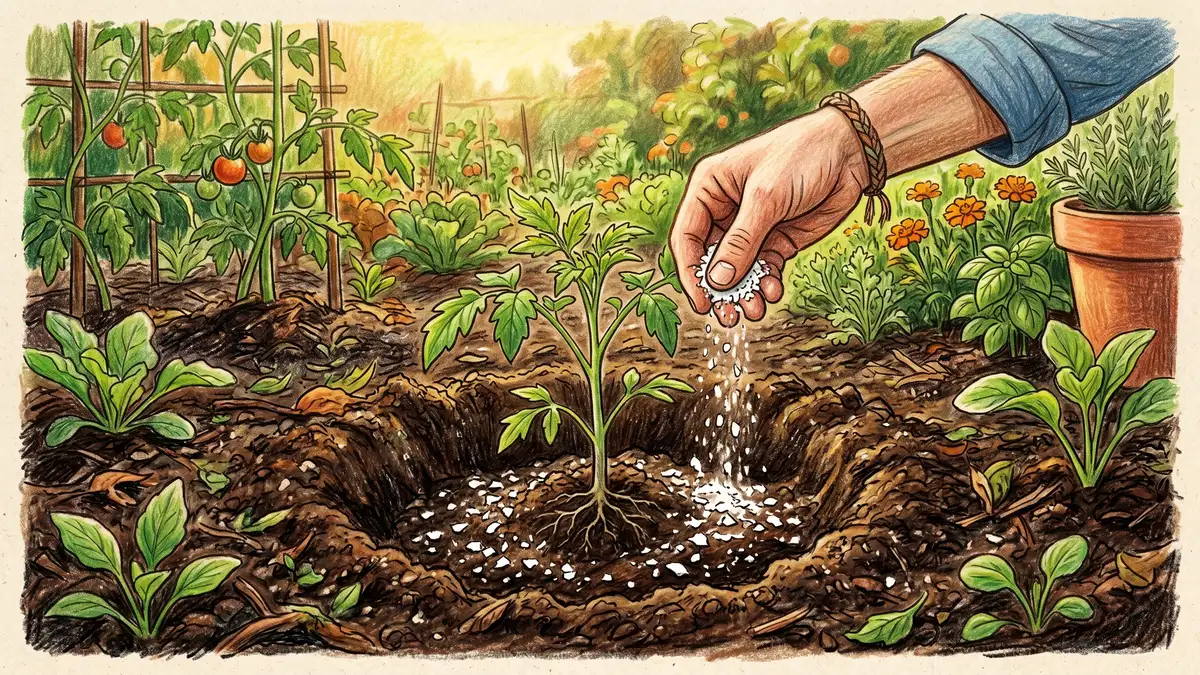
Eggshell powder application rates depend on the goal. There are four common use cases in a US backyard.
1. Tomato, pepper, and eggplant planting holes: 1 tablespoon eggshell powder mixed into the soil at the bottom of each planting hole, blended with the backfill. This delivers a slow-release calcium boost for the developing root zone. Best for acidic soils where calcium availability tracks pH.
2. Container mix: Half cup eggshell powder per cubic foot of potting soil, blended thoroughly before filling pots. Container mixes often lack adequate calcium because they are based on peat or coir rather than mineral soil. Eggshell powder supplies both calcium and a modest pH lift.
3. Side-dressing established plants: Half cup powder per plant, scratched into the soil around the dripline 4 to 6 weeks after transplanting. Most useful for heavy calcium feeders such as brassicas.
4. Whole-bed liming amendment: 1 lb of eggshell powder per 100 sq ft of bed, broadcast and raked into the top 4 in of soil 4 to 6 weeks before planting. This is the rate that approximates agricultural lime at a modest liming level. Avoid if your soil already tests above pH 7.0.
The blossom end rot myth
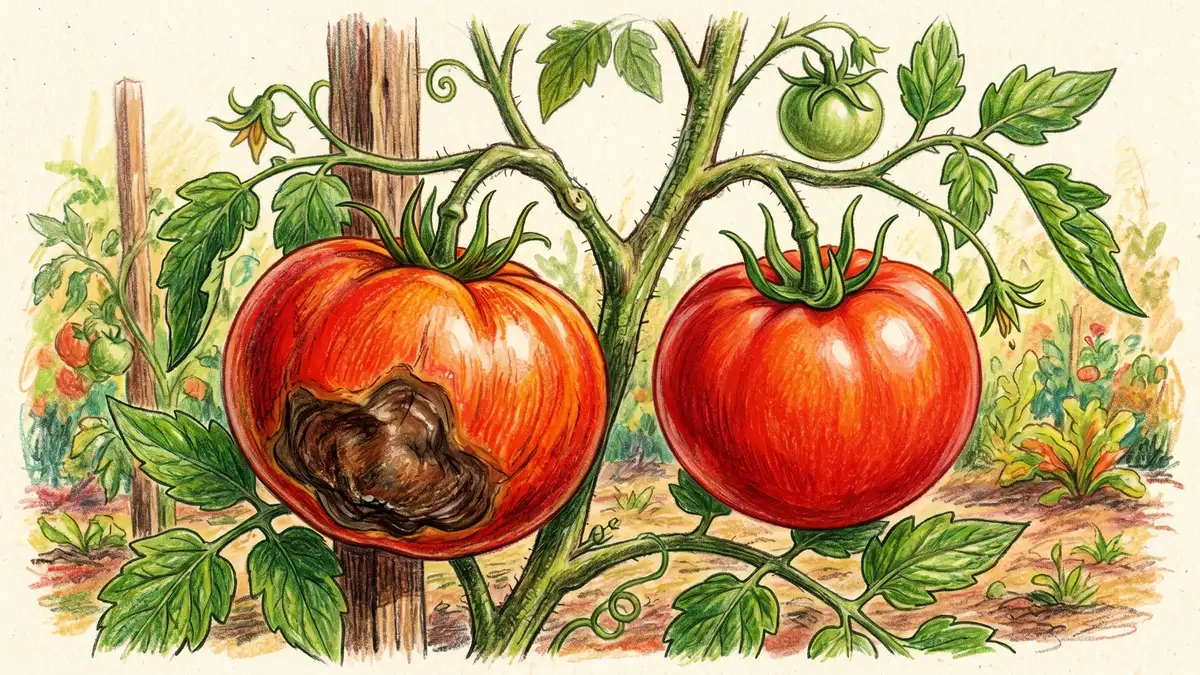
Blossom end rot (BER) on tomatoes, peppers, and squash shows up as a dark, sunken spot on the bottom of the fruit. The popular advice for decades has been to bury an eggshell at the bottom of each planting hole to prevent it. Decades of US extension service research has clarified that this advice is largely wrong about the cause and only marginally useful in practice.
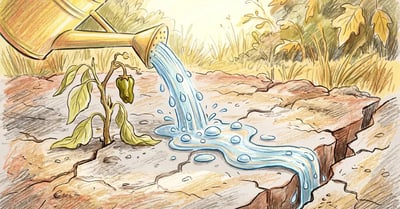
Blossom end rot is caused by inadequate calcium reaching the developing fruit, but the limit is almost never soil calcium. Most US garden soils contain 1,000 to 5,000 lbs of available calcium per acre, which is far more than tomatoes can use. The actual cause of BER is impaired calcium transport from the soil into the fruit. Calcium moves with water in the xylem, so any condition that disrupts steady water uptake disrupts calcium delivery: uneven watering, drought stress, root damage from cultivation, excessive nitrogen fertilization, or rapid fruit growth in the first wave of fruit set.
Why this works (the permaculture insight)
Permaculture principle 1 is "observe and interact". The eggshell-and-blossom-end-rot story is a classic case of the wrong observation leading to the wrong intervention. A gardener sees blossom end rot, sees the visible calcium in an eggshell, and combines them into a folk remedy. The actual permaculture solution is to look at the system: build deep mulch to retain moisture, water consistently with drip irrigation, build organic matter to improve cation exchange capacity, and avoid heavy nitrogen pulses. Those interventions address the cause, not the symptom. Calcium-rich eggshell powder is fine to add, but it will not fix BER on its own.
The University of Illinois Extension, NC State Extension, and Cornell Cooperative Extension all publish current guidance that confirms calcium amendments rarely prevent BER. Steady watering and mulching prevent BER. Cornell's Vegetable MD Online specifically notes that "applying additional calcium is unnecessary in most home garden situations." So by all means add eggshell powder for the small calcium and lime benefit, but do not rely on it to solve blossom end rot.
Eggshells in the compost pile
For most backyard gardeners, the compost pile is where eggshells end up. The science supports this practice with two caveats.
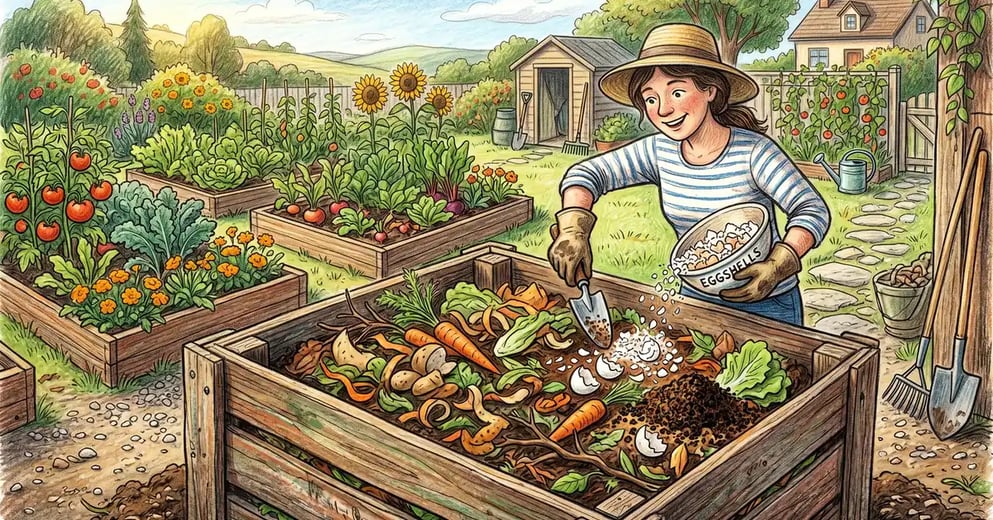
Crush before adding. Whole shells in a cold compost pile remain whole for years. Crushed shells (1 to 5 mm pieces) break down faster but still slowly, on a 1 to 3 year timeline. The finer the crush, the more usable the calcium becomes by the time the compost finishes. A few pulses in a blender or food processor before adding to the pile is the easiest way to accelerate breakdown.
Hot vs cold compost timeline. A hot compost pile (130 to 160 degrees F sustained for 7 to 14 days) accelerates the breakdown of organic matter dramatically, but does little for the calcium carbonate itself. Heat does not dissolve eggshells. Moisture, organic acids, and microbial respiration do. A well-managed hot pile that goes through multiple turning cycles and stays moist for 6 to 12 months will reduce coarsely crushed shells to soft, half-dissolved fragments. A cold compost pile takes 2 to 4 times as long.
Do eggshells in compost attract rodents? Modern US extension research (including from Cornell Waste Management Institute) finds that clean, dry, baked eggshells do not attract rodents in any meaningful way. Mice and rats are attracted by residual egg whites, sugars, oils, and animal proteins on unrinsed shells. Rinse and dry your shells before adding to the pile and the rodent issue largely disappears.
Eggshells in worm bins
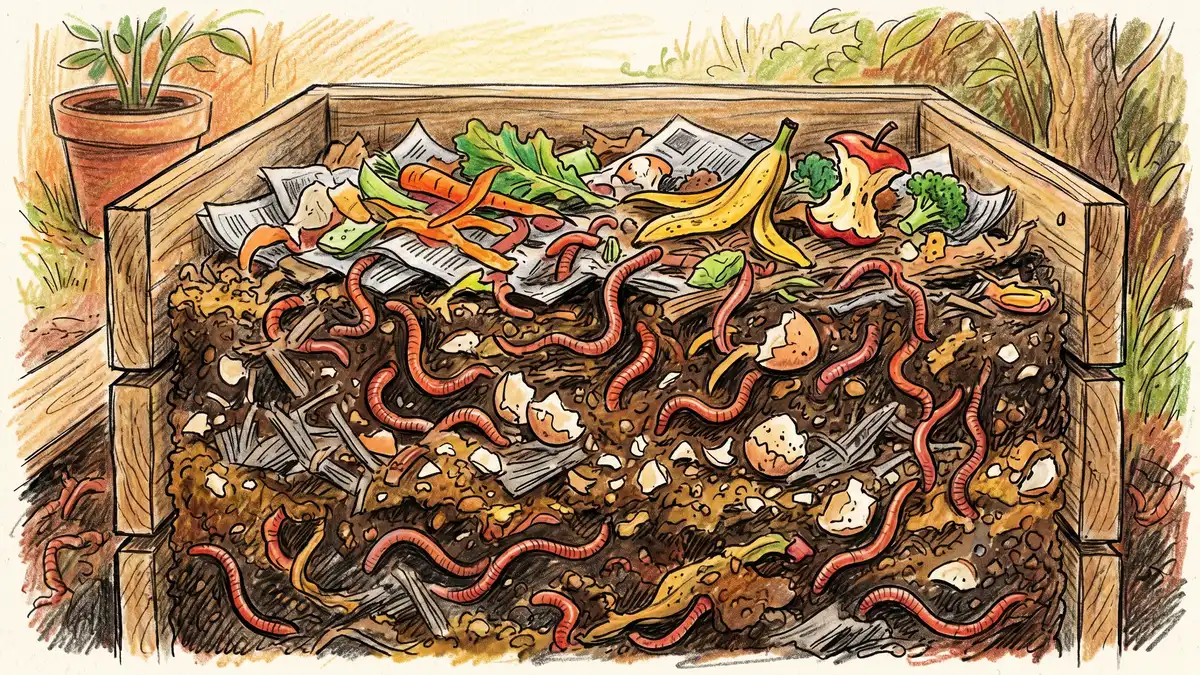
Worm bin operators have a particular love for crushed eggshells. The shells serve two functions for red wigglers (Eisenia fetida):
- Grit for the worm gizzard. Worms have no teeth. They use a small muscular gizzard with grit particles to grind food. Crushed eggshells (1 to 3 mm) provide the perfect grit size. Without grit, worm digestion slows and reproduction drops.
- pH buffer in worm castings. Worm bins tend to acidify over time as food waste breaks down. Eggshell calcium carbonate buffers the pH back toward neutral, preventing the "sour" worm bin syndrome that kills worm populations.
The standard worm bin dose is 1 tablespoon crushed eggshell per cubic foot of bedding, added monthly. Do not powder for worm bins. Worms need the grit texture more than the rapid calcium release. Some worm farmers blend half powder and half crushed for both effects.
Eggshell tea for indoor plants
"Eggshell tea" is the practice of steeping crushed eggshells in water for 24 to 48 hours, then watering plants with the strained liquid. The idea is that some calcium dissolves into the water and becomes immediately available to the plant.
Practically, the calcium concentration in eggshell tea is very low. Calcium carbonate is barely soluble in plain water (around 15 mg/L at room temperature). Adding a splash of vinegar accelerates dissolution but creates an acidic solution that needs dilution before use. The bottom line: eggshell tea is mostly a feel-good practice. Houseplants benefit far more from a quarterly application of finely powdered eggshell stirred directly into the top inch of potting mix.
Eggshell alternatives at a glance
| Source | Calcium content | Effect on soil pH | Speed of release |
| Eggshell powder (finely ground) | ~36% Ca | Raises (lime equivalent) | Weeks to months |
| Agricultural lime (calcitic) | ~38% Ca | Raises strongly | Weeks to months |
| Dolomitic lime | ~22% Ca + 12% Mg | Raises strongly | Weeks to months |
| Gypsum (calcium sulfate) | ~22% Ca | Neutral (no pH change) | Weeks |
| Bone meal | ~22% Ca + 13% P | Mildly raises | Months |
| Oyster shell flour (poultry grade) | ~36% Ca | Raises (lime equivalent) | Weeks to months |
| Wood ash | ~25% Ca + K | Strongly raises | Weeks (use sparingly) |
Source: Penn State Extension and UMass Extension lime and calcium amendment guides.
If you have alkaline soil and still want to supply calcium, gypsum is your answer. It supplies calcium without raising pH further. For acidic soil, agricultural lime, eggshell powder, and dolomitic lime (if you also need magnesium) are interchangeable.
Do eggshells deter slugs?
This is the second common myth. The idea is that sharp eggshell edges cut into slug and snail bodies, deterring them from crossing the barrier. Practical observation and a 2014 study by the Oregon State University Extension Master Gardener program both find that eggshells lose effectiveness as soon as they get wet. They also bend and flatten under slug bodies more than they cut. The same OSU work found that copper tape, iron phosphate slug bait, and consistent hand-picking work much better than eggshells.
Eggshells may slightly slow a slug or two but should not be relied on for slug control. Stick with iron phosphate bait (organic-certified, non-toxic to pets) or copper tape for serious slug pressure.
Get the Weekly Dig
One practical permaculture guide a week, written for gardeners who do this on weekends: composting that actually finishes and soil that feeds itself. Free, no spam, unsubscribe any time.
Join the Weekly DigFAQ
Do eggshells add calcium to soil?
Yes, but the speed and amount depend on particle size. Whole or coarsely crushed eggshells release calcium very slowly, on a timescale of 1 to 10 years, which is too slow to matter for the current growing season. Finely powdered eggshells (under 75 microns) release calcium within weeks to months and have a liming and calcium effect comparable to agricultural lime in acidic soils.
What plants don't like eggshells?
Avoid eggshells around plants that prefer acidic soil: blueberries, azaleas, rhododendrons, hydrangeas (for blue blooms), camellias, gardenias, and pin oaks. Eggshells raise soil pH, which is the opposite of what these acid-loving plants need. Also avoid heavy applications around plants growing in already-alkaline soil (pH above 7.0).
How long do eggshells take to decompose in compost?
Whole shells persist in compost for 5 to 10 years or longer. Coarsely crushed shells (5 to 10 mm) take 1 to 3 years to substantially break down. Finely crushed shells (1 to 3 mm) take 6 to 18 months. Powdered eggshells dissolve into the compost matrix within weeks to a few months. Hot composting accelerates organic matter breakdown but does little for the calcium carbonate itself.
Do eggshells in compost attract rats?
Rinsed and dried eggshells do not attract rats meaningfully. Rodents are attracted by residual egg whites, fats, and protein odors on unrinsed shells. Rinse your shells immediately after cracking each egg, then dry and optionally bake them, and the rat problem largely disappears. The same rinse step also prevents the slight sulfur smell that some eggshells develop in damp compost.
Do I need to bake eggshells before composting?
Baking at 200 to 250 degrees F for 10 to 15 min is optional but recommended. It sterilizes any residual Salmonella, drives off remaining moisture, and makes the shells brittle enough to grind easily. For shells going straight into a compost pile without grinding, just rinse and air-dry them. For shells you plan to powder for direct soil amendment, baking makes the grinding step much easier.
Can I use eggshells in worm bins?
Yes, eggshells are one of the best worm bin amendments. Crushed shells (1 to 3 mm pieces) provide grit that worms need for their gizzard digestion and act as a pH buffer that prevents the worm bin from going acidic over time. The standard dose is 1 tablespoon crushed eggshell per cubic foot of bedding, added monthly. Skip the powder grind for worm bins. Worms benefit more from the grit texture.
What is the best way to use eggshells in the garden?
The most effective use is finely powdered eggshell (under 75 microns) applied to acidic soils that need a lime and calcium boost. Powder rates: 1 tablespoon per tomato or pepper planting hole, half cup per cubic foot of container mix, or 1 lb per 100 sq ft as a broadcast amendment. Apply 4 to 6 weeks before planting and water in. For most other uses (compost pile, worm bin), crushed but not powdered shells are fine.
Are eggshells better than lime for the garden?
Eggshell powder and agricultural lime have nearly identical chemistry and neutralizing value when both are ground to similar fineness. Eggshells are a waste-stream alternative that lets you recycle a kitchen byproduct, but agricultural lime is cheaper, easier to obtain at scale, and pre-ground to optimal particle size. For small gardens with modest needs, eggshell powder is a great substitute. For larger projects, buy a 40 lb bag of pelletized lime and save yourself the grinding.
Need the gear for this?
Bins and tumblers picked by yard size, with the honest trade-offs for each.
See the compost bin picksResources
- Iowa State University Extension: Eggshells and Coffee Grounds in Compost
- University of Illinois Extension: Eggshells in the Garden
- NC State Extension: Blossom End Rot Fact Sheet
- Penn State Extension: Calcium and Tomatoes
- Cornell Waste Management Institute: Home Composting Resources
- UMass Extension: Tomato Blossom End Rot
- Oregon State Extension: Eggshells do not stop slugs