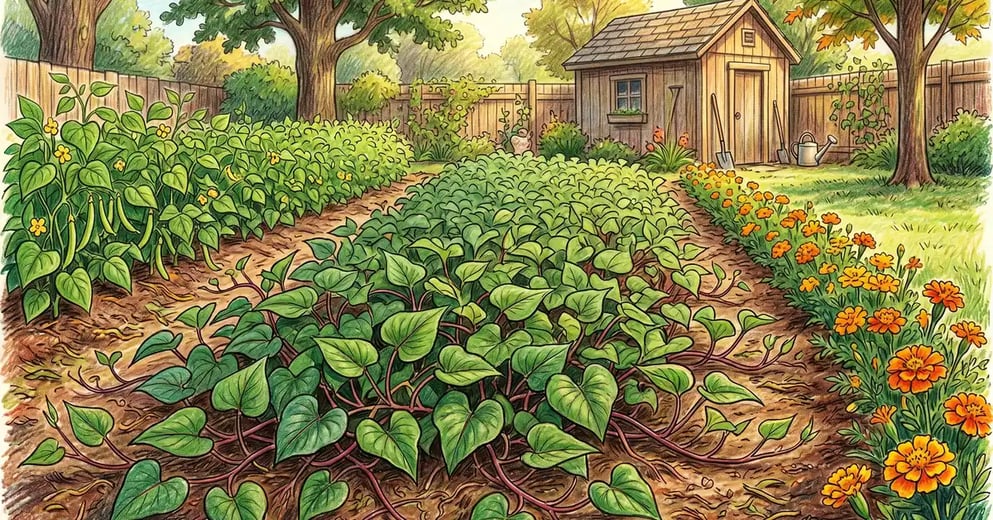

Sweet potatoes (Ipomoea batatas) sprawl across the ground for 90 to 170 days, putting them in close contact with whatever else shares the bed. Pair them with bush beans, cowpeas, and marigolds and you get higher yields, fewer pests, and less weeding. Pair them with cucumbers, tomatoes, or sunflowers and you get all three problems amplified. This guide covers the 10 strongest companions, the plants to avoid, and how to lay out a tropical root combo in a US backyard. what to grow alongside okra
Sources: USDA-ARS Vegetable Lab Charleston SC; LSU AgCenter sweet potato research; UF/IFAS sweet potato production guides.
Sweet potatoes are not in the same family as regular potatoes. They are members of the morning glory family (Convolvulaceae), not the nightshade family. That distinction matters in the garden because their pests, diseases, and growth habit differ in important ways from Solanum tuberosum. Sweet potato vines sprawl 4 to 10 ft across the soil surface, rooting at the nodes in many cultivars, while their storage roots form below the original transplanted slip. In the right companion arrangement, those sprawling vines become a living mulch that protects the soil and supports the rest of the bed. In the wrong arrangement, they smother smaller crops and compete heavily for moisture.
The 10 best companion plants for sweet potatoes
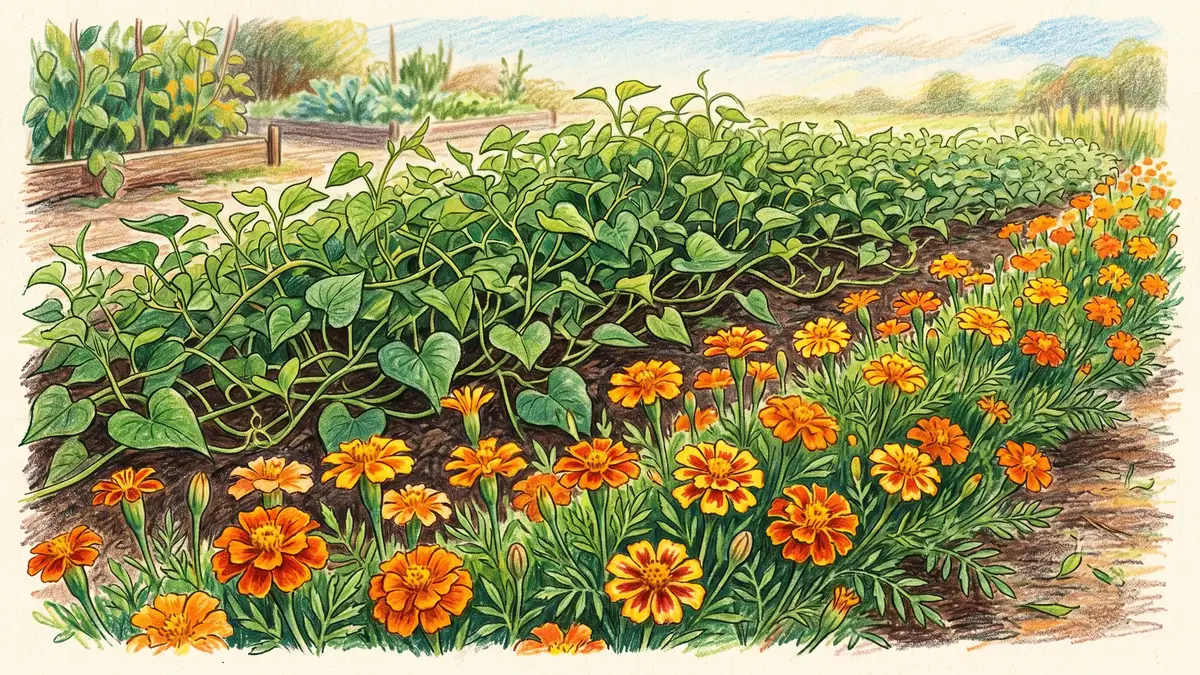
Every strong companion does at least one of three things: fixes nitrogen, deters pests, or supports beneficial insects. The 10 plants below are the ones with the best combination of practical experience and US extension service documentation.
| Companion | Why it helps | Where to place it |
| French marigold (Tagetes patula) | Suppresses southern root-knot nematode (Meloidogyne incognita) via alpha-terthienyl in root exudates | Bed perimeter and between rows, 12 in apart |
| Bush beans | Fix atmospheric nitrogen; modest 18 to 24 in height does not shade vines | Inter-row at 6 in spacing within the bean row |
| Cowpeas / southern peas (Vigna unguiculata) | Heat-tolerant nitrogen fixer; living mulch suppresses weeds | Edge bands, sown 1 to 2 weeks after slips |
| Nasturtium | Trap crop for aphids and flea beetles; edible flowers | Corners of the bed, 18 to 24 in clusters |
| Sweet alyssum | Attracts hoverflies and parasitoid wasps that eat aphids | Front edge of bed, low border |
| Dill (Anethum graveolens) | Umbel flowers feed predatory wasps and hoverflies | Small clumps at bed corners |
| Oregano and thyme | Aromatic deterrent; attracts pollinators when flowering | Dry, well-drained bed edges |
| Yarrow | Attracts beneficials; deep taproot accesses subsoil nutrients | One clump per corner |
| Beets and radishes | Early-season catch crop; harvest before vines spread | Center of bed, sown 3 weeks before slips |
| Borage | Pollinator magnet; reportedly deters tomato hornworm-related pests | One plant per 10 ft of row |
Source: UF/IFAS, UGA Cooperative Extension, NC State Extension, and LSU AgCenter sweet potato production publications.
Why marigolds belong on every sweet potato bed
If you only add one companion plant to your sweet potato bed, make it French marigolds. The southern root-knot nematode (Meloidogyne incognita) is one of the most damaging soil pests in US sweet potato production from Virginia south through Texas. Infected roots form swollen galls that disrupt water and nutrient uptake, reducing yield by 20 to 60 percent in heavy infestations. Tagetes patula roots release alpha-terthienyl, a thiophene compound that is toxic to several nematode species at low concentrations.
The University of Florida IFAS and USDA-ARS field trials show that French marigolds grown as a season-long intercrop or as a cover crop in the year before sweet potatoes can reduce Meloidogyne populations by 30 to 90 percent depending on the marigold cultivar and soil temperature. Single Gold, Tangerine, and Petite Gold are the cultivars with the strongest documented suppression. African marigold (Tagetes erecta) also suppresses nematodes but is taller (24 to 36 in) and can shade vines if planted inside the bed rather than at the perimeter.
The legume side of the bed
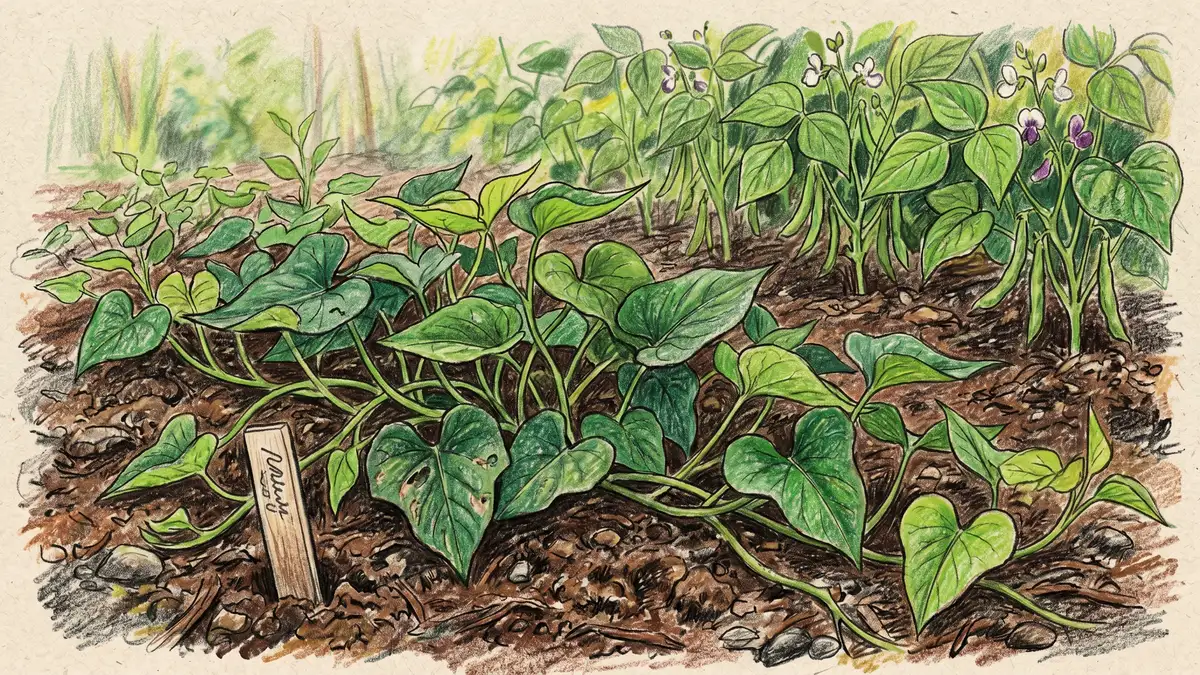
Sweet potatoes are moderate nitrogen feeders. Too little nitrogen produces stunted, pale vines and small roots. Too much nitrogen produces lush vines and tiny roots, because the plant spends its energy on leaves instead of storage. Legumes fix atmospheric nitrogen into a slow-release form that matches sweet potato demand surprisingly well.
Bush beans are the easiest legume to integrate. They reach harvest in 50 to 60 days, well before sweet potato vines fill the bed. Plant a row of bush beans down the center between sweet potato rows about 1 week after transplanting slips. Harvest the beans when the slips are 30 days old, cut the plants at the soil line, and leave the roots in place to release fixed nitrogen as they decompose. The decomposing root nodules feed the sweet potatoes through the second half of the season.
Cowpeas (southern peas) are the better choice in the US South where summer heat shuts down standard bush beans. Vigna unguiculata tolerates 90+ degree F heat and drought, fixes 50 to 150 lb of nitrogen per acre when grown densely, and produces edible pods. The Iron and Clay cowpea variety, popular in southern US cover-crop rotations, doubles as a beneficial insect attractor when allowed to flower. Sow cowpeas in narrow bands along the bed edges 1 to 2 weeks after sweet potato transplant to avoid early competition.
Pole beans need careful placement. They can reach 6 to 8 ft and shade sweet potato vines if planted in the middle of the bed. Use them only on the north or east edge of the bed, on a vertical trellis, so sunlight reaches the sweet potatoes uninterrupted through midday.
The Three Sisters style guild for sweet potatoes
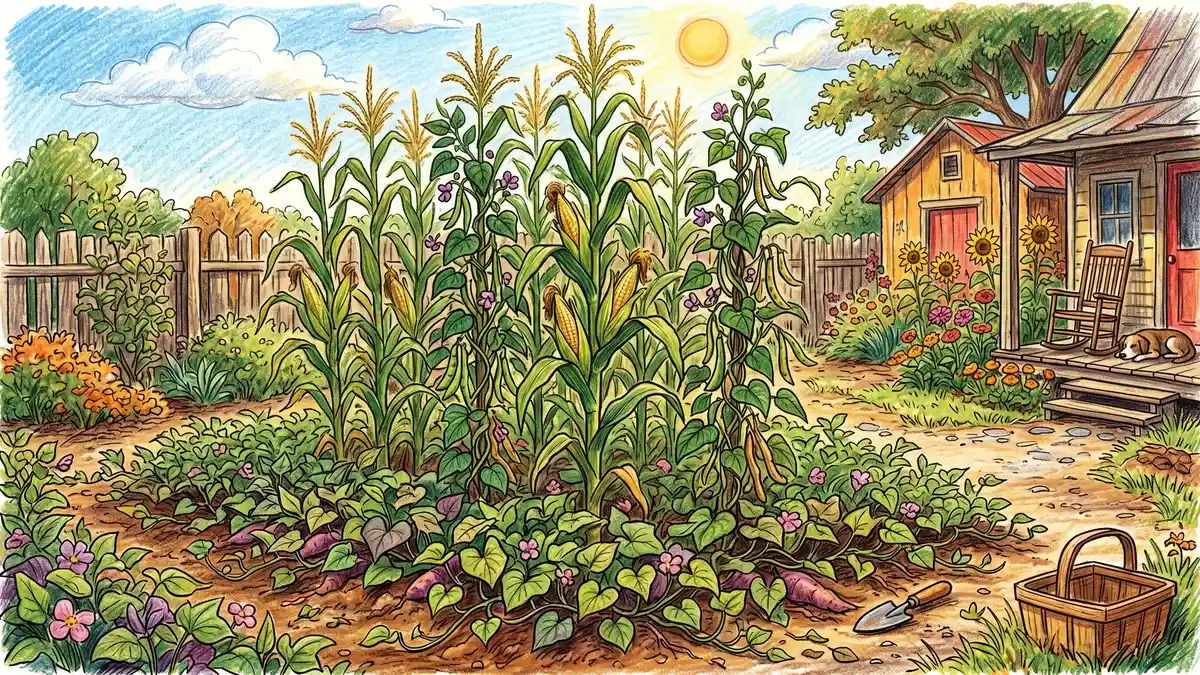
The classic Three Sisters guild (corn, beans, squash) was developed by Indigenous farmers of the US Northeast and Southwest for regular crops. A southern US variant uses sweet potatoes instead of squash. The guild stacks three layers:
- Vertical layer: sweet corn or field corn, planted in clusters 12 to 18 in apart, with 4 to 6 stalks per cluster for wind support.
- Climbing layer: pole beans or cowpeas planted at the base of each corn cluster after corn reaches 6 in tall.
- Ground layer: sweet potato slips planted between corn clusters, with vines spreading outward to cover the bare soil and suppress weeds.
This pattern is popular in West African and African-American gardening traditions across the US South, where it is sometimes called an "African Three Sisters" or simply a sweet potato guild. UGA Cooperative Extension trials in southern Georgia have shown that this stacked planting produces 80 to 90 percent of the yield of separate monocultures while using only half the bed space, an effective land equivalent ratio (LER) of 1.6 to 1.8.
Why this works (the permaculture insight)
Permaculture principle 8 is "integrate rather than segregate". The sweet potato guild integrates a heavy nitrogen-feeder (corn) with a nitrogen-fixer (cowpea) and a living mulch (sweet potato), creating a self-supporting micro-ecosystem where each element provides what another needs. The vines suppress weeds for the corn. The corn supports the climbing beans. The beans feed the corn. The whole guild produces three different food crops from one bed, on rainfall alone in most US climates south of zone 7.
Plants to avoid near sweet potatoes
Some plants undermine sweet potato production through direct competition, allelopathy, or shared pathogens. The five worst neighbors:
- Regular potatoes (Solanum tuberosum): Share root-knot nematode hosts and several soil-borne pathogens. They are different species but pest cross-over is common. Rotate, do not interplant.
- Tomatoes: Heavy potassium feeders that draw down the same nutrient pool sweet potatoes need most. Also share verticillium wilt susceptibility.
- Cucumbers, melons, squash: Vine-on-vine competition for the ground layer. They tangle, smother each other, and trade viruses.
- Sunflowers: Mildly allelopathic through root exudates. They suppress nearby plants including sweet potatoes.
- Fennel: Broadly allelopathic. Most vegetables underperform near fennel. Move fennel to a corner by itself.
Onions and other alliums are a less obvious mismatch. They prefer drier conditions and a slightly higher pH than sweet potatoes, and they show no documented benefit to sweet potato production. Skip them in this bed.
Layout: a 4 ft by 12 ft sweet potato companion bed
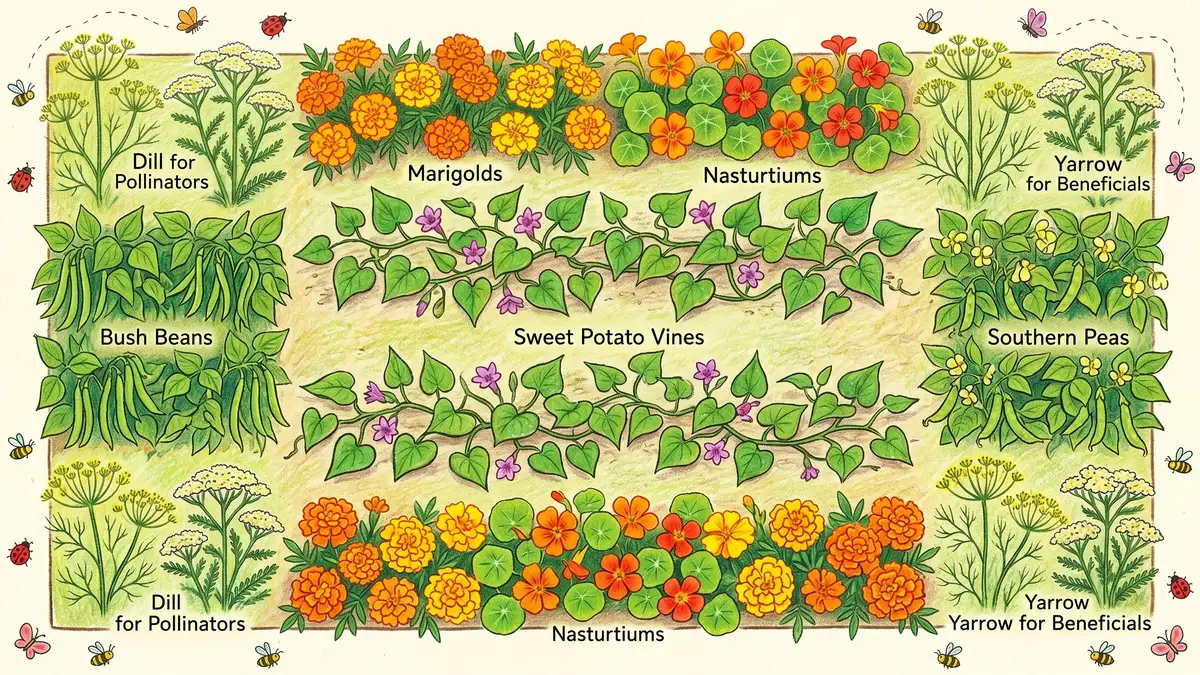
Here is a tested, beginner-friendly layout for a 4 ft by 12 ft raised bed in USDA zones 7 to 9. Adjust spacing and timing for cooler zones.
Prep the bed in spring
Loosen the top 12 in of soil. Mix in 1 to 2 in of compost. Aim for pH 5.5 to 6.5. Build a slight mound or ridge if your soil is heavy clay. Hold off on adding aged manure or high-nitrogen amendments, which push vine growth at the expense of roots.
Edge with French marigolds
Plant French marigolds (Single Gold, Tangerine, or Petite Gold) along all four edges of the bed, 12 in apart. About 14 plants for the 4 ft x 12 ft footprint. These will release alpha-terthienyl through the soil all season.
Plant sweet potato slips after the last frost
Wait until soil reaches 65 degrees F (typically 2 to 4 weeks after last frost). Plant two rows of slips down the center of the bed, 18 in apart within row, rows 24 in apart. About 16 slips total for a 4 ft x 12 ft bed. Water deeply at transplant.
Add bush beans or cowpeas 7 to 10 days later
Sow a band of bush beans or cowpeas down the center strip between the two sweet potato rows, 6 in apart within row. Use cowpeas if you are in zone 8 or warmer; bush beans for zone 7. These will mature before the sweet potato vines fill in.
Add insectary corners
Plant nasturtium, dill, or sweet alyssum at the four corners of the bed. Each corner can hold 1 to 2 plants of one species. These small insectary patches feed predatory wasps and hoverflies all season.
Harvest and rest
Harvest sweet potatoes 90 to 170 days after transplant, when leaves yellow or just before the first frost. Cure tubers at 80 to 85 degrees F and 85 percent humidity for 4 to 7 days before storage. Cut bean and cowpea plants at soil line; leave the roots to decompose and feed next year's crop.
Cultivars for the US backyard
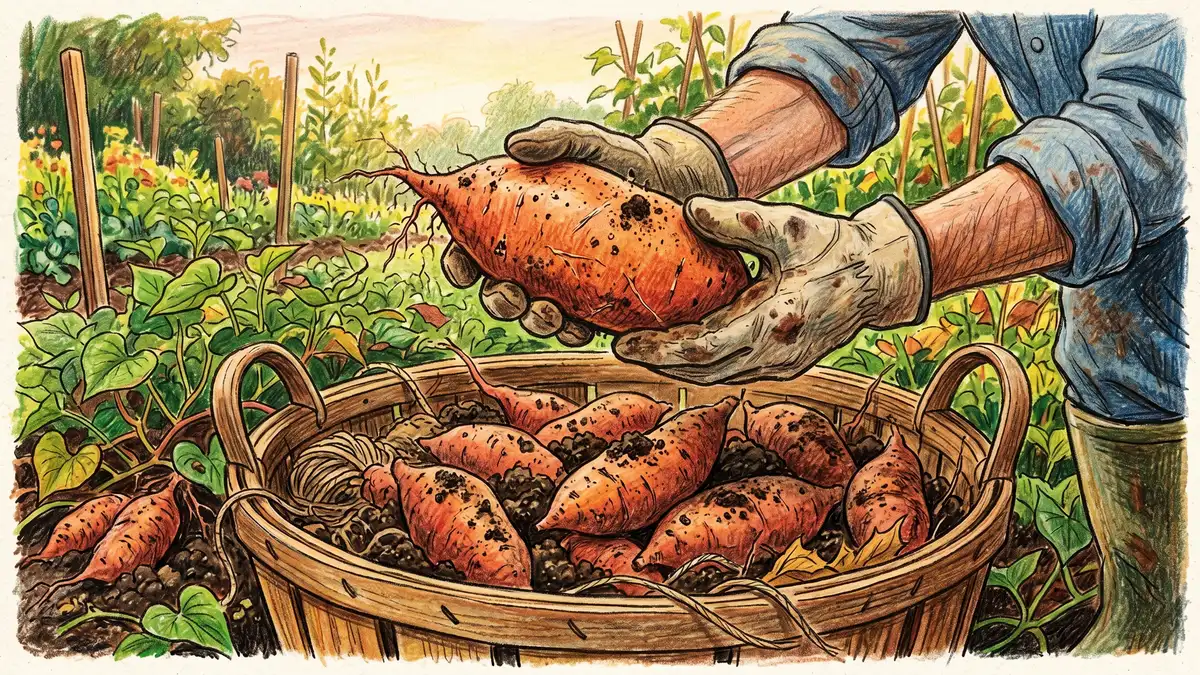
The companion plants do not change much across the country, but the sweet potato cultivar should match your climate and growing season.
- Beauregard: The classic US southern variety. 90 to 110 days. Reliable yields. Orange flesh. The standard cultivar for the South.
- Covington: NC State Extension's improved cultivar. Better disease resistance than Beauregard. 110 to 120 days.
- Centennial: Cold-tolerant by sweet potato standards. The best choice for zones 5 to 6 with a 100-day window.
- Garnet: Deep red skin, orange flesh. 110 to 120 days. Popular for fresh market.
- Jewel: Long-season variety, 130+ days. High yields in the deep South.
- Japanese sweet potato (Murasaki): Purple skin, white flesh. 110 to 120 days. Drier, less sweet flesh.
- Korean sweet potato (Hannah): Cream skin, ivory flesh. Buttery, chestnut-like flavor. 110 days.
If your growing season is shorter than 100 frost-free days, use black plastic mulch under the slips to warm the soil and add 2 to 3 weeks of effective season. Permaculture systems often achieve the same effect with thick organic mulch around (not over) the slip after the soil has warmed, paired with a south-facing aspect.
Pest management with companions
The sweet potato weevil (Cylas formicarius) is the most damaging US sweet potato pest, especially in zones 8 to 11. Adult weevils lay eggs in roots and the larvae tunnel through them. There is no rescue spray that removes weevils after infestation, so prevention through crop rotation, certified clean slips, and habitat diversification is essential. The University of Florida IFAS recommends a 2 to 3 year rotation away from sweet potatoes for any bed that has had weevils.
Wireworm and white grub damage is reduced by maintaining a flowering insectary perimeter that supports predator beetles. Marigold edges and dill clusters do most of this work in the design above.
For southern root-knot nematode, the marigold ring works as both an in-season suppression tool and a year-over-year soil cleanup. Some southern US growers rotate a full bed of French marigolds for one full season every 3 to 4 years specifically to break nematode cycles.
Container sweet potatoes and small-space companions
Sweet potatoes grow well in 25-gallon grow bags or fabric pots. The vines will cascade over the sides of the container, so plan space below for them to spread. Each container can take 1 to 2 sweet potato slips plus a perimeter of 4 to 6 French marigolds in the same pot. Smaller patio containers (15 to 20 gallons) work with dwarf or ornamental varieties such as the dark-leaved Sweet Caroline series, which produces small edible tubers and decorative foliage.
For balcony permaculture, the sweet potato vine itself is the companion: it acts as a temperature buffer for adjacent containers by shading their soil with its broad foliage. Pair with a 5-gallon bush bean container and a marigold edge planter and you have a balcony scale guild that mirrors the larger backyard layout.
Get the Weekly Dig
One practical permaculture guide a week, written for gardeners who do this on weekends: companion pairings that hold up under scrutiny, and the ones that do not. Free, no spam, unsubscribe any time.
Join the Weekly DigFAQ
What grows well with sweet potatoes?
The strongest companion plants for sweet potatoes in a US backyard are French marigolds (nematode suppression), bush beans and cowpeas (nitrogen fixation), nasturtium and sweet alyssum (beneficial insect habitat), dill and yarrow (predatory wasp attraction), and beets or radishes as an early-season catch crop before vines spread.
What should you not plant with sweet potatoes?
Avoid regular potatoes (shared pests), tomatoes (verticillium and potassium competition), cucumbers, melons, and squash (vine competition, shared viruses), sunflowers (allelopathy), and fennel (broadly allelopathic). Keep onions and other alliums in a separate bed because they prefer drier conditions and a higher pH than sweet potatoes.
Can sweet potatoes and tomatoes grow together?
Not recommended. Both crops are heavy potassium feeders and they share susceptibility to verticillium wilt. Tomatoes also shade the sprawling sweet potato vines as they grow tall, reducing photosynthesis and root development. Plant them in separate beds with a 4-foot buffer minimum.
Do marigolds really protect sweet potatoes?
Yes. French marigolds (Tagetes patula) release alpha-terthienyl through their roots, a compound that is toxic to southern root-knot nematode (Meloidogyne incognita) at low concentrations. USDA-ARS and UF/IFAS trials show 30 to 90 percent reductions in nematode populations in soil that has hosted French marigolds for at least one full season.
How far apart should sweet potatoes be planted?
Plant slips 12 to 18 in apart within the row, with rows 36 to 60 in apart. Wider spacing produces larger individual tubers. Tighter spacing produces a greater number of smaller tubers. For a backyard 4 ft wide bed, use two rows 24 in apart with slips 18 in apart in the row.
Can I plant cowpeas with sweet potatoes?
Yes. Cowpeas (Vigna unguiculata) are one of the strongest sweet potato companions in the US South. They tolerate heat and drought, fix atmospheric nitrogen, and produce edible pods. Sow cowpeas 1 to 2 weeks after transplanting sweet potato slips so the slips can establish before the cowpeas hit full vigor.
What is the Three Sisters with sweet potatoes?
A southern US variant of the traditional Three Sisters replaces squash with sweet potatoes as the ground-cover layer. The full guild is corn (vertical), pole beans or cowpeas (climbing), and sweet potatoes (ground). UGA Extension trials show this guild produces 80 to 90 percent of monoculture yield using half the bed space, an effective land equivalent ratio of 1.6 to 1.8.
When should I plant sweet potatoes?
Plant slips after the last frost when soil temperatures hit 65 degrees F or higher. In USDA zone 7 this is typically late May. In zone 8 mid May. In zone 9 early May. In zones 10 to 11 sweet potatoes can be planted year round but the spring planting produces the largest roots.
Resources
- LSU AgCenter: Sweet potato production research
- UF/IFAS: Sweet Potato Production in Florida (HS944)
- NC State Extension: Sweet Potato Production Guide
- UGA Cooperative Extension: Commercial Sweet Potato Production (Bulletin 677)
- USDA-ARS Vegetable Research Lab: Charleston, SC sweet potato research
- Texas A&M AgriLife Extension: Sweet potato home garden guides
- SARE: Marigold as a cover crop and nematode suppressant