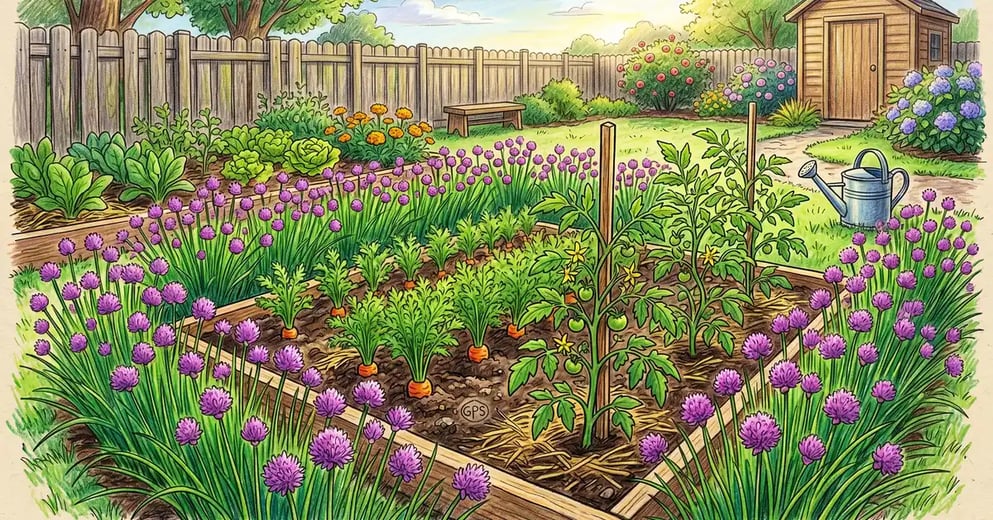

Chives (Allium schoenoprasum) are the most multifunctional herb you can squeeze into a small US backyard. The hollow leaves release sulfur compounds that mask the scent of carrots from carrot rust fly. The purple pompom flowers feed hoverflies and parasitoid wasps starting in May. The clumps stay neat at the bed edge for 5 to 10 years before they need division. Plant chives once and you bring pest protection, beneficial insect habitat, and a culinary harvest to every bed they touch. companion planting leeks
Sources: Cornell University Cooperative Extension; UF/IFAS; Iowa State Extension; Penn State Extension home herb production guides.
Chives belong to the same plant family as onions, garlic, leeks, and shallots (the Amaryllidaceae). What makes them more practical than their cousins for companion planting is their growth habit: a small, clumping perennial that stays in place year after year, sends up edible greens in earliest spring, and produces a flush of purple flowers right when many vegetable beds are starting their growing season. This guide covers the 12 strongest companion plants for chives, the 4 plants to avoid, and how to lay out a chive-protected backyard bed.
How chives protect your garden
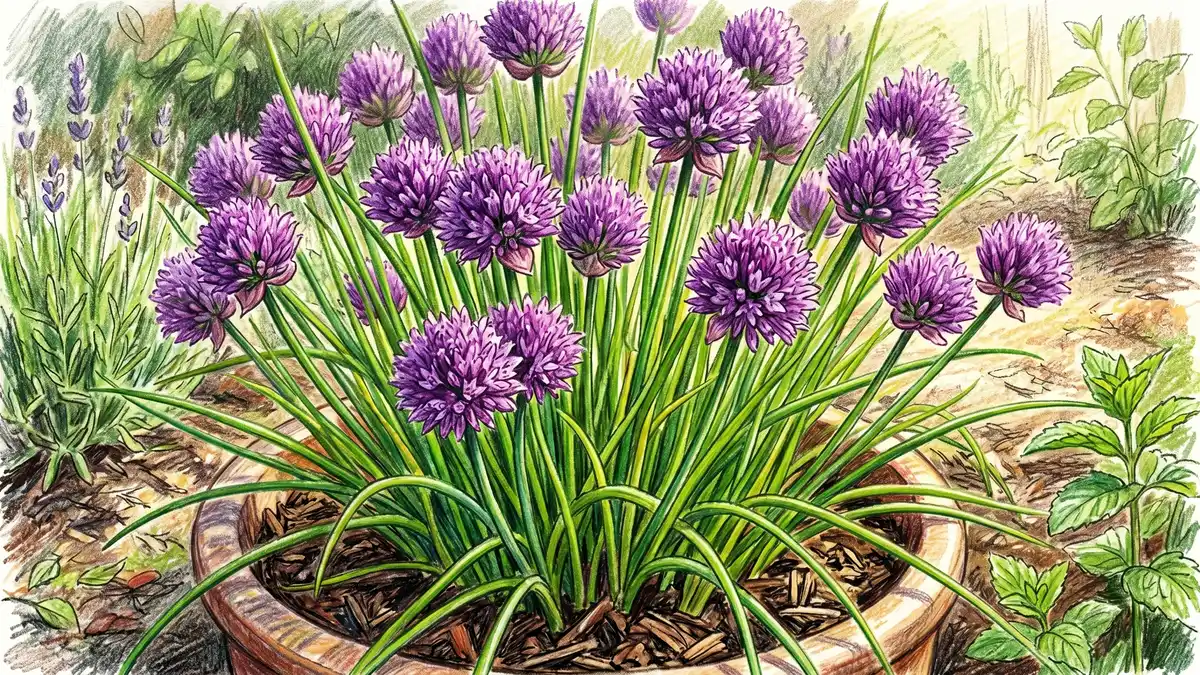
Chives work in three ways. First, when you brush a chive leaf or insects chew on one, the plant releases volatile sulfur compounds (allyl sulfides, propanethial S-oxide, and diallyl disulfide). These compounds disrupt the scent-based host-finding behavior of carrot rust fly, aphids, Japanese beetles, and several other common garden pests. The pests have a harder time locating the crops they actually want to eat because the chive odor masks the host plant signal.
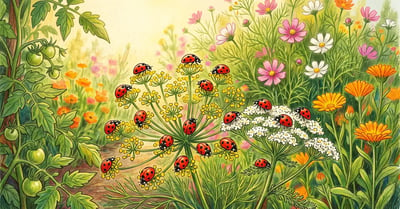
Second, chive flowers are one of the best beneficial-insect plants you can grow in a backyard. The umbel-shaped purple pompoms produce nectar at a height that suits hoverflies (whose larvae are voracious aphid predators), parasitoid wasps that target caterpillars, and small native bees. Cornell University Cooperative Extension research on insectary plants ranks alliums in flower among the top 10 nectar sources for biological pest control in a kitchen garden.
Third, chive roots release low concentrations of sulfur compounds and other secondary metabolites that subtly shift the soil microbial community in the immediate root zone. This is the same mechanism that gives chives their downside (suppressing legume nodulation), but on most crops it has a neutral or mildly protective effect against soil-borne fungal pathogens.
Why this works (the permaculture insight)
Permaculture principle 5 is "use and value renewable resources and services". Chives provide a renewable, perennial pest-deterrent service that requires no inputs after planting. The same clump of chives at the corner of a bed can keep deterring carrot rust fly for 5 to 10 years, attract beneficial insects every spring, and supply you with free seasoning every week from April through October. One plant. Three stacked functions. Zero ongoing cost. That stacking is what separates a permaculture garden from a conventional one.
The 12 best companion plants for chives
| Companion | How chives help | Best placement |
| Carrots | Mask scent from carrot rust fly (Psila rosae); 30 to 70 percent damage reduction in trials | Continuous edge or interspersed every 12 to 18 in |
| Tomatoes | Deter aphids, flea beetles, and spider mites | Ring around each plant or bed edge |
| Peppers | Aphid deterrence; pollinator attraction | Edge of bed or between plants |
| Roses | Aphid deterrence; possible reduction in black spot pressure | Ring at the base of each rose bush |
| Brassicas (cabbage, broccoli, kale, cauliflower) | Deter cabbage moth and cabbage looper egg-laying | Between rows or at bed corners |
| Apple trees | Reduce apple scab and codling moth pressure; classic permaculture apple guild plant | Cluster at the dripline of each tree |
| Strawberries | Deter slugs and aphids; early-season pollinator attraction | Continuous edge around the strawberry bed |
| Grapes | Reduce Japanese beetle damage; traditional companion in European viticulture | Single clump every 6 to 10 ft along the vine row |
| Mediterranean herbs (thyme, oregano, marjoram) | Compatible water and sun requirements; visual border interest | Mixed herb bed edge |
| Lettuce | Mild pest deterrence; edible chive flower garnish | End of row or bed corners |
| Beets and parsnips | Root-crop compatibility; pollinator support when flowering | Interspersed in the root vegetable bed |
| Kohlrabi | Cabbage moth deterrence (same as other brassicas) | Between rows of kohlrabi |
Source: Cornell Cooperative Extension companion planting guides; Iowa State Extension; UF/IFAS herb production publications.
The classic chive and carrot pair
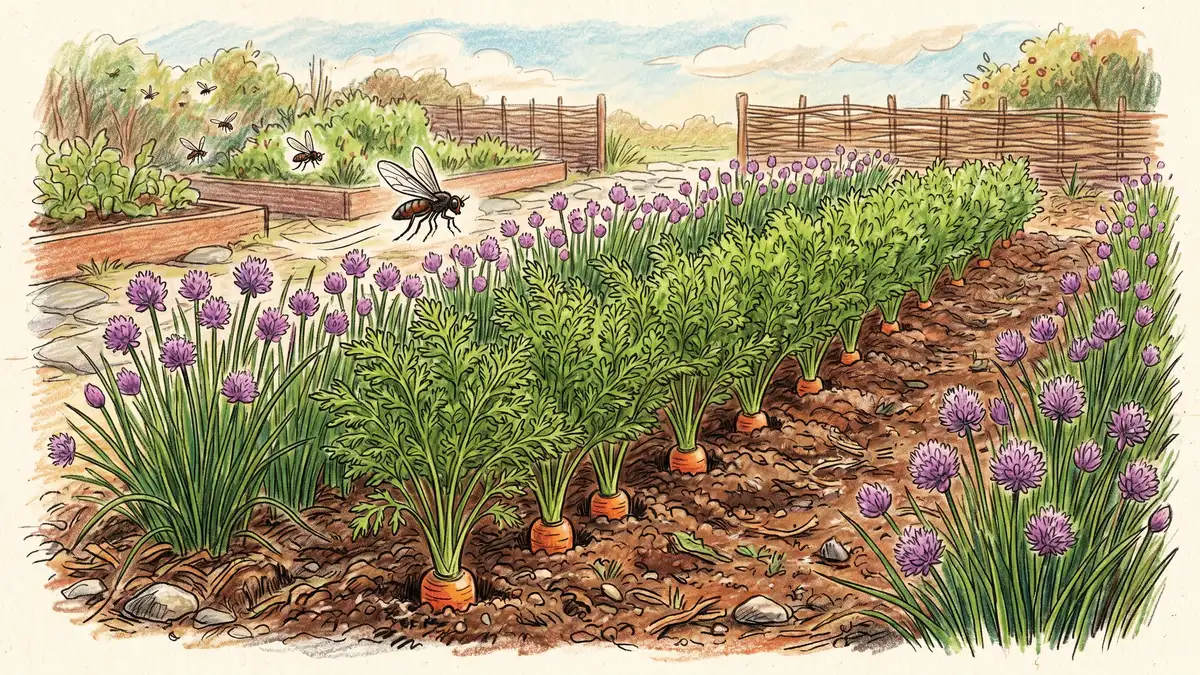
If you only ever pair chives with one crop, pair them with carrots. The carrot rust fly (Psila rosae) is one of the most damaging US carrot pests, especially in the Pacific Northwest, the upper Midwest, and the Northeast. Adult flies locate carrot rows by detecting the volatile terpenes that carrot foliage releases. Larvae hatch and tunnel into the carrot roots, causing the characteristic rust-colored frass tunnels that ruin the harvest.
Multiple US extension service trials, including work at Cornell Cooperative Extension and Iowa State Extension, have shown that interplanting alliums with carrots reduces carrot rust fly damage by 30 to 70 percent. The effect strengthens when:
- Chives are well established before carrots are sown, so the scent is already present when carrot rust fly adults emerge in April or May.
- Chives form a continuous border or are interspersed every 12 to 18 in within the carrot row, distributing odor evenly.
- You brush or harvest the chive leaves periodically, which releases additional volatile sulfur compounds.
For a 4 ft by 8 ft carrot bed, plant a continuous chive border on all four sides, roughly 6 to 10 in from the bed edge. About 20 chive plants will edge a bed that size. The chives will return every spring, expanding slightly each year. Carrot rust fly damage drops noticeably from year two onward as the chive border establishes its full odor profile.
Plants to avoid near chives
The list of plants to keep away from chives is short but firm:
- Beans (bush, pole, runner, lima, fava): allium-suppressed nitrogen fixation, reduced yield.
- Peas (English, snow, snap, southern peas, cowpeas): same Rhizobium issue as beans.
- Asparagus: both crops are heavy feeders with shallow root systems that compete directly. Asparagus also benefits from completely undisturbed bed conditions.
- Sage: prefers drier conditions than chives and can suffer if planted in the same moisture regime. They look like they should pair (both are perennial culinary herbs) but they want different watering schedules.
The bean and pea rule is the strict one. The other three are more "less optimal than separate beds" than truly incompatible. If your space is tight and you must mix sage with chives, it works in a Mediterranean herb bed with sharp drainage and low water input.
Chives in the rose garden
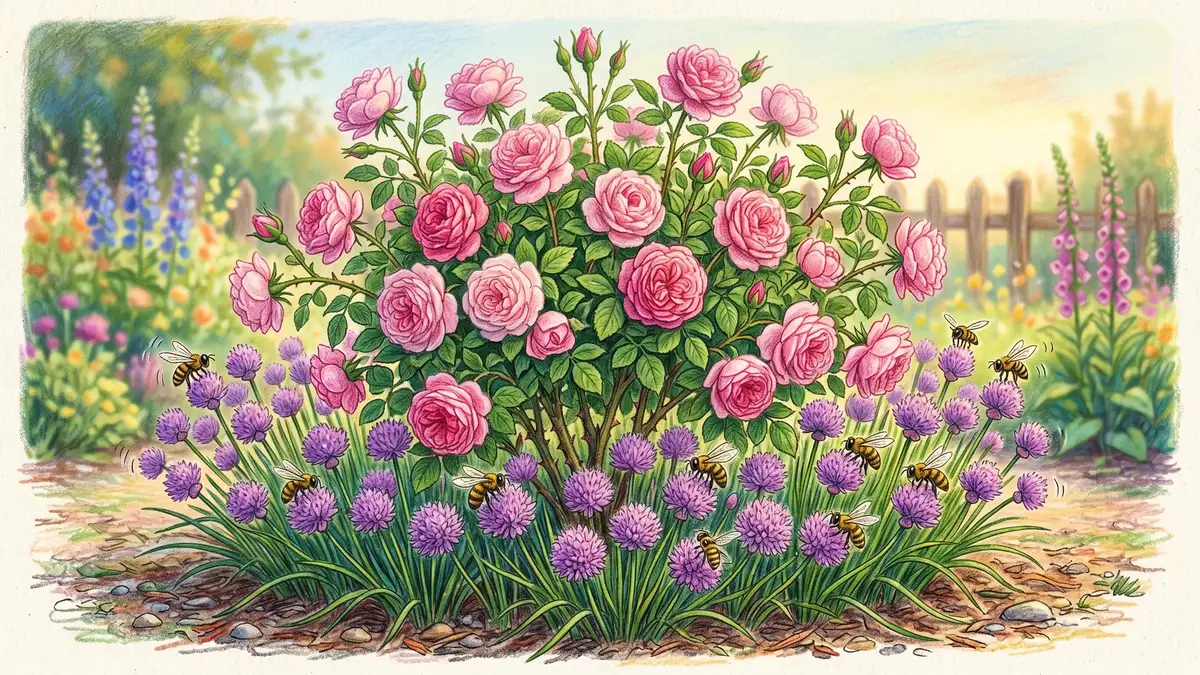
The rose-and-chives pairing is one of the oldest companion plantings in Western horticulture. The mechanism is straightforward: aphids are the primary pest of roses, and the sulfur volatiles from chive foliage interfere with aphid host-finding behavior. The dense growth of chives at the base of the rose also creates a small microclimate that, combined with good rose pruning, can marginally reduce black spot fungal pressure by improving air movement at the soil-leaf interface.
Plant a ring of 6 to 10 chive plants around each established rose bush, 8 to 12 in out from the central canes. The chives will reach mature size in their second season and stay productive for 5 to 10 years before needing division. The combination of pink, red, or white rose flowers above and purple chive pompoms below is one of the most attractive plant pairings in a US cottage garden.
Chives near roses also extend the pollinator support window. Roses themselves provide pollen but limited nectar, especially in modern cultivars. Chive umbels supply both, attracting the hoverflies and small native bees that contribute to a healthier garden ecosystem.
The apple tree guild with chives
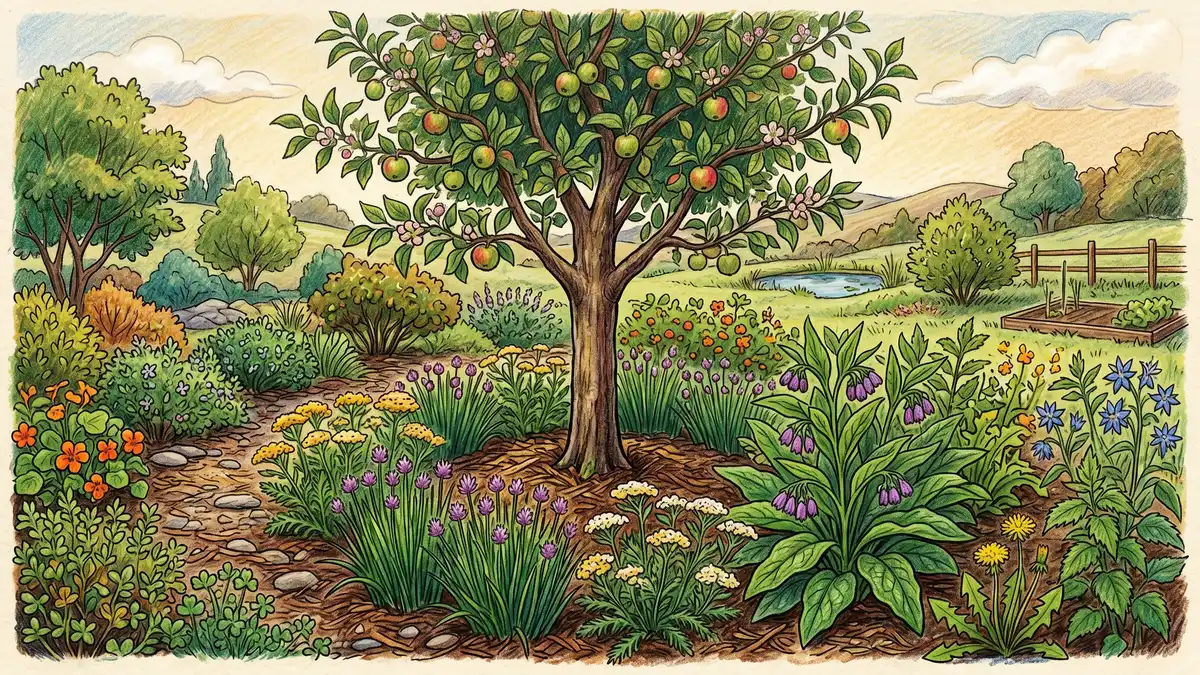
Permaculture practitioners since Bill Mollison have included chives in their classic apple tree guild design. The full guild typically includes:
- Center: apple tree (or another fruit tree, pear works equally well).
- Inner ring (chives and other alliums): deter codling moth, apple scab, and other apple pests at the dripline.
- Middle ring (comfrey, yarrow): dynamic accumulators that mine deep nutrients and feed the topsoil through chop-and-drop mulching.
- Outer ring (nitrogen fixers like clover): feed the tree slowly through root exudates and mulch.
- Vertical accent (nasturtium, native flowers): beneficial insect habitat.
For a young apple tree, plant 8 to 12 chive divisions in a ring at the dripline (typically 18 to 36 in from the trunk on a 1 to 2 year old tree). As the tree grows, the dripline expands outward. Divide and replant the chive ring every 3 to 4 years to keep pace. The chive ring stays put for the life of the tree, which can be 25 to 60 years for a backyard apple.
How to grow chives well
Site selection
Full sun to partial shade. Well-drained soil with pH 6.0 to 7.0. Most US backyards meet this naturally. Chives tolerate clay, sand, or loam with moderate organic matter. In hot southern zones (zone 8 and warmer), plant where chives get afternoon shade to prevent leaf scorch.
Planting
Set divisions or transplants 8 to 12 in apart for individual clumps, or 6 in apart for a continuous edge. From seed, sow in early spring directly in the bed or start indoors 6 to 8 weeks before the last frost date. Seed-grown chives take a full season to reach full size; division is faster.
Watering and feeding
Moderate water through the growing season. About 1 in of rain or supplemental irrigation per week. Top-dress with 1 in of compost each spring. Avoid heavy nitrogen fertilization, which produces lush leaves but weakens flavor.
Harvest
Cut leaves with scissors, taking the outer leaves first and leaving 2 in of stub for regrowth. Harvest small amounts continuously rather than scalping the whole plant. The flowers are edible and best at peak bloom in May or June.
Division and renewal
After 3 to 4 years, chive clumps become crowded and leaf size drops. Dig up the entire clump in early spring or fall, split into 4 to 6 sections with a sharp spade, and replant 8 to 12 in apart. Each division should contain at least 10 bulblets and a healthy root mass.
Flowering management
Let chives flower for the beneficial insect benefits. If you want a longer leaf harvest, cut about half the flower scapes before they fully open. The remaining flowers feed the pollinators while the cut clumps push out more tender new growth.
Common chives versus garlic chives
Two species share the chive name in US gardens. They look similar at first glance but have different roles.
| Trait | Common chives (A. schoenoprasum) | Garlic chives (A. tuberosum) |
| Leaf shape | Hollow, tubular, 8 to 12 in | Flat, solid, 12 to 18 in |
| Flavor | Mild onion | Mild garlic |
| Flower color | Purple pompom | White flat-topped umbel |
| Bloom time | May to June | August to September |
| Hardiness | USDA zones 3 to 9 | USDA zones 4 to 9 |
| Self-seeding | Modest | Vigorous (can become weedy) |
| Best for | Pest deterrence, spring nectar | Late-summer nectar, Asian cooking |
Source: Iowa State University Extension; Cornell Cooperative Extension allium production guides.
For backyard companion planting, common chives are the default choice. Their early bloom matches the timing of aphid and carrot rust fly emergence, and they expand much less aggressively than garlic chives. Garlic chives are still useful as a late-summer pollinator support and in beds where their later flowering extends the nectar window. Deadhead garlic chives if you do not want them to self-seed everywhere.
US cultivars for the backyard
Most US garden centers sell unnamed seedling chives that work fine. For specific traits, look for these named cultivars:
- Forescate: deep purple flowers, slightly taller than standard chives at 12 to 14 in.
- Profusion: heavy bloomer with extra-large flower heads; great for pollinator beds.
- Staro: thick, productive leaves; preferred for kitchen production.
- Polyvert: medium-thick leaves with classic mild onion flavor.
- Geisha (garlic chives): compact form, less aggressive than standard garlic chives.
- Nira (garlic chives): the traditional Japanese culinary garlic chive; broad flat leaves.
Container and indoor chives
Chives grow well in 8 to 12 in pots. Use a quality potting mix with added compost, water when the top inch of soil dries, and place where the pot gets at least 6 hours of direct sun (south or west window indoors). On a balcony, a chive pot paired with a tomato pot and a thyme pot is a complete miniature companion planting setup. Divide indoor chives every 2 to 3 years; they exhaust container soil faster than in-ground clumps.
Get the Weekly Dig
One practical permaculture guide a week, written for gardeners who do this on weekends: companion pairings that hold up under scrutiny, and the ones that do not. Free, no spam, unsubscribe any time.
Join the Weekly DigFAQ
What grows well with chives?
The strongest companions for chives are carrots (mask scent from carrot rust fly), tomatoes (deter aphids), peppers, roses (deter aphids and reduce black spot pressure), brassicas like cabbage and broccoli (deter cabbage moth), apple trees (classic permaculture guild plant), strawberries (deter slugs), grapes, lettuce, beets, parsnips, and Mediterranean herbs like thyme and oregano.
What should you not plant with chives?
Avoid planting chives within 18 to 24 inches of beans, peas, or any other legumes. Allium root exudates inhibit the Rhizobium bacteria that legumes need for nitrogen fixation, reducing legume yield by 15 to 30 percent. Also keep chives separate from asparagus (root competition) and traditional sage (different water needs).
Can you plant chives with tomatoes?
Yes. Chives are one of the strongest tomato companions. The sulfur compounds released by chive foliage deter aphids, flea beetles, and spider mites. Plant a ring of chives at the base of each tomato plant or around the edge of the tomato bed. The shallow chive roots do not compete with the deeper tomato root system.
Can you plant chives with peppers?
Yes. Peppers benefit from chive companion planting in the same way tomatoes do (aphid deterrence and pollinator attraction). Since peppers are shorter than tomatoes, plant chives toward the north or east edge of the pepper bed to avoid any shading. Chives also work well between pepper plants.
Can chives and rosemary be planted together?
Yes, but plant them at the edges of a shared bed rather than tightly intermixed. Rosemary prefers drier, lower-water conditions than chives. In a Mediterranean herb bed with sharp drainage, both can coexist with chives at the slightly wetter end and rosemary at the drier end. Mulch with gravel rather than wood chips to support the rosemary side.
Why are chives bad for beans?
Allium root exudates contain sulfur compounds that inhibit the Rhizobium bacteria living in symbiosis with bean roots. These bacteria fix atmospheric nitrogen into a form the bean plant can use. When allium roots interfere with that process, the bean plant gets less nitrogen, produces fewer nodules, and yields 15 to 30 percent less. The same applies to peas and all other legumes.
How long do chive plants live?
An individual chive clump can live and produce for 5 to 10 years in good conditions. After 3 to 4 years the clump becomes crowded and leaf size drops, so divide and replant the divisions to refresh productivity. A divided clump goes on producing for another 3 to 4 year cycle before needing the next division.
Do chives repel pests?
Yes, chives deter several pests through their sulfur-based volatile compounds. Documented effects include carrot rust fly damage reduction of 30 to 70 percent, aphid colony reduction on tomatoes and roses, Japanese beetle reduction on grapes and roses, and slug deterrence on strawberries. The effect is not 100 percent control but a meaningful component of integrated pest management.
Resources
- Cornell University Integrated Pest Management: companion planting and beneficial insects
- Iowa State University Extension: Chives growing guide
- UF/IFAS: Growing herbs in the home landscape
- Penn State Extension: Herbs production guides
- NC State Extension Gardener Handbook: Herbs chapter
- Michigan State University Extension: Companion planting principles
- UC ANR Cooperative Extension: Companion planting guide