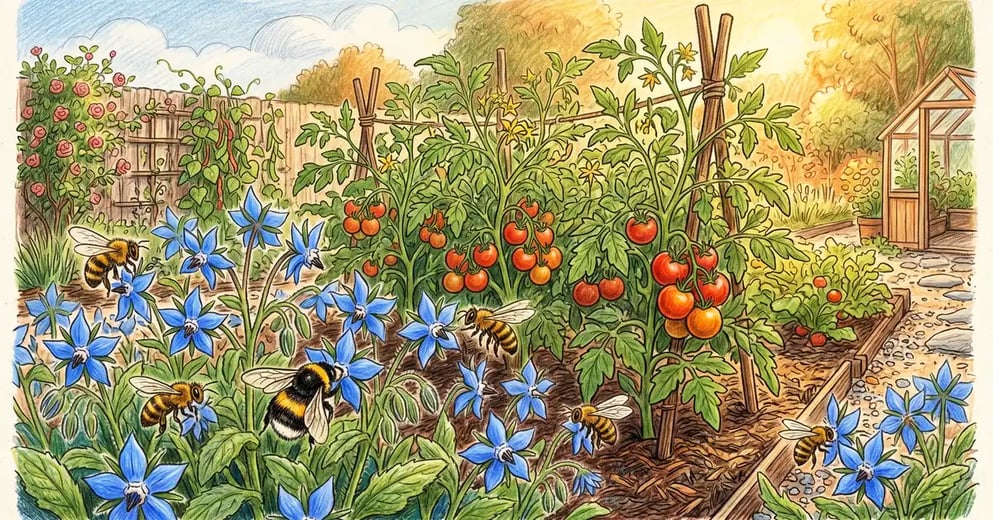

If you only plant one flower in your tomato bed this summer, make it borage. The bright blue star-shaped blooms refill nectar within 2 minutes after a bee visit, pull pollinators in by the dozen, and pair with tomatoes for bigger fruit set, fewer hornworms, and richer soil at the end of the season.
What borage actually is
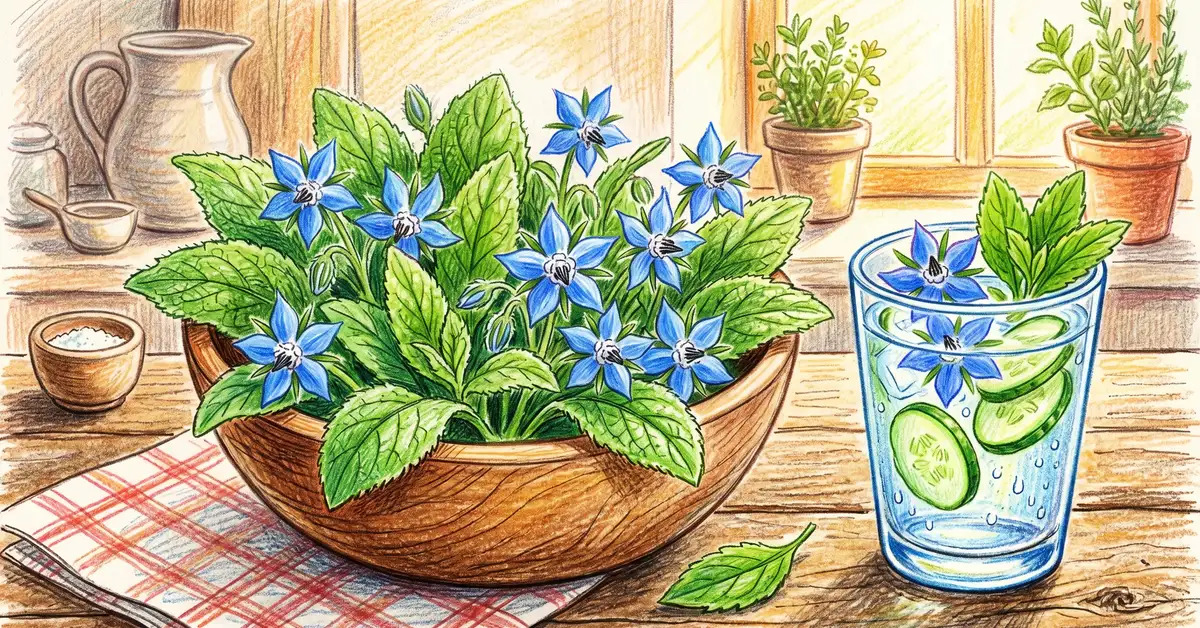
Borage is a fast-growing annual herb in the Boraginaceae family, native to the Mediterranean and naturalized in much of the United States. It typically reaches 18 to 36 inches (46 to 91 cm) tall with hairy stems, large grey-green leaves, and bright blue (occasionally pink) star-shaped flowers with prominent black anthers. The whole plant has a fresh cucumber taste, which is why both the young leaves and the flowers end up in summer salads and gin drinks.
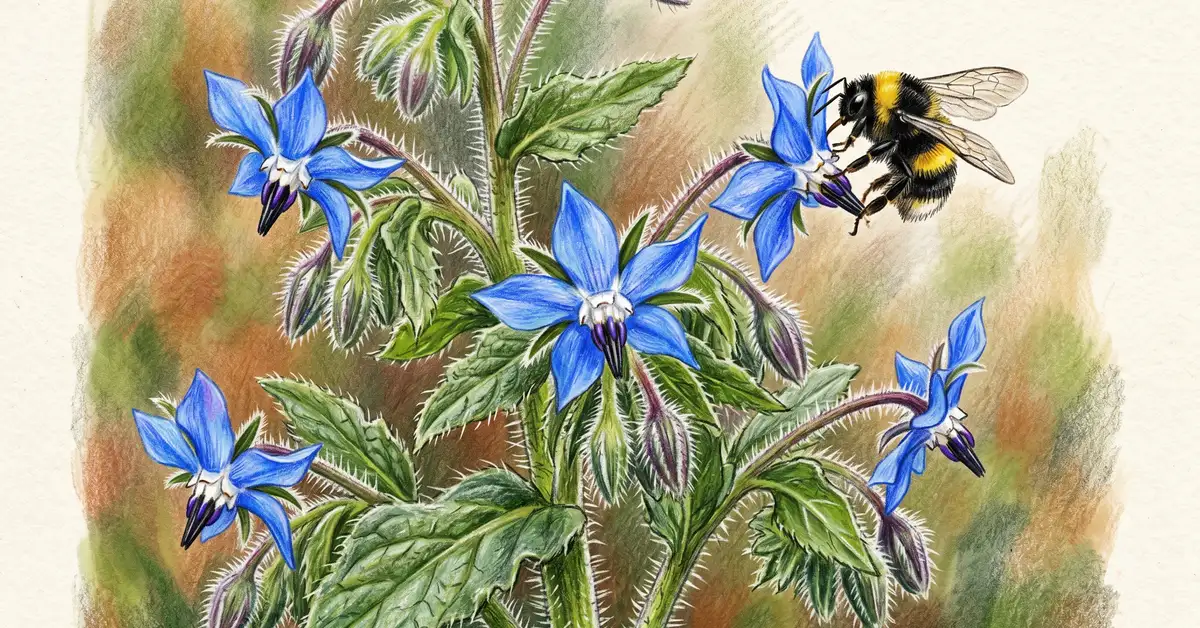
The reason borage matters in a backyard vegetable bed is the nectar economy it builds underneath your other crops. According to research from the UC Davis Honey Bee Research Facility, borage refills its nectar reservoir within roughly 2 minutes after a bee visits the flower. Most flowers take 30 minutes to several hours. That rapid refill is why honeybee, bumblebee, and native bee traffic over a borage stand stays heavy throughout the day, where it would taper off at a normal flower bed by midmorning.
This high pollinator traffic is the lever that ties borage to better tomatoes. Tomatoes are largely self-pollinating, but research from Clemson Cooperative Extension and the NC State Extension Gardener Handbook shows fruit set, fruit weight, and seed count all rise 10 to 25 percent when bumblebees actively buzz-pollinate flowers. A borage plant 3 feet from a tomato pulls bumblebees into the same airspace, which translates to more bee visits per tomato flower and bigger fruit.
Why borage and tomatoes are a classic pairing
The borage-tomato pairing has appeared in companion planting books since at least the 1970s, but the actual mechanisms are surprisingly well-documented. University of Maryland Extension HG #16 lists four distinct benefits that show up in field trials and farmer reports:
Why this works (the permaculture principle)
Permaculture calls this a guild: a small group of plants that produce more together than the sum of their separate yields. Borage is not just a flower; it is a function. It pulls in pollinators, it feeds predator insects, it mines calcium from the subsoil with its taproot, and it provides chop-and-drop biomass at the end of the season. Each function would justify a separate plant in a conventional garden. Permaculture stacks all four onto one species and tucks it into the spaces between tomatoes, where it costs nothing extra in real estate. This is the same logic behind companion planting at the bed level and food forest design at the garden scale.
1. Pollinator magnet for tomato fruit set. Borage attracts bumblebees, which are the most efficient buzz-pollinators of tomato flowers. The vibration of a bumblebee's flight muscles shakes pollen loose inside the anther cone that hand-shaking and wind do not reach as effectively.
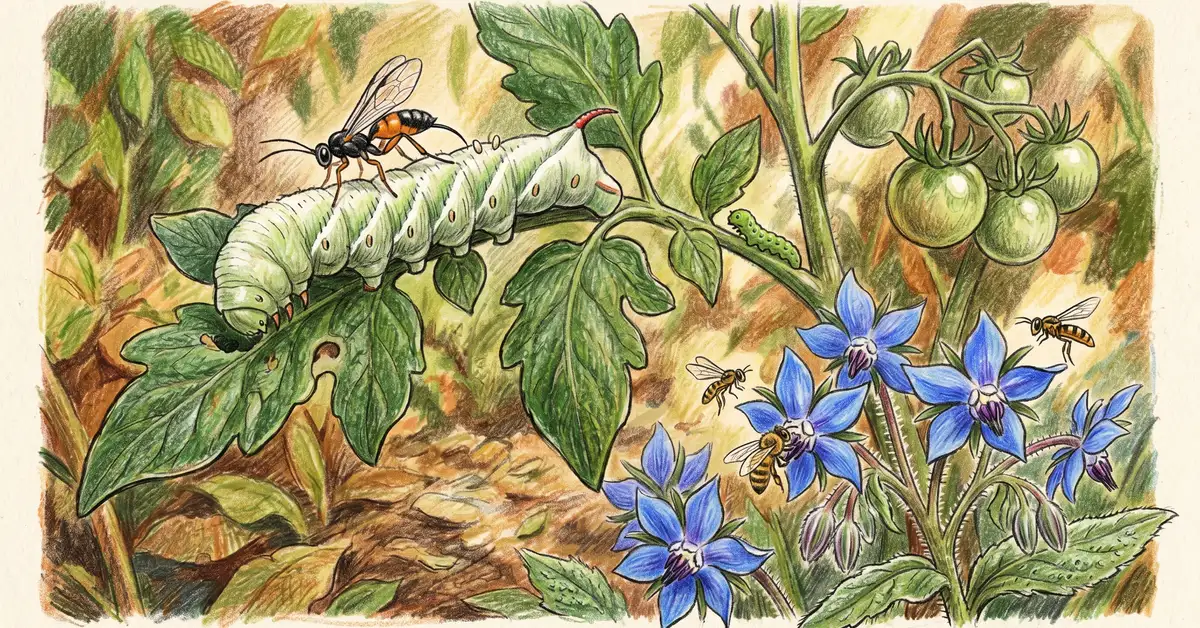
2. Predator wasp habitat for tomato hornworm control. The small white parasitic wasps (Braconidae, mostly Cotesia congregata) that lay eggs on tomato hornworms feed on borage nectar as adults. Purdue Extension Bulletin E-77 identifies borage as one of the recommended insectary plants for boosting parasitoid populations in vegetable gardens. More borage flowers means more adult wasps available to find and parasitize the hornworms that would otherwise strip your tomato plants overnight.
3. Calcium mining via deep taproot. Borage develops a fleshy taproot that reaches 18 to 24 inches (46 to 61 cm) into the subsoil. The leaves accumulate calcium, potassium, and magnesium pulled up from below the tomato root zone. Chopped and dropped at the base of a tomato plant, that biomass releases nutrients exactly where the tomato needs them, particularly calcium, which is the limiting nutrient for blossom end rot.
4. Continuous nectar through the whole tomato season. Borage flowers from late June through the first hard frost in most US zones. That overlap with the tomato bloom and fruit set window means pollinator support is available for every truss your tomato produces, not just early or late in the season.
The 5-step planting walkthrough
This sequence covers a late spring sowing alongside your tomato transplants. Total hands-on time is about 15 to 20 minutes for a bed of 6 tomato plants. Cost is roughly $3 to $5 in borage seed.
Wait until soil hits 60 to 70 F
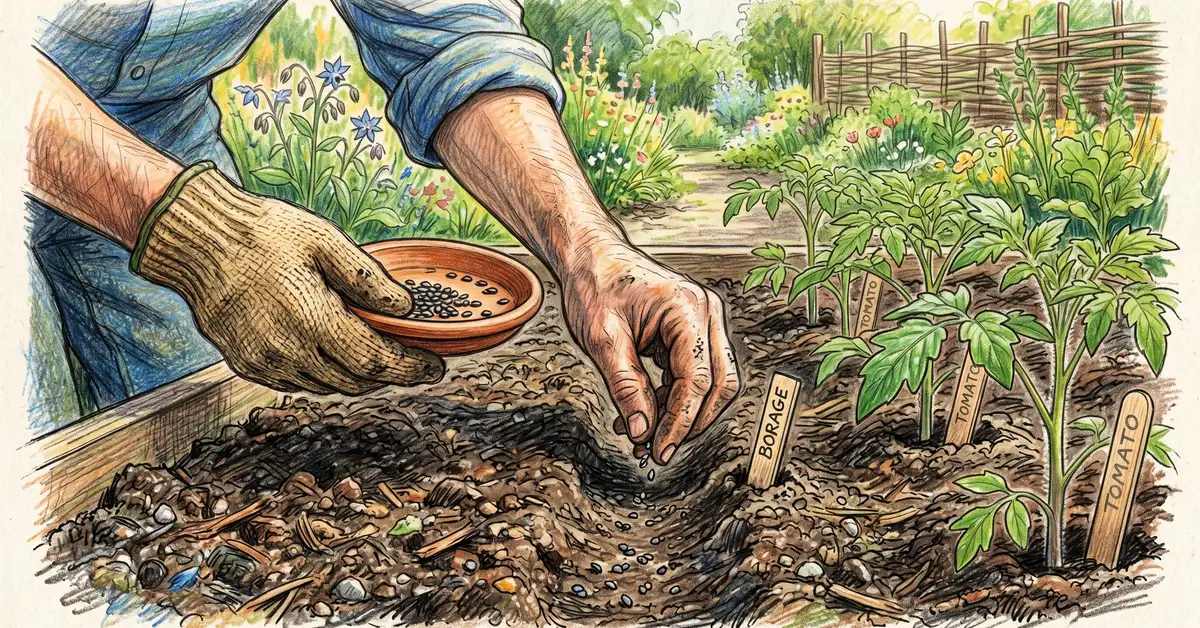
Borage germinates best in warm soil, typically 5 to 14 days after the last frost in your zone. Plant tomatoes first as transplants, then sow borage seed in the same bed. In USDA zones 6 to 8 that usually means mid-May. In zones 4 to 5, late May to early June. In zones 9 to 10, late March to early April. Direct-sow only. Borage does not transplant well because of its taproot.
Choose your spacing ratio
The right ratio is about 1 borage plant for every 3 to 5 tomato plants. For a typical backyard bed of 6 tomatoes, plant 2 borage clusters. Position them where they will not shade short tomato varieties or block your access for staking and pruning. Corners and bed edges work well.
Sow seed 1/4 to 1/2 inch deep
Push 3 to 4 seeds into the soil at each spot you want a plant, then cover lightly with soil and water in gently. Borage seed needs darkness to germinate, so make sure the cover is solid. NC State Extension Gardener Plant Toolbox notes that thinned seedlings should be 12 inches (30 cm) apart for full-size plants.
Water through germination then let it ride
Keep the soil moist for the first 2 weeks until you see cotyledons. After that borage is drought-tolerant and largely self-sufficient. It will appreciate the same watering schedule as your tomatoes but does not need extra attention. No fertilizer required.
Harvest leaves and flowers as you go
Once the plant reaches 12 inches (30 cm), start harvesting young leaves for salads and flowers as a garnish or for gin drinks. Frequent picking encourages continuous bloom. Let one or two plants go to seed at the end of summer so you have volunteers next year.
The chop-and-drop trick
The often-overlooked benefit of borage comes at the end of the season. By August, the plants are large, slightly leggy, and have already produced massive nectar for 8 to 10 weeks. This is the moment to cut them back hard and use them as mulch.
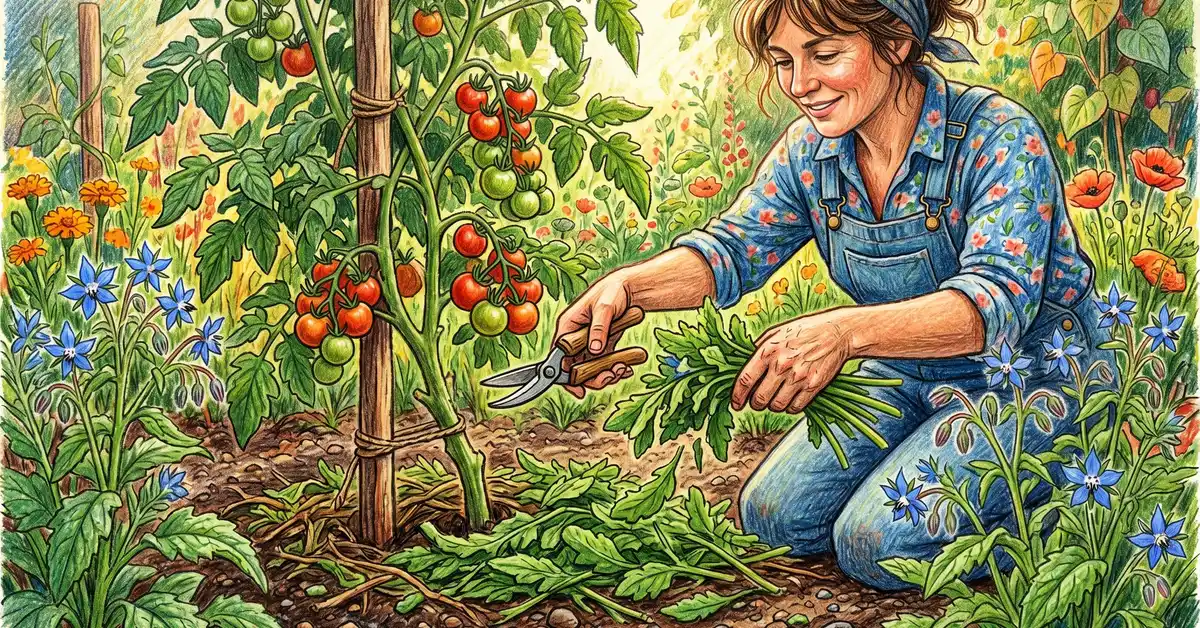
Cut the borage stems at the base, chop the leaves and stems into 4 to 6 inch (10 to 15 cm) pieces, and spread them around the base of your tomato plants in a 2 to 3 inch (5 to 7.5 cm) layer. The plant comes back from the crown within 2 to 3 weeks for another flush of bloom before frost. The chopped biomass breaks down over the rest of the season, releasing calcium and potassium right where the tomato roots need it.
This is called chop-and-drop in permaculture and has been studied as a soil-building method by the Rodale Institute for over four decades. The calcium content in borage leaves is particularly useful for preventing blossom end rot on tomatoes in the second half of summer when calcium uptake often falters during dry spells.
What else borage pairs with (and what to avoid)
| Plant | Pairing | Why |
| Tomatoes | Excellent | Bee attraction, hornworm wasps, calcium mining, season-long bloom |
| Strawberries | Excellent | Increases bee visitation and fruit weight by 15 to 30% in trials |
| Squash and zucchini | Excellent | Bumblebee buzz-pollination improves squash fruit set dramatically |
| Cabbage family (kale, broccoli, brussels) | Good | Deters cabbage worm moths via aromatic foliage |
| Beans and peppers | Good | Pollinator support, no negative interactions |
| Fennel | Avoid | Fennel is allelopathic to most plants in the garden, including borage |
| Densely planted root crops (carrots, beets) | Caution | Borage taproot competes for the same vertical soil space |
Source: University of Maryland Extension HG #16 and Clemson Cooperative Extension.
Edible uses (and one safety note)
Both the young leaves and the flowers are edible. Young leaves taste like cucumber and work well chopped into salads, blended into yogurt dips, or steeped as a tea. The flowers freeze beautifully into ice cubes for summer drinks and are the traditional garnish for a Pimm's cup. The flavor of older leaves becomes coarse and hairy, so harvest young.
Letting borage become a permanent fixture
Borage is technically an annual but it self-seeds prolifically. Most gardeners who plant it once never have to buy seed again. By August the plants drop hundreds of seeds, which germinate in fall or the following spring depending on your zone. Native Plant Trust and USDA Invasive.org do not list borage as invasive in any US state, though it can spread aggressively in a small bed if you let every plant set seed. Manage by deadheading flowers after they fade in any beds where you do not want volunteers.
In a permaculture context this self-seeding behavior is a feature not a bug. Borage that returns voluntarily costs you nothing and is already positioned where it was last successful. Many gardeners treat it as a permanent understory in their tomato and squash beds, the same way they treat other companion flowers in a long-term planting scheme.
Get the Weekly Dig
One practical permaculture guide a week, written for gardeners who do this on weekends: companion pairings that hold up under scrutiny, and the ones that do not. Free, no spam, unsubscribe any time.
Join the Weekly DigFrequently asked questions
Is borage a perennial?
No, borage is an annual. It germinates, flowers, sets seed, and dies within a single growing season. However, it self-seeds reliably and most gardens establish a self-perpetuating borage patch after the first year.
What is borage good for?
Borage has three main uses: as a companion plant for tomatoes, strawberries, squash, and cabbage; as a pollinator support plant with continuously refilling nectar; and as a culinary herb with cucumber-flavored edible leaves and flowers. The chopped foliage also serves as a calcium-rich chop-and-drop mulch.
Is borage edible?
Yes, the young leaves and the flowers are edible. The taste is described as fresh cucumber. Use leaves in salads, soups, or as a tea. Flowers work as a garnish, in summer drinks, or frozen into ice cubes. Avoid older leaves which become coarse and hairy.
Is borage invasive?
Borage is not listed as invasive in any US state by the USDA Invasive Species Database. It does self-seed aggressively, however, which can be a nuisance in small managed beds. Deadhead spent flowers to control spread.
How to plant borage?
Direct-sow borage seed 1/4 to 1/2 inch deep after the last frost when soil temperature reaches 60 to 70 F. Cover lightly (seed needs darkness to germinate), water in, and thin seedlings to 12 inches apart. Do not transplant. Borage has a taproot that resents disturbance.
What not to plant with borage?
Avoid planting borage near fennel, which is allelopathic and suppresses most nearby plants. Also avoid placing borage in densely planted root crop beds (carrots, beets) where the taproots will compete for the same vertical soil space.
How tall does borage grow?
Borage typically reaches 18 to 36 inches (46 to 91 cm) tall and 12 to 18 inches (30 to 46 cm) wide. In rich soil or with extra moisture it can reach 3 feet. Plants tend to flop slightly when mature, which is normal.
How do I harvest borage seeds?
After flowers fade, the calyx (the green base of the flower) holds 4 small black seeds. Once the calyx dries to brown, tip the seed head over a paper plate and gently shake. Seeds will fall out. Store dry seeds in a sealed jar in a cool place. They remain viable for 3 to 5 years.
Resources
- University of Maryland Extension: Companion Planting HG #16
- Clemson Cooperative Extension: Tomato Companion Planting
- NC State Extension Gardener Plant Toolbox: Borago officinalis
- NC State Extension Gardener Handbook: Companion and Pollinator Plants
- Purdue Extension: Insectary Plants for Beneficial Insects (E-77)
- UC Davis Honey Bee Research Facility
- Rodale Institute: Chop-and-Drop and Living Mulches
- NCCIH: Borage Safety and Use