
What Should You Plant With Artichokes?
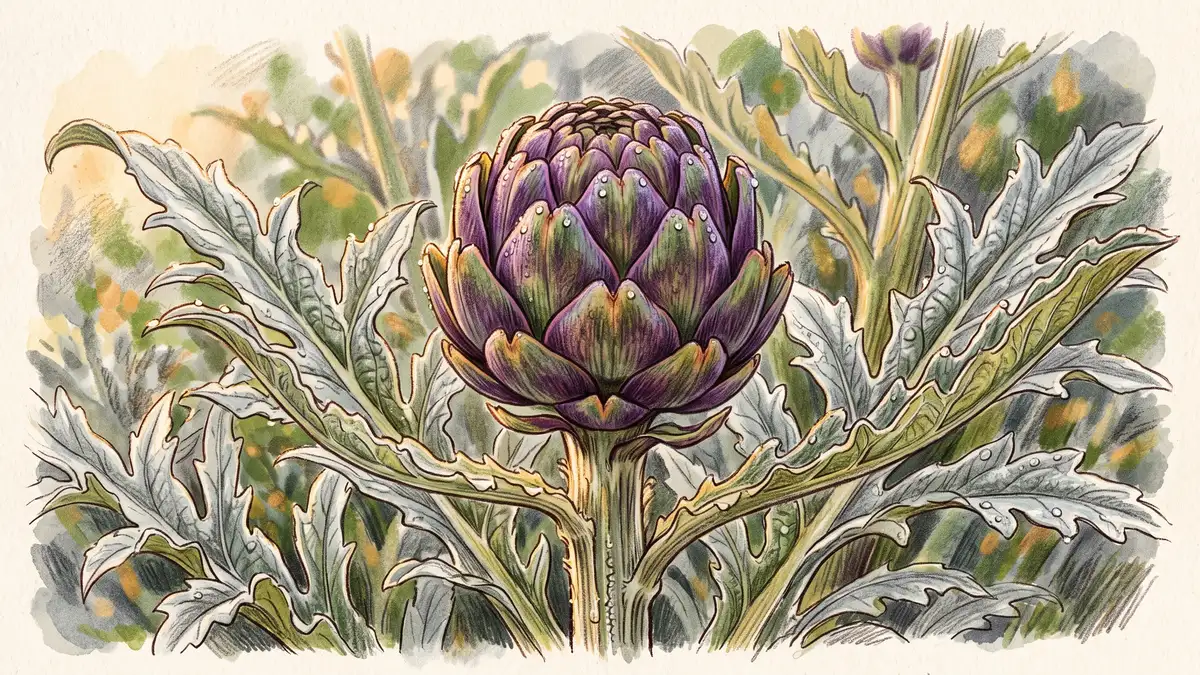
Start with the size problem, because everything else follows from it. A globe artichoke is not a vegetable you slot between the lettuce. The UC Master Gardener Program describes mature plants reaching 3 to 4 feet tall and roughly 6 feet in diameter, spaced 4 to 6 feet apart. Virginia Tech puts well-grown perennial plants at 4 to 5 feet tall and wide. companion planting around rhubarb
So the honest answer is: whatever can live beside a plant that takes a 6-foot circle, drinks steadily, feeds heavily, and casts real shade for half the year. That rules out most sun-hungry annuals. It rules in the Mediterranean herb palette, nitrogen-fixing legumes, and a few low insectary flowers. Toby Hemenway notes in Gaia's Garden that artichokes barely fit under dwarf fruit trees unless pushed out to the drip line. In a guild, the artichoke is not understory. It is the anchor.
What we will cover:
- Spacing that actually reflects mature plant size, from four extension services
- Which Mediterranean partners match the artichoke's water and light needs
- What to keep out of the bed, and which of the usual warnings hold up
- Where the companion planting evidence is solid and where it is only folklore
Key Takeaway
Design the bed around one artichoke per 15 to 30 square feet, then fill the perimeter, not the interior. Companions go at the canopy edge and beyond, where they get light. Anything planted directly beneath a mature crown will be shaded out by the second season.
How Far Apart Should Artichokes Be Planted?
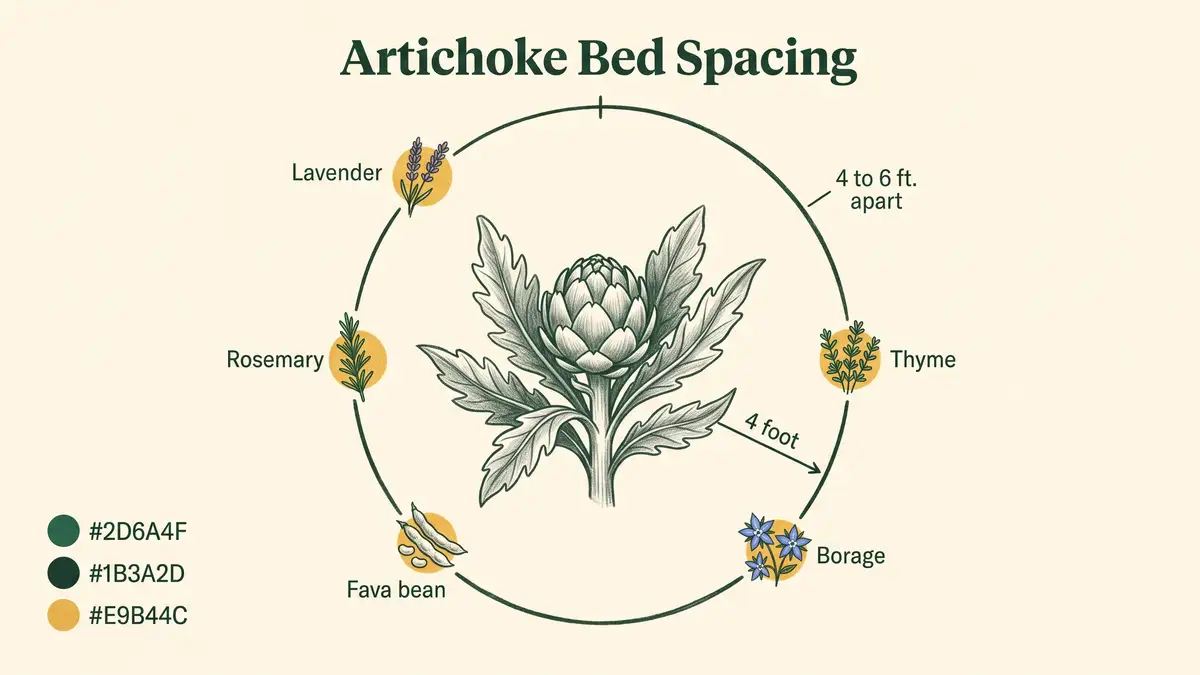
Between 2.5 and 6 feet, and the range is climate, not sloppiness. UC ANR's 4 to 6 feet assumes a long-lived perennial crown in coastal California. Utah State's 18 inches assumes an annual grown from seed and pulled at frost. Both are right for their context.
For a Mediterranean-style bed in most of the US, take the middle: Oregon State recommends spacing starts 3 to 5 feet apart, and says explicitly to consider the shade they will cast. That clause is the companion planting instruction hiding inside a spacing recommendation.
| Source | Plant Spacing | Row Spacing | Grown As |
| UC Master Gardener Program | 4-6 ft. | - | Perennial, coastal CA |
| Oregon State Extension | 3-5 ft. | - | Perennial or annual |
| Texas A&M AgriLife | 2.5-3 ft. | 3-4 ft. | Intensive home garden |
| Virginia Tech | 2.5 ft. | 6 ft. | Commercial (2,906 plants/acre) |
| Utah State Extension | 18 in. | 2-3 ft. | Annual from seed |
Sources: UC Master Gardener Program, Oregon State Extension, Texas A&M AgriLife, Virginia Tech, Utah State Extension
Texas A&M gives the reason for generosity plainly: leaving plenty of room reduces the chance of disease becoming a problem, and artichokes are prone to root rot in soil that stays wet. Wide spacing is not just about light. It is airflow, and airflow is disease management.
Why This Works: Stacking in Space
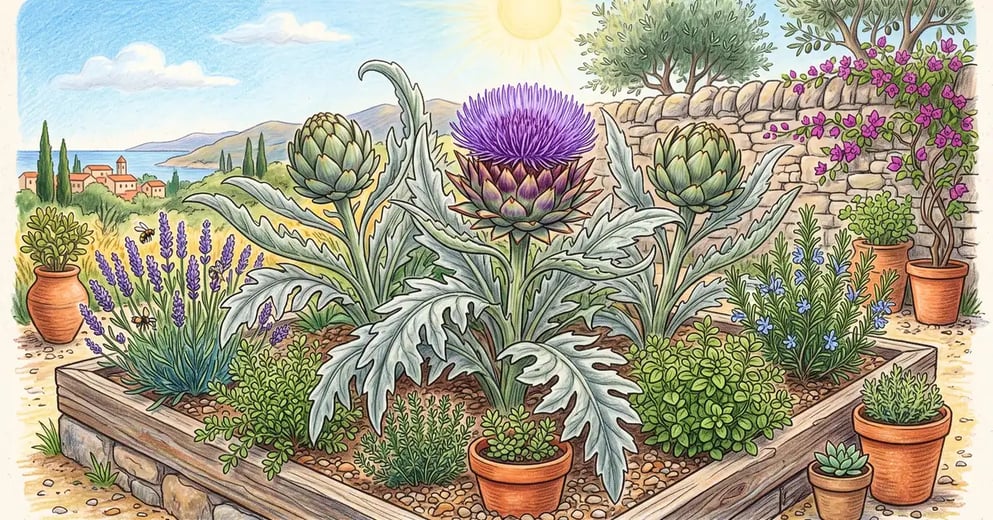
Permaculture design asks you to fill every niche, but only with plants that can use what is left. The artichoke takes the tall, sunny, moisture-rich centre. What remains at the edge is bright, drier and shallower, exactly the niche lavender, thyme and oregano evolved for on Mediterranean hillsides. You are not squeezing plants in. You are matching each one to the conditions the anchor creates.
Which Mediterranean Companions Actually Work?
Match water needs first, then light, then function. This is where most companion planting lists go wrong. They pair plants by folklore rather than by whether the two can share an irrigation schedule.
Artichokes are thirsty. Utah State recommends 1 to 2 inches of water per week in several applications, kept up right through bud formation. Cornell is blunt about the consequence: the artichoke will survive drought but will not produce well. Lavender, by contrast, resents wet feet. That does not make them incompatible, but it does mean lavender belongs at the bed's dry outer edge, not in the irrigated zone.
| Companion | Mature Size | Where It Goes | What It Contributes |
| English lavender | 2-3 ft. | Dry outer edge, full sun | Pollinators, structure year-round |
| Rosemary | 3-5 ft. | South or west edge | Windbreak, evergreen bulk, bees |
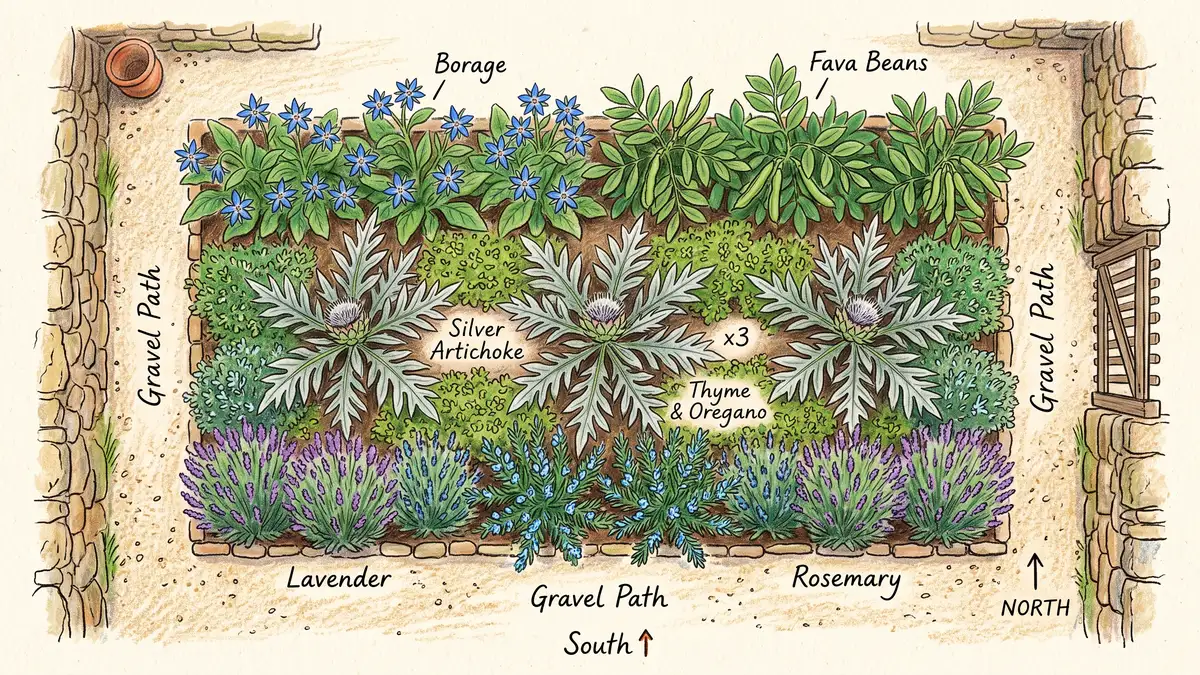
| Thyme, oregano | 6-12 in. | Sunny gaps between crowns | Living mulch, shallow roots |
| Borage | 2-3 ft. | North side, partial shade OK | Insectary flowers, self-seeds |
| Fava beans | 3-4 ft. | Cool-season, between crowns | Nitrogen fixation, spring cover |
| Garlic, shallots | 1-2 ft. | Bed perimeter, fall-planted | Uses the bed while artichokes rest |
Sizes from Utah State Extension, English Lavender in the Garden and NC State Extension Plant Toolbox, Salvia rosmarinus
Fava beans deserve a mention. Artichokes are heavy feeders: Texas A&M puts the requirement at about 0.1 pound of nitrogen per 100 square feet, and Utah State recommends 2 teaspoons of nitrogen fertilizer per plant every four weeks. A cool-season legume in the gaps is the obvious permaculture answer, but be honest about the evidence: no extension trial has quantified how much fixed nitrogen an adjacent artichoke actually receives. Sound principle, thin data. Our guide to nitrogen-fixing companions covers what the research does and doesn't show.
What Should You Keep Out of the Artichoke Bed?
Two categories: light competitors and disease bridges. The second has real documentation behind it. UC ANR's artichoke problem guide names curly dwarf virus, which curls leaves, dwarfs plants and produces small misshapen buds, and the recommended control includes removing milkthistle, an alternate host. The same logic applies to artichoke plume moth: cut plants to ground level annually, chop the material and bury it under 6 inches of soil, clear nearby thistles. Ornamental thistles or cardoon in the same bed run a bridge for both problems.
Light competition is more mundane. Tomatoes, peppers, eggplants and squash all want full sun and get shaded out on the artichoke's north side. Give them a different bed. Jerusalem artichokes, despite the name, are an unrelated sunflower with aggressive rhizomes and belong nowhere near a permanent crown.
One piece of research is worth flagging. Rial and colleagues documented phytotoxic allelochemicals in cardoon, the wild relative of the globe artichoke, in 2014. That is real evidence Cynara produces plant-suppressing compounds. It does not tell you how much a garden artichoke releases, or which neighbours care. Treat it as a reason to give companions their own root space, not as a rule about pairings. We cover this half-evidence problem in the science of companion planting.
Common Mistake to Avoid
Planting too late and getting no buds at all. Artichokes need vernalization: Virginia Tech specifies exposure to 50 °F or less for 8 to 10 days, roughly 190 to 240 hours, before plants will initiate buds. Utah State makes the same point in practical terms, warning that plants set out too late in spring never receive the chilling and simply grow leaves all season. Start seed indoors in January and transplant 3 to 4 weeks before your frost-free date.
How Do You Build the Bed?
One weekend for three artichokes plus companions, roughly $120 to $200 including plants and amendments.
Fix drainage before anything else
Texas A&M warns that artichokes rot in soil that stays wet, while Cornell puts the preferred pH at 6.5 to 8.0 in deep, fertile soil high in organic matter. If water pools after rain, build up rather than dig down. Work several inches of compost through the top foot.
Set the artichokes on 4-foot centres
Three plants in a triangle need roughly 60 to 80 square feet including working room. Orient them on the north side of the bed so their canopy shades the least. Water in well.
Ring the perimeter with the dry crowd
Lavender and rosemary at the sunniest, driest edge, 2 to 3 feet out from the artichoke canopy line. Keep them off the drip irrigation. Thyme and oregano fill the sunny gaps between crowns as living mulch.
Add the seasonal layer, then mulch deep
Fava beans and garlic go in during fall or late winter, in the space the artichokes will later fill. Mulch the irrigated zone 3 inches deep with compost or straw. Utah State recommends mulching specifically to keep soil cool and moist for these shallow feeder roots.
Why This Works: Succession in Time
A guild does not only stack plants in space, it stacks them in time. Artichokes in most US climates go quiet for part of the year, and UC ANR actually recommends cutting them to the ground and withholding water to force summer dormancy. That gap is not wasted space. Fall-planted garlic and cool-season favas occupy the bed exactly when the anchor plant is resting, which is the same logic that runs a Mediterranean food forest through its dry season.
Context worth a line: artichokes are almost entirely a California crop. USDA NASS recorded 4,200 harvested acres in California in 2025, at 155 hundredweight per acre, valued above $86 million. Florida researchers have to use gibberellic acid to replace missing chill hours, reporting up to 15,420 pounds per acre from Imperial Star. If your climate has cool springs, you have an advantage most of the country lacks.
Frequently Asked Questions
What should you not plant with artichokes?
Keep out thistle relatives, including ornamental thistles and milkthistle, because UC ANR identifies milkthistle as an alternate host for curly dwarf virus and recommends removing it. Also avoid sun-demanding annuals like tomatoes, peppers and squash, which will be shaded by the artichoke canopy within two seasons. Jerusalem artichoke is an unrelated plant with spreading rhizomes and does not belong in a bed with a permanent perennial crown. Our roundup of companion planting mistakes covers similar traps.
How many artichokes does one plant produce?
UC ANR reports that a mature plant sends up 10 or more stems in a season, each carrying four to five buds, which puts a well-grown perennial in the range of 40 to 50 buds a year. Utah State gives the same 3 to 5 buds per flower stalk. First-year plants produce considerably less, often a handful, since UC ANR notes real production starts about a year after planting. Expect a modest first season and full yields from year two.
Do artichoke plants come back every year?
In the right zone, yes. Cornell describes globe artichoke as reliably hardy to zone 6 with good mulching and occasionally zone 5 in a mild winter, perennial across zones 6 to 9. UC ANR says a well-managed plant can stay in production for five years or more. Colder than that and you have choices: Utah State recommends either heavy mulching with 4 to 6 inches of soil topped by 8 to 12 inches of leaves or straw, or lifting the crowns after frost, storing them in moist sand, and dividing and replanting in spring.
Are artichokes perennial in zone 6?
Usually, with protection. Cornell puts the reliable perennial range at zone 6 and up, provided plants are well mulched, and notes zone 5 survival in mild winters. The complication is that heavy frost damages flower stalks even when the crown survives, so a zone 6 plant may live through winter and still lose its earliest buds to a late freeze. Short-season cultivars like Imperial Star and Violetto are the safer bet in cold zones because they can also be run as annuals from seed.
Does companion planting actually help artichokes?
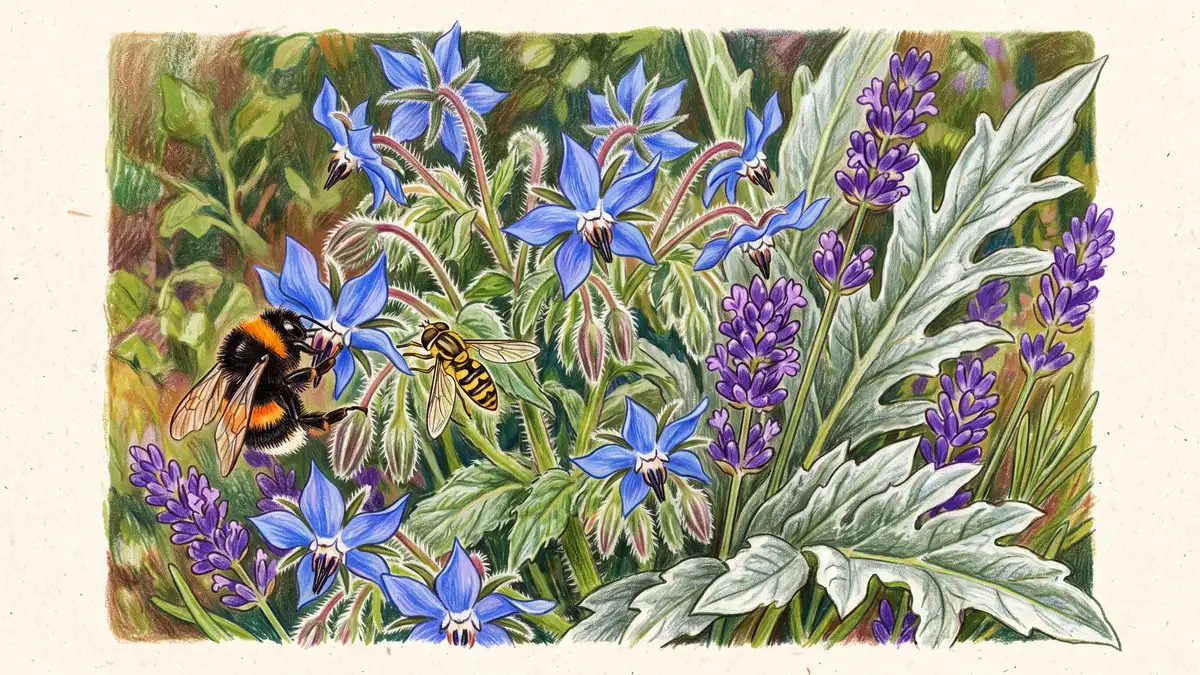
Partly, and it is worth being clear about which parts. Well supported: wide spacing improves airflow and reduces disease, removing thistle relatives cuts virus and plume moth pressure, and matching companions to the artichoke's water regime prevents both over- and under-watering. Weakly supported: specific claims that one herb repels artichoke pests. UC ANR's own aphid advice is physical, prune affected parts and dislodge with water, not botanical. Flowering companions like borage and lavender do reliably bring in pollinators and beneficial insects, which is a real mechanism even where the pest-repellent claims are not.
Get the Weekly Dig
One practical permaculture guide a week, written for gardeners who do this on weekends: companion pairings that hold up under scrutiny, and the ones that do not. Free, no spam, unsubscribe any time.
Join the Weekly DigTreat the artichoke as the fixed point and everything else becomes a design decision rather than a guess. For pairings across the rest of the garden, start with our companion planting chart, and for the other half of this bed see companion planting rosemary.
Resources
- UC Master Gardener Program — Artichokes: Growing, Spacing and Pest Problems
- Virginia Tech Extension — Globe Artichoke (Publication 438-108, PDF)
- Utah State University Extension — How to Grow Artichoke in Your Garden
- Texas A&M AgriLife Extension — Artichokes
- Oregon State University Extension — How to Grow Artichokes in Oregon
- Cornell University — Globe Artichokes Growing Guide
- Rial et al. (2014) — Phytotoxicity of Cardoon (Cynara cardunculus) Allelochemicals
- USDA NASS — California State Agriculture Overview