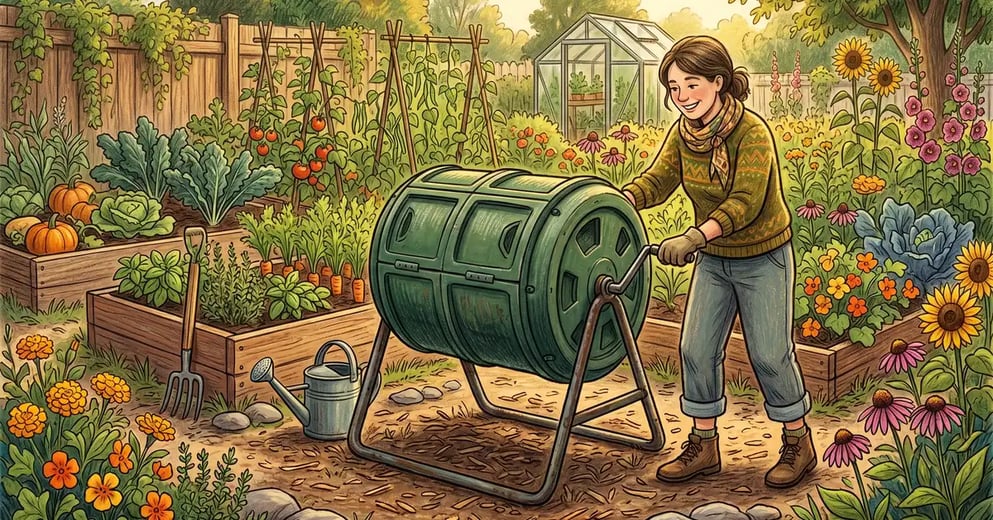

A backyard compost pile turns kitchen scraps into garden gold in 6 to 12 months. A tumbler does it in 4 to 8 weeks. The reason is simple: oxygen reaches every particle every time you turn the barrel, and that aerobic environment lets the bacteria and fungi do their work at maximum speed. The hard part is choosing the right tumbler for your household, because the wrong one stalls, smells, and goes back to the curb within a year.
GrowPerma is a participant in the Amazon Services LLC Associates Program. If you buy through a link on this page we may earn a commission at no extra cost to you. We only link to products we would put in our own garden.
How a compost tumbler actually works
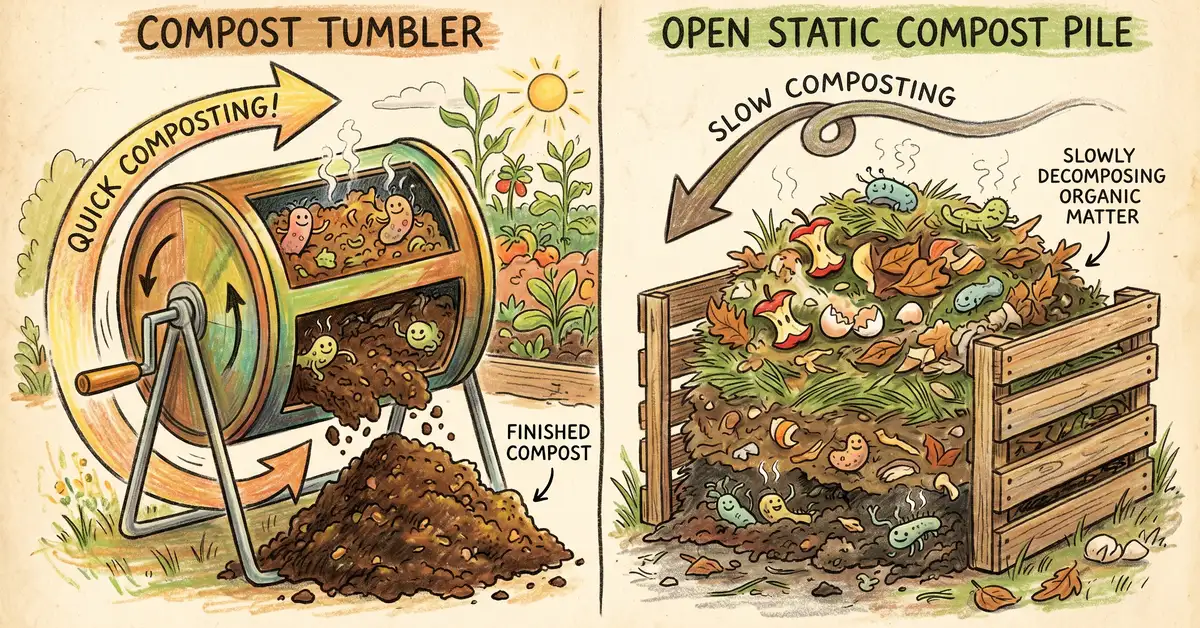
The tumbler is a closed barrel on a stand with an internal axle. You load it through a hatch, close the hatch, and spin the barrel 5 to 10 turns every 2 to 3 days. The spin does three things at once. It mixes the contents so oxygen reaches every particle. It breaks up clumps so dense pockets do not turn anaerobic. And it drops material onto the internal mixing fins, which shear the matter and accelerate decomposition. The result is a thermophilic (hot) compost process at 130 to 160 F that finishes in 4 to 8 weeks vs the 6 to 12 months of a static cold pile per Cornell Waste Management Institute.
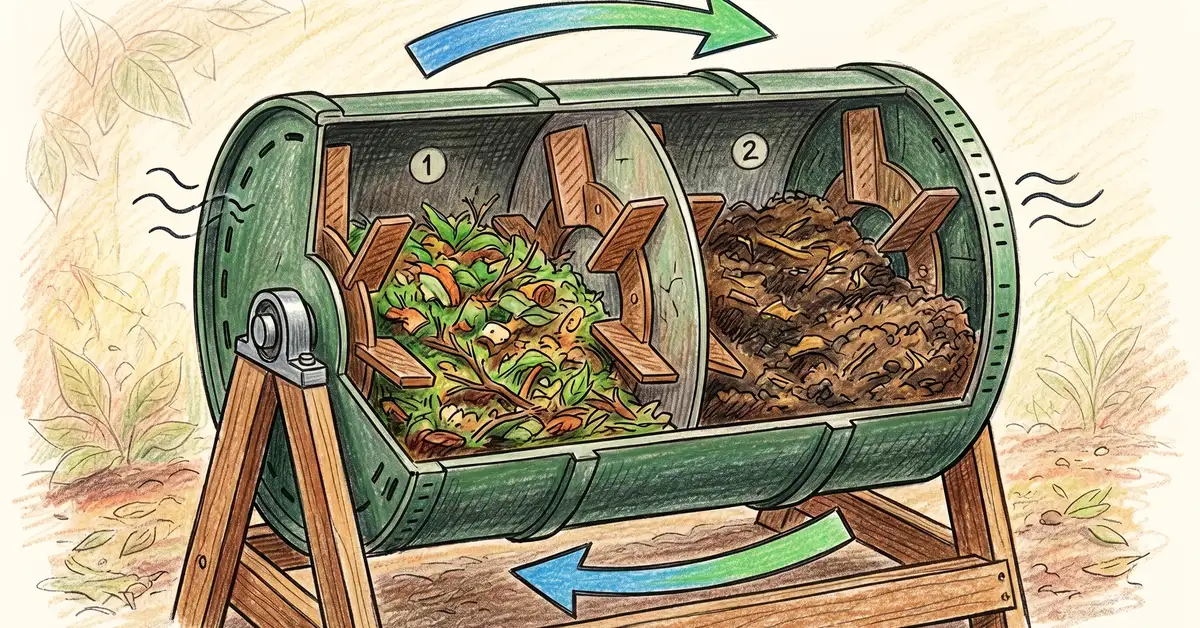
Three design features matter for performance:
Chamber count. Single chamber tumblers (one big barrel) require waiting for a full batch to finish before you add new material. Dual chamber tumblers split the barrel into two separate compartments. Fill chamber A while chamber B cures. This is the major modern advancement and the reason dual chamber dominates the US market in 2026.
Ventilation. Holes or slots in the barrel walls let CO2 out and fresh O2 in. Aerobic bacteria need that oxygen. Designs with internal aeration ribs spread the oxygen across the compost mass during rotation.
Mixing fins. Interior ridges and ribs on the chamber wall toss the compost as the barrel spins. Without fins the contents slide as one block, defeating the point of tumbling.
The 5 best compost tumblers in the 2026 US market
Why this works (the permaculture principle)
Permaculture treats waste as a misplaced resource. Every banana peel, every coffee filter, every grass clipping holds nutrients that the next generation of plants needs. A compost tumbler is a small machine for closing that loop in 4 to 8 weeks instead of 6 to 12 months. The same logic underpins our broader composting guide: cycle nutrients in place, build soil structure, reduce inputs.
FCMP Outdoor IM4000 Dual Chamber Tumbler ($130 to $160, 37 gal)
The most popular dual chamber tumbler in the US for 5+ years running. Made in Canada from BPA-free UV-stabilized polyethylene with steel frame and galvanized hardware. Two 18.5-gallon chambers. Internal aeration bars and ribs. Generous loading door. Easy assembly (under 30 minutes for most). Limitation: the chambers are smaller than they sound on paper because the divider takes 2 to 3 gallons total. Best for 1 to 4 person households.
Yimby Tumbler Composter ($100 to $140, 37 gal)
Functionally similar to the FCMP IM4000 at a slightly lower price. Dual chamber, recycled polyethylene, steel frame. Slightly thinner wall material than the FCMP but holds up well in moderate climates. A good budget alternative if you do not need the FCMP's slightly more durable build.
EJWOX Garden Compost Bin Tumbler ($150 to $180, 43 gal)
A larger dual chamber tumbler with 21.5 gallon chambers. Wider barrel with more mixing surface area. Reinforced steel frame. Choose this over the FCMP if your household generates more than 1 quart of scraps per day, or if you want extra capacity for fall leaves and summer grass clippings.
Lifetime 60058 Single Chamber Tumbler ($200 to $280, 80 gal)
A large single-chamber tumbler designed for big households and big gardens. 80 gallon capacity. Heavy-duty UV-stabilized polyethylene. The single chamber means batch composting (fill, cure, harvest, repeat) rather than continuous. Good for users who generate a lot of yard waste seasonally and want one big finished batch rather than steady output.
Joraform JK270 Insulated Tumbler ($700 to $900, 70 gal)
The premium choice for cold climates. Swedish-designed insulated dual-chamber tumbler with thick insulation that holds thermophilic temperatures even in northern US winters. The only model in this list that maintains active composting at zero degrees F. Stainless steel hardware, expected lifespan 15 to 25 years. Worth the price for cold-climate users who want year-round composting.
Tumbler vs static bin (and when to choose each)
| Factor | Tumbler | Static bin |
| Speed to finished compost | 4 to 8 weeks | 6 to 12 months |
| Turning effort | Low (5 to 10 spins, 30 seconds) | High (pitchfork the pile every 2 to 4 weeks) |
| Capacity | 37 to 80 gallons typical | Effectively unlimited |
| Woody material | No (clogs the rotation, slows breakdown) | Yes (slowly) |
| Pest exclusion | Excellent (sealed) | Moderate to poor |
| Winter performance | Slows or stops unless insulated | Slows or stops |
| Upfront cost | $100 to $900 | $0 (DIY) to $150 |
| Best for | Kitchen scraps + small/medium yards | Big yards, lots of yard waste, woody material |
Source:.
What to put in (and what to keep out)
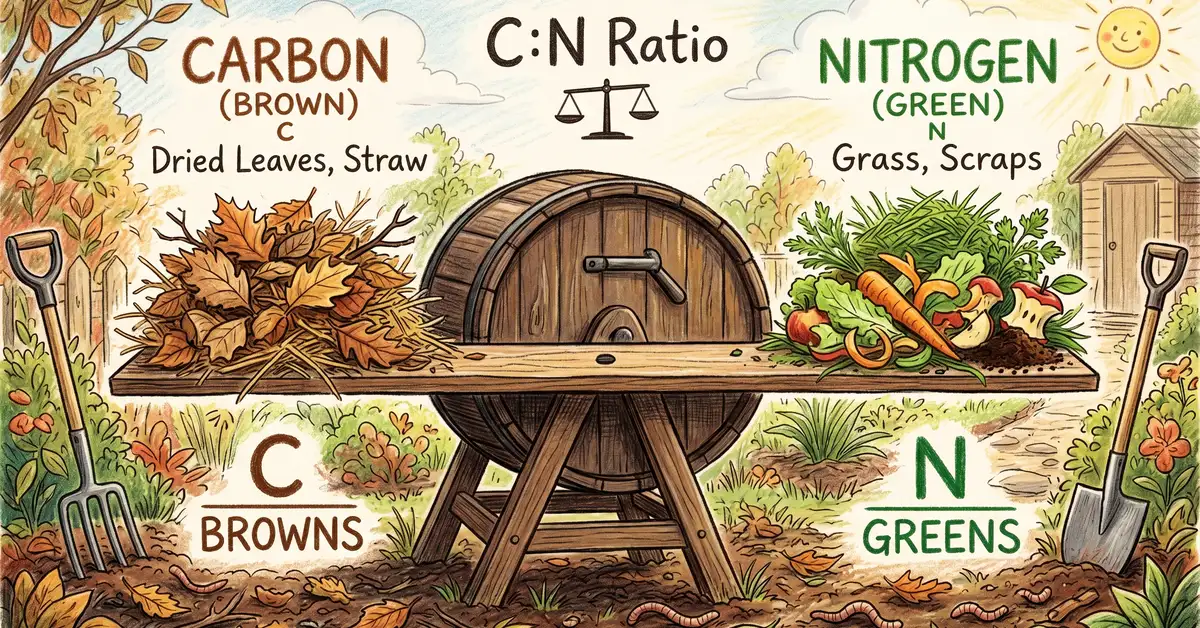
The compost rule that decides whether your tumbler succeeds: target a carbon-to-nitrogen ratio of 25-30:1 by weight. The shorthand is "browns to greens" at about 3:1 by volume.
Greens (nitrogen-rich) include: fruit peels, vegetable scraps, coffee grounds, tea bags (compostable only), grass clippings, fresh garden trimmings, eggshells (crushed).
Browns (carbon-rich) include: dried leaves, shredded newspaper, shredded cardboard, sawdust from untreated wood, straw, paper egg cartons.
Always keep out: meat, fish, bones, dairy, oil, fat, pet waste (cat and dog), human waste, diseased plant material, glossy magazines or color-printed paper, charcoal ash, synthetic chemicals, persistent weeds with seeds.
Limit: citrus peels in large quantity (acidic, slows process), grass clippings without enough browns (turns to slimy mat), woody stems and small branches (slow to break down and clog the tumbler).
The 5 most common tumbler problems and fixes
Too wet (sour, slimy, ammonia smell). Cause: too many greens or recent rain through a poorly-sealing hatch. Fix: add 2 to 4 cups of shredded cardboard or dry leaves and spin. Repeat in 3 days. Smell should clear within a week.
Too dry (no decomposition, browns still recognizable). Cause: too many browns, no moisture. Fix: add 1 to 2 cups of water and spin. Aim for "wrung-out sponge" moisture. Continue normal additions.
Not heating up (lukewarm, slow breakdown). Cause: too small a volume of fresh material or not enough nitrogen. Fix: add a generous shot of greens (grass clippings, vegetable scraps, or coffee grounds) and turn daily for 3 to 5 days until temperature rises.
Pests of attention (fruit flies, wasps). Cause: hatch left open or food scraps exposed at the surface. Fix: bury fresh additions under 2 to 3 inches of existing compost or browns. Keep hatch closed at all times.
Frozen in winter. Cause: most uninsulated tumblers stall at 20 F and below. Fix: continue adding through winter as a holding system. Composting resumes in spring. For year-round active composting in cold climates, use an insulated tumbler like the Joraform JK270.
Sizing a tumbler to your household
The single most common mistake is buying a tumbler too small for the household. Compost volumes from kitchen scraps alone average 0.5 to 1.0 lb per person per day. Add weekly grass clippings and seasonal leaf falls and total volume climbs quickly. Match capacity to output:
1 to 2 people, small garden: 30 to 40 gallon dual chamber. FCMP IM4000 or Yimby Tumbler fits comfortably.
3 to 4 people, medium garden: 40 to 50 gallon dual chamber. EJWOX 43-gallon or two FCMP IM4000 tumblers gives steady continuous output.
5+ people or large garden with heavy yard waste: 70+ gallon single chamber or paired dual chambers. Lifetime 60058 80-gallon or two EJWOX tumblers handle the volume.
Cold climate year-round: Joraform JK270 insulated. Single unit replaces seasonal storage with continuous active composting.
How to harvest finished compost from a tumbler
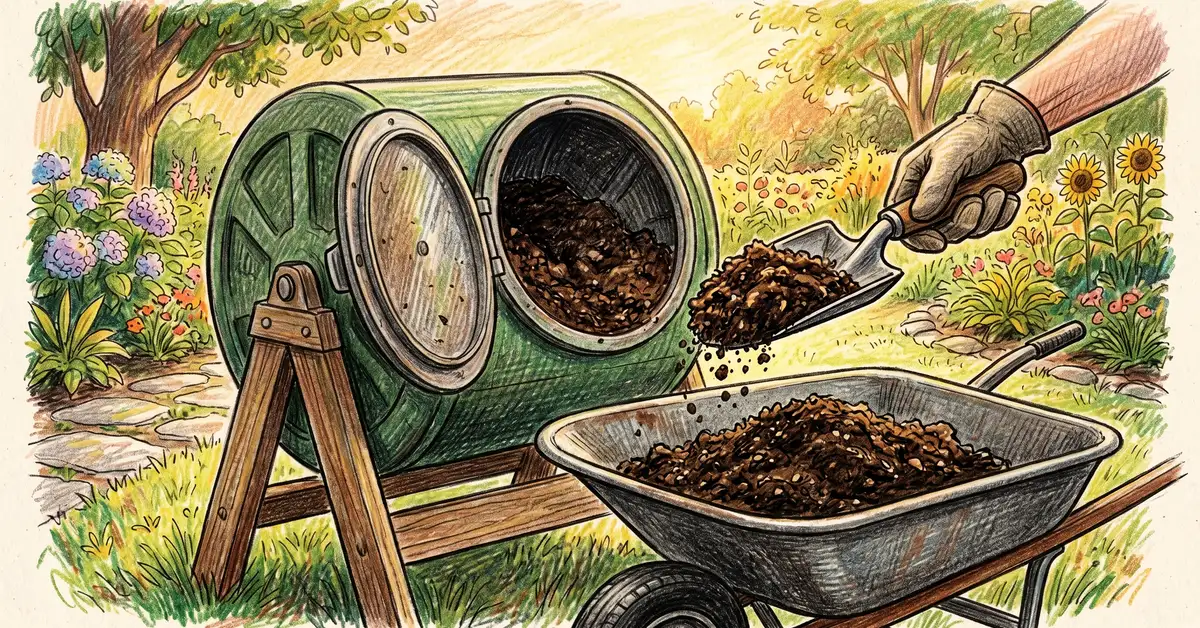
Finished compost in a tumbler looks and smells different from the inputs. Three signs to look for:
Dark brown to nearly black color. Original colors (orange peel, green leaf, eggshell white) are gone.
Crumbly texture. The compost breaks apart in your hand into small particles, not slimy clumps.
Earthy smell. The aroma should be like forest floor, not garbage or ammonia.
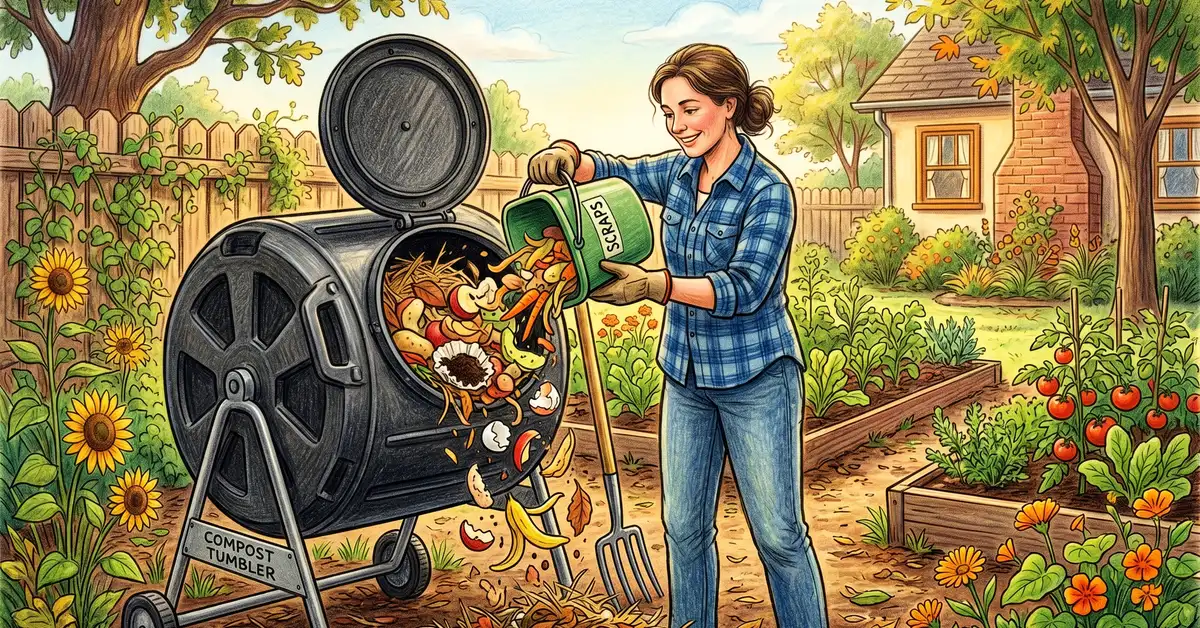
To harvest: place a wheelbarrow or large bucket under the hatch, rotate the chamber to position the hatch downward, open the hatch slowly. A 37-gallon chamber typically yields 4 to 6 cubic feet of finished compost per batch. Use 2 to 4 inches as a top-dress on vegetable beds, or mix at 25 percent volume into potting soil.
Need the gear for this?
Bins and tumblers picked by yard size, with the honest trade-offs for each.
See the compost bin picksGet the Weekly Dig
One practical permaculture guide a week, written for gardeners who do this on weekends: composting that actually finishes and soil that feeds itself. Free, no spam, unsubscribe any time.
Join the newsletterFrequently asked questions
What is the best compost tumbler for most US households?
The FCMP Outdoor IM4000 dual chamber tumbler is the most reliable choice for 1 to 4 person households in 2026. 37-gallon dual chamber design, $130 to $160, made in Canada from UV-stabilized recycled polyethylene with a steel frame. The Yimby Tumbler is a near-identical alternative at a slightly lower price. For larger households or gardens, choose the EJWOX 43-gallon dual chamber or the Lifetime 60058 80-gallon single chamber.
What not to put in a compost tumbler?
Avoid meat, fish, bones, dairy, oils and fats, pet waste, diseased plant material, glossy or color-printed paper, charcoal ash, persistent weed seeds, and large quantities of citrus peels. Tumblers also struggle with woody material like branches and thick stems, which slow rotation and decomposition.
What do you put in a compost tumbler to start?
Start with a base layer of browns (dried leaves or shredded cardboard) 4 to 6 inches deep, then alternate browns and greens at a 3:1 brown:green volume ratio as you fill. A handful of finished compost or garden soil as a starter introduces the microbes. Moisten lightly so the contents feel like a wrung-out sponge. Spin 5 to 10 turns to mix.
Is a compost tumbler worth it?
For most US households with a kitchen and a garden, yes. Tumblers finish compost in 4 to 8 weeks vs 6 to 12 months for a static pile, eliminate pitchforking, exclude rats and raccoons, and keep odors contained. The main weakness is capacity (most under 80 gallons) and inability to compost woody material.
Compost tumbler vs bin (which is better)?
A tumbler is better for kitchen scraps, small to medium yards, and people who want fast pest-free composting. A static bin is better for high-volume yard waste, woody material, and gardeners who want effectively unlimited capacity. Many gardeners use both: a tumbler for kitchen scraps and a static bin or wire ring for autumn leaves.
How long does compost take in a tumbler?
4 to 8 weeks during the warm season when the tumbler is properly loaded, balanced 3:1 brown:green, kept at wrung-out-sponge moisture, and turned every 2 to 3 days. Cold winter conditions can stretch this to 12 weeks or more, and most uninsulated tumblers effectively stall below 20 F.
Can you put grass clippings in a compost tumbler?
Yes, but balance them with browns. Grass clippings alone form a dense anaerobic mat. For every 1 part grass clippings by volume, add 3 parts dried leaves, shredded cardboard, or other browns. Then spin to mix.
Do you need two compost tumblers?
No if you choose a dual chamber tumbler. The dual chamber design solves the continuous-output problem in one unit: chamber A fills while chamber B cures, then they swap. If you have a single chamber tumbler and want continuous output without waiting for batches, then yes a second tumbler is useful.