
What Is Back to Eden Gardening?
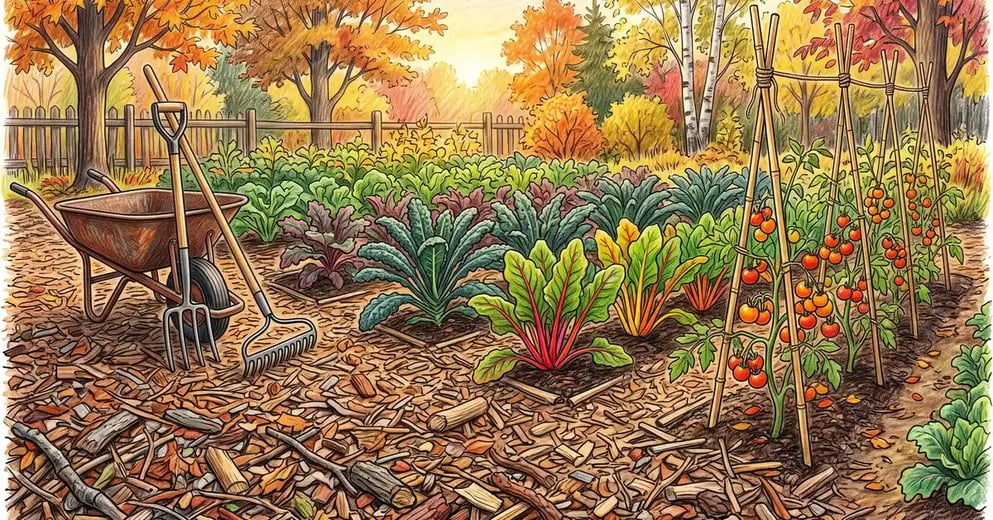
Back to Eden gardening is the practice of covering your soil permanently with several inches of coarse arborist wood chips and never tilling again. It took its name from a 2011 documentary by Dana Richardson and Sarah Zentz about Paul Gautschi, an arborist and gardener in Sequim, Washington, who has run his orchard and vegetable beds under a deep chip layer for decades. manure for the garden
The film is compelling and the before-and-after soil is real. What the film does not give you is a controlled trial. Gautschi's evidence is long-term observation on one maritime site with cool summers and wet winters, which raises the obvious question for the rest of us: how much of this holds up when you check it against the research?
Quite a lot, as it turns out, but not the parts most people repeat online. The method works well in orchards, perennial beds and paths. It gets shaky the moment you try to direct-sow carrots into it. Below is what the extension research and the arboriculture literature actually support, and where the popular version of the method has drifted away from both.
What we will cover:
- What the depth research actually says, and why "4 to 8 inches" is context-dependent rather than universal
- Whether wood chips really tie up your soil nitrogen (the answer depends entirely on placement)
- The two situations where the method reliably fails
- How to source 12 cubic yards of chips for free and what that covers
Key Takeaway
Back to Eden is not a novel invention. It is one implementation of a well-studied practice: surface-applied coarse arborist chips on undisturbed soil. The research backs the practice strongly for woody and perennial plantings. It does not back applying it unmodified to an annual vegetable seedbed, which is exactly where most beginners start.
How Deep Should Wood Chip Mulch Actually Be?
There is no single correct depth, and this is where most online advice goes wrong. The recommendation changes depending on what you are growing and what you are trying to achieve.
The most useful number comes from a two-year Cornell study published in Arboriculture & Urban Forestry, which tested mulch depths from 1 to 6 inches and measured soil moisture, temperature, oxygen, weed growth and stem growth. Greenly and Rakow found 3 inches to be the optimum, producing the greatest stem growth in both tree species tested, ahead of both deeper treatments and unmulched controls. Soil oxygen and temperature did decline slightly as depth increased, though not significantly.
| Situation | Recommended Depth | Source |
| Around woody ornamentals | 3 to 4 in. (do not exceed 4) | Oregon State Extension |
| Optimum for tree stem growth | 3 in. | Cornell / ISA trial |
| General weed suppression | 4 in. | Colorado State Extension |
| Ornamental landscape beds | 4 to 6 in. | WSU Extension |
| Restoration sites, deep-rooted weeds | 8 to 12 in. | WSU Extension |
| Paths and orchard alleys | 4 to 8 in. | Back to Eden practice |
Sources: Oregon State University Extension EC 1629, Colorado State University Extension, Washington State University Extension, Greenly & Rakow, Arboriculture & Urban Forestry
Notice the tension in that table. Oregon State caps chips at 4 inches around woody ornamentals because deeper layers cut air exchange to the soil, and Colorado State puts it plainly: more is not better. Meanwhile Washington State endorses 8 to 12 inches on restoration ground. Both are right. They are answering different questions. A restoration site fighting established quackgrass needs smothering depth. A young apple tree needs air.
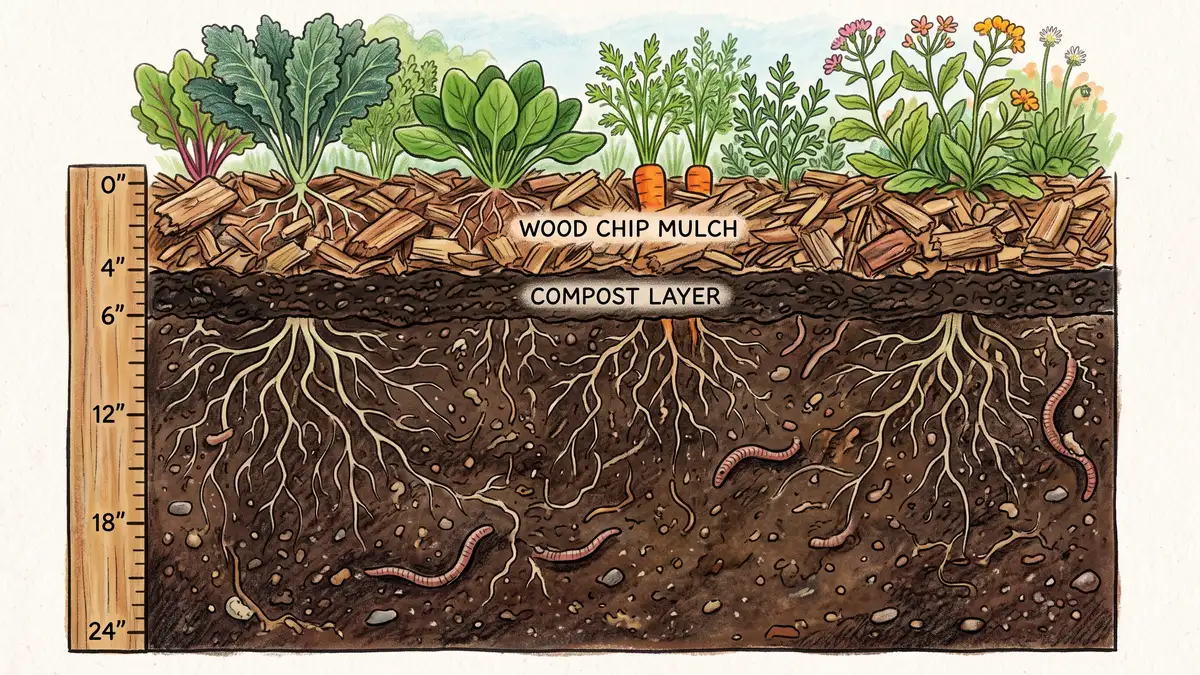
The practical rule: 4 inches in beds, deeper only in paths and on ground you are trying to reclaim. Top up when the layer drops below about 3 inches, which for wood chips means roughly every one to two years.
Do Wood Chips Steal Nitrogen From Your Soil?
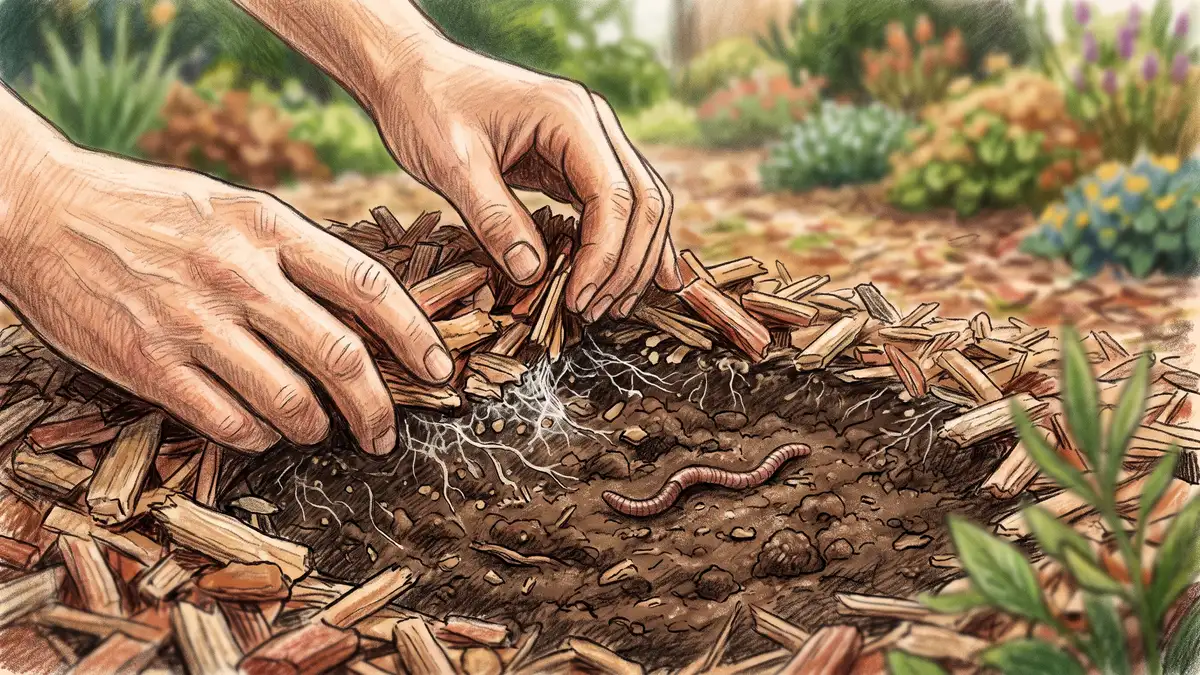
Not when they sit on the surface. Absolutely when you dig them in. This is the single most misunderstood point about the method, and getting it right resolves about half the arguments you will find online.
Wood is rich in lignin, suberin and tannins, which makes it very high in carbon relative to nitrogen. When soil microbes get access to all that carbon, they multiply and pull available nitrogen out of the soil to do it. That is real chemistry, and it is why Colorado State warns that incorporated wood can take ten years or more to break down, holding nitrogen hostage the whole time.
But surface mulch is a different situation. The microbes only get contact at the boundary. Washington State Extension describes the nitrogen depletion zone as confined to the mulch-soil interface, a narrow band that leaves established, deeper roots untouched. The Cornell trial backs this from the other direction: soil pH, nitrate and salt levels were unaffected by mulch type or depth all the way to 6 inches.
Why This Works: The Nitrogen Interface Is a Feature
That thin, nitrogen-poor band at the top of the soil is not a flaw to be corrected. It is the mechanism doing your weeding. Windblown weed seeds land in a zone with no available nitrogen and cannot establish, while your established plants feed from soil beneath it. This is the permaculture idea of stacking functions in physical form: one layer suppressing weeds, holding moisture, buffering temperature and slowly feeding the soil food web, all without you doing anything.
The practical consequence: do not throw down nitrogen fertilizer as insurance when you spread fresh chips. Linda Chalker-Scott's position at WSU is that years of research have found no reduction in soil nitrogen under wood chip mulches, and that fertilizer should follow a demonstrated deficiency from a soil or tissue test, not a hunch. If you are unsure where your soil actually stands, that is worth settling before you cover everything up.
Three Mistakes That Break the Method
Tilling chips in. This converts a harmless surface layer into a decade-long nitrogen sink. Piling chips against trunks. Keep the layer tapering away from stems rather than mounded against them. Not adjusting your watering. A thick mulch layer holds moisture well, and if you keep irrigating on the old schedule you will end up with waterlogged, air-poor soil and worse growth than you started with.
Where Does Back to Eden Actually Fail?
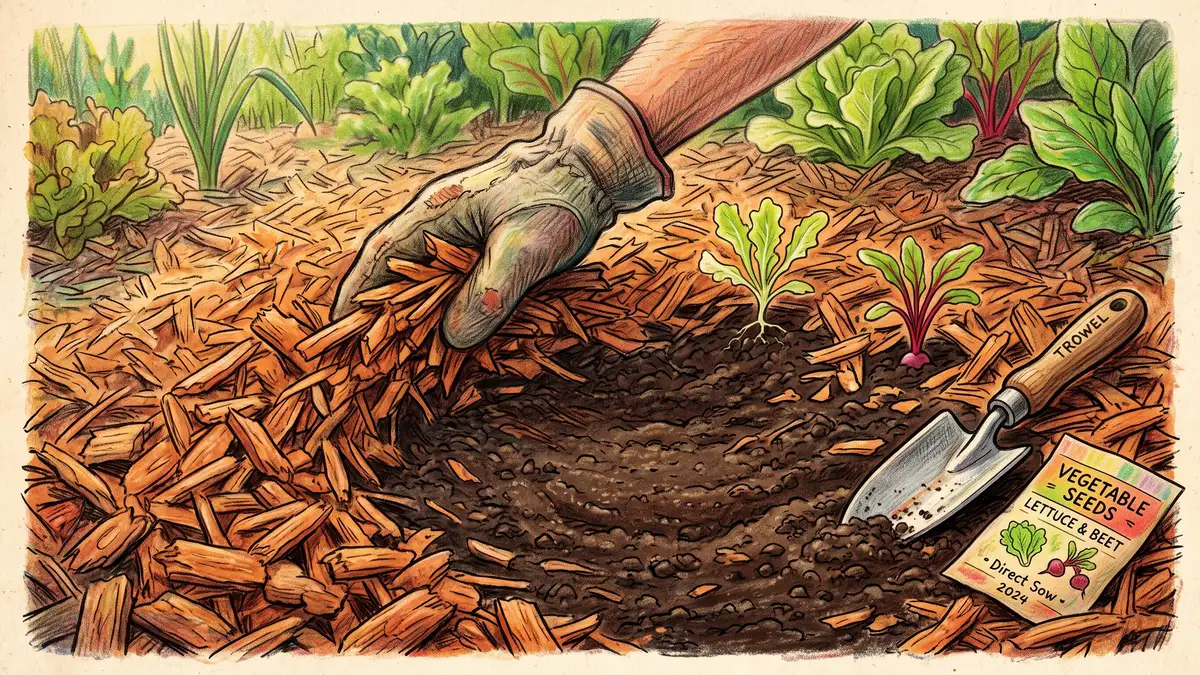
Annual vegetable beds, and specifically direct sowing. The same nitrogen-poor interface that kills weed seedlings does not distinguish between a dandelion and your carrots. Chalker-Scott is direct about this: high carbon-to-nitrogen mulches are inadvisable in annual beds and vegetable gardens.
Transplants are mostly fine, because you are pushing an established root system through the chips into soil below. Small seeds are not. If you want to direct-sow lettuce, carrots, radish or beets, rake a clean strip of chips aside, sow into bare soil, and let the crop get several inches tall before you pull the mulch back in around it.
The second failure is regional. Gautschi gardens on the Olympic Peninsula, where summers are cool and winters are wet. In a hot, dry climate the same chip layer behaves differently, and in a humid one it can hold more slug habitat than you want. Chalker-Scott argues coarse chips actually harbour predatory ground beetles rather than slugs, but the honest answer is that the data on that interaction is thin and outcomes vary by site.
One more worth knowing: Cooperative Extension has flagged heavy wood chip layers as favourable habitat for invasive jumping worms, which now affect much of the eastern and midwestern US. Extension staff still recommend adding organic matter, but if jumping worms are established in your county it is worth inspecting a delivery before spreading it.
The Cardboard Question
Most Back to Eden tutorials start with a cardboard or newspaper layer. Colorado State Extension advises against it, on the grounds that sheet materials interfere with water and air movement and are unnecessary at adequate mulch depth. If you are covering bare or lightly weedy ground, skip it. If you are smothering established perennial weeds, cardboard earns its place, but understand you are trading air exchange for weed control.
Key Takeaway
Match the method to the planting, not the other way round. Perennials, shrubs, fruit trees and paths take deep chips well. Annual beds want a thinner layer, transplants rather than direct sowing, and a strip of bare soil whenever you do sow seed. Gardeners who run chips on the perennial side and compost on the annual side get more out of both than anyone trying to apply one material everywhere.
How Do Wood Chips Compare to Straw, Leaves and Bark?
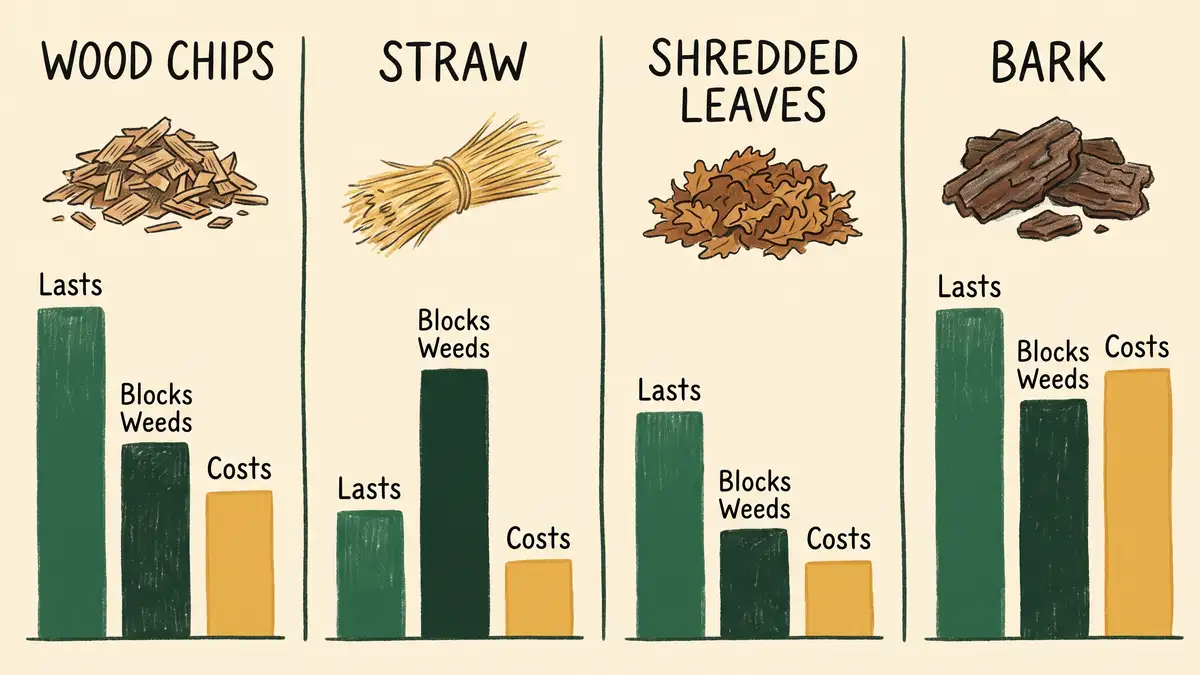
Arborist chips win on longevity and cost and lose on nutrient release. Oregon State rates mulch materials across seven characteristics, and arborist chips score top marks for both water conservation and weed control while sitting at the bottom for nutrient contribution.
| Material | Water Conservation | Weed Control | Nutrient Release | Reapply Every |
| Arborist wood chips | High | High | Low | 1-2 years |
| Screened wood chips | Moderate | High | Low | 1-2 years |
| Bark mulch | Moderate | Moderate | Low | 2-4 years |
| Shredded leaves | Moderate | Moderate | Moderate | Annually |
| Compost as top layer | Moderate | Poor (seedbed) | High | Annually |
Sources: Oregon State University Extension EC 1629, Washington State University Extension
The counterintuitive row is compost. Fine composted material makes an excellent soil amendment and a poor top mulch, because it is a near-perfect seedbed for every weed seed that lands on it. If you want both, put compost down first and chips on top, which is what the Back to Eden layering does. Our full mulching guide covers how to match material to situation in more detail.
Chips also buffer temperature better than most alternatives. Measurements reported by Pacific Horticulture put the minimum-to-maximum soil temperature swing under wood chips at roughly 9°F across a midsummer month, against about 5°F under forest leaf debris and far wider swings under bare soil and turf.
How Do You Get Enough Wood Chips?
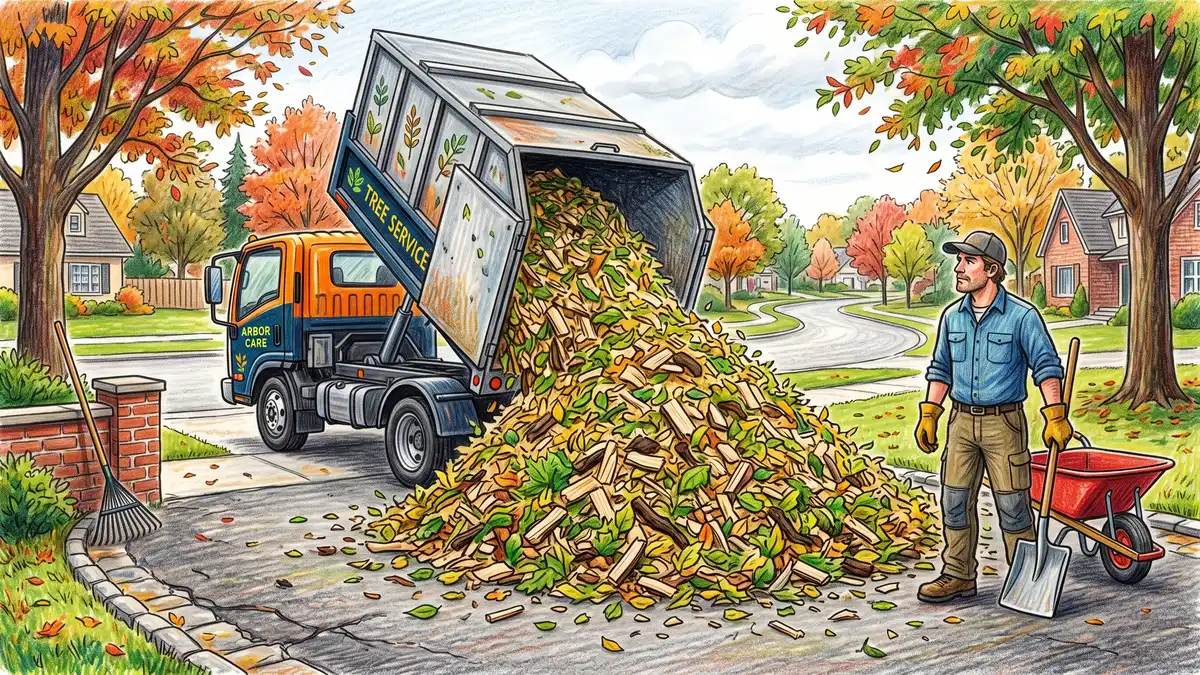
Free, from tree services, and the hard part is storage rather than sourcing. Arborists pay tipping fees to dump chips, so a driveway they can unload into is genuinely useful to them.
Work out your volume
One cubic yard covers 324 square feet at 1 inch deep. So 1,000 square feet at 4 inches needs about 12.3 cubic yards. Measure your beds and paths before you call anyone.
Get on a list
Sign up with ChipDrop or call local tree services directly. Be clear you will take a full load: one delivery is an entire truck, up to roughly 20 cubic yards, and it arrives with no notice.
Take mixed chips, not screened bark
You want ragged arborist chips with green leaves and fine twigs mixed through. That variety of particle size and nitrogen content is what drives the biology. Uniform screened bark is a decorative product and behaves differently.
Spread within a few weeks
A 20-cubic-yard pile will heat up and can go anaerobic and sour in the middle if it sits all season. Move it out onto beds and paths while it still smells like a forest floor.
Why This Works: Mimicking the Forest Floor
What you are building is a duff layer. In any woodland, organic matter arrives from above and decomposes downward, never mixed in, and the soil structure beneath stays intact and layered. Deep chip mulch reproduces that sequence deliberately. This is why the method rewards patience: the first season looks like nothing is happening, and by the third the soil underneath has genuinely changed. It is the same logic behind sheet mulching and lasagna beds, applied on a longer timescale with a coarser material.
Late summer through fall is the best window to start. The chips settle over winter, the soil biology has months to colonise the boundary layer before spring, and you are not trying to work around a bed full of growing crops. If you are already planning the rest of your fall jobs, this slots naturally into preparing the garden for winter.
Frequently Asked Questions
Does Back to Eden gardening really work?
For perennials, orchards, shrubs and paths, yes, and the supporting research is solid. Surface-applied arborist chips conserve moisture, suppress weeds, buffer soil temperature and build organic matter over time, all documented in extension and arboriculture literature. Where the method oversells itself is annual vegetable beds, particularly anything direct-sown. The honest summary is that Back to Eden repackages a well-studied practice with a compelling story attached, and the practice is better supported than the story.
How thick should the wood chip layer be?
Four inches is the sensible default for beds. Oregon State caps chips at 4 inches around woody ornamentals because deeper layers restrict air exchange, and a Cornell trial found 3 inches produced the best stem growth of any depth tested. Go deeper, 8 inches or more, only in paths or on ground where you are actively smothering established perennial weeds. Top up when the layer thins below about 3 inches, typically every one to two years.
Do I need to add nitrogen when I put down fresh wood chips?
No, not as a routine precaution. Surface-applied chips only interact with soil at the boundary, and the resulting nitrogen-poor band is shallow enough that established roots are unaffected. Washington State Extension has found no reduction in soil nitrogen under wood chip mulches. The exception is if you till chips into the soil, which does cause serious and long-lasting nitrogen tie-up. If plants do show deficiency, confirm it with a soil or tissue test before fertilizing.
Can I plant seeds directly into wood chips?
Not successfully. Small seeds cannot reach light, moisture and nutrients through a coarse, nitrogen-poor layer, and the seedlings that do germinate usually fail. Rake the chips aside to expose a strip of bare soil, sow into that, and pull the mulch back once seedlings are several inches tall. Transplants are a different matter and go in fine, because their roots are already established and reach through into the soil below.
What kind of wood chips should I avoid?
Fewer than most people think. Concerns about black walnut toxicity and disease transmission through chipped wood are much weaker than their reputation suggests when the material is used as surface mulch rather than dug in. The genuinely useful cautions are practical: avoid chips from treated or painted lumber, do not use chips of unknown origin in potting mix or directly in planting holes, and inspect deliveries for jumping worms if they are established in your area.
How long before I see results?
Moisture retention and weed suppression are immediate, within the first season. Changes to soil structure and organic matter are slower, generally becoming obvious in the second or third year as the bottom of the chip layer breaks down into the soil surface. Plan on topping up every one to two years and treat it as a multi-year project rather than a single weekend's work. The soil under a five-year-old chip layer looks nothing like the soil under a one-year-old one.
Is Back to Eden the same as no-dig gardening?
They overlap but are not identical. Both refuse tillage and keep soil permanently covered. No-dig, as popularised by Charles Dowding, typically uses compost as the surface layer and works well for intensive annual vegetable production. Back to Eden uses coarse wood chips, which last far longer and suppress weeds better but release almost no nutrients and are poorly suited to direct sowing. Many gardeners end up running both: compost on the annual beds, chips on the paths and perennials. It fits comfortably within a broader permaculture approach to soil.
Get the Weekly Dig
One practical permaculture guide a week, written for gardeners who do this on weekends: permaculture design for real backyards. Free, no spam, unsubscribe any time.
Join the Weekly DigResources
- Washington State University Extension — Wood Chip Mulch: Landscape Boon or Bane?
- Oregon State University Extension EC 1629 — Mulching Woody Ornamentals With Organic Materials
- Colorado State University Extension — Mulching
- Greenly & Rakow, Arboriculture & Urban Forestry — Effect of Wood Mulch Type and Depth
- Arboriculture & Urban Forestry — Compost and Wood Chip Mulch for Urban Soil Quality
- Pacific Horticulture — Benefits of Mulch in Regulating Soil Temperature
- Garden Professors (Linda Chalker-Scott, WSU) — Maddening Mulch Myths
- Ask Extension — Wood Chip Mulch and Invasive Jumping Worms
- ChipDrop — What to Expect From a Wood Chip Delivery